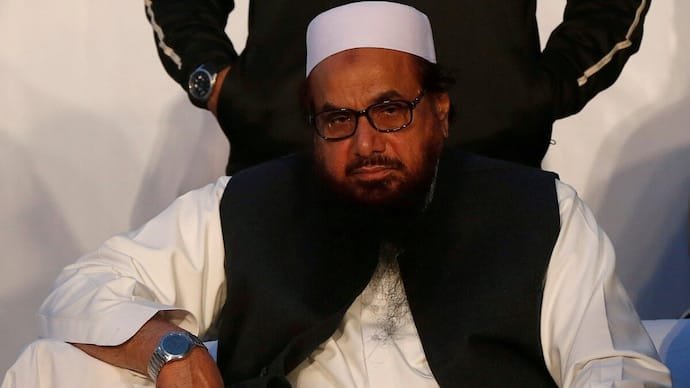
Jammu, India — The National Investigation Agency (NIA) is set to send court summons to Pakistan-based Lashkar-e-Taiba founder Hafiz Saeed after he was named as an accused in the Pahalgam terror attack case. The summons will direct Saeed to appear before the special NIA court in Jammu and will be routed through the Ministry of External Affairs.
- Key Highlights:
- Hafiz Saeed has been named as an accused in the Pahalgam terror attack case.
- The special NIA court has already issued a non-bailable warrant against him.
- The NIA alleges Saeed was among the masterminds behind the April 2025 attack.
- The court may proceed with a trial in his absence if the required legal conditions are fulfilled.
Summons to be routed through MEA
The special NIA court in Jammu is expected to issue the summons as part of the legal process requiring Saeed to appear for trial. Since he is based in Pakistan, the summons will be routed through the Ministry of External Affairs.
The court has already issued a non-bailable warrant against Saeed. The NIA has accused him of playing a key role in the conspiracy behind the attack in Pahalgam on April 22, 2025, in which 25 tourists and a local resident were killed.
Saeed has been named in the case in his individual capacity as well as in connection with his alleged leadership of the banned Lashkar-e-Taiba and its proxy outfit, The Resistance Front.
Trial in absentia possible under law
If Saeed does not appear after the required legal procedures have been completed, the special court may consider conducting the trial in his absence under Section 356 of the Bharatiya Nagarik Suraksha Sanhita, 2023.
The provision allows a court to conduct an inquiry or trial and pronounce judgment against a proclaimed offender who has absconded to evade legal proceedings and has no immediate prospect of arrest.
However, a trial in absentia cannot begin immediately. The court must first complete specified procedural requirements, including issuing two consecutive arrest warrants and publishing a notice requiring the proclaimed offender to appear.
The law also requires 90 days to pass from the date charges are framed before a trial in absentia can begin. If the accused is not represented during such proceedings, the state must provide an advocate for the defence.
Hafiz Saeed named in supplementary chargesheet
The NIA named Saeed in a supplementary chargesheet filed in July. The agency has charged him under provisions of the Bharatiya Nyaya Sanhita, 2023, and the Unlawful Activities (Prevention) Act, 1967.
The allegations include waging war against India and conspiring from Pakistan to carry out the attack. The supplementary chargesheet continues the investigation detailed in the agency’s original 1,597-page chargesheet.
According to the NIA, the supplementary filing sets out details of the alleged Pakistan-based conspiracy, Saeed’s role and evidence gathered during the investigation. The agency has alleged that the attack involved Pakistani handlers, foreign terrorists and local logistical support.
What the original chargesheet alleged
The NIA’s original chargesheet was filed on December 15, 2025. It named seven accused, including alleged Pakistani handler Sajid Jatt and the banned LeT/TRF as a legal entity.
Three Pakistani terrorists identified as Faisal Jatt alias Suleman Shah, Habeeb Tahir alias Jibran and Hamza Afghani were also named. The agency said all three were subsequently killed by security forces during Operation Mahadev in Dachigam in July 2025.
Two local residents, Parvaiz Ahmad and Bashir Ahmad Jothad, were arrested on allegations of harbouring the terrorists. The accused were charged under provisions of the Bharatiya Nyaya Sanhita, the Arms Act and the UAPA.
NIA focuses on alleged local support network
The investigation has also examined the alleged role of local support networks in facilitating the movement and activities of foreign terrorists. According to the agency’s chargesheet, local harbourers allegedly provided assistance including shelter, movement and logistical support.
The NIA has described the alleged operational structure as involving Pakistan-based handlers, infiltrated terrorists and local assistance. It has also alleged that The Resistance Front was used as a proxy for Lashkar-e-Taiba to obscure the involvement of its Pakistan-based parent organisation.
The agency has further alleged that the attackers selected tourists on the basis of their religious identity with the objective of creating communal divisions and harming Kashmir’s tourism sector.
Pahalgam case investigation
The attack took place in Pahalgam on April 22, 2025. The case was initially registered by Pahalgam Police before the Union Home Ministry transferred the investigation to the NIA.
Following the killing of the three alleged Pakistani terrorists during Operation Mahadev, the investigation has continued to focus on identifying and prosecuting those accused of planning, facilitating and supporting the attack.
The next major procedural step involving Saeed is the delivery of the court summons through the Ministry of External Affairs. If he does not appear and all statutory requirements are subsequently fulfilled, the special NIA court may consider proceeding against him in absentia.

Praveen Yadav is the Founder and Editor at The Nation Bulletin. With over 3 years of experience in digital journalism and news reporting, he covers national affairs, governance, and breaking current events with a commitment to factual accuracy and verified reporting.