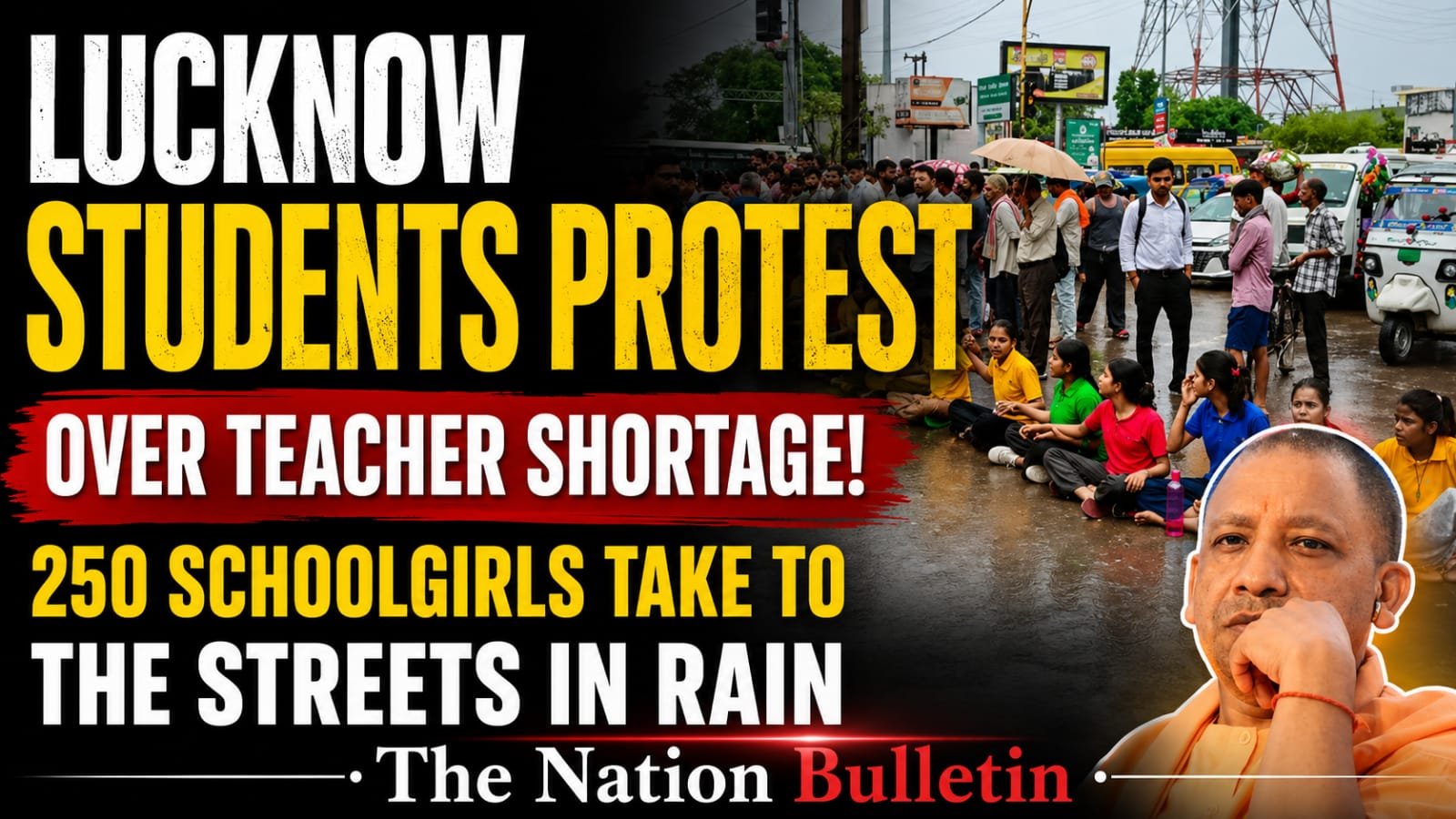
LUCKNOW, India — Lucknow Students Protest : Around 250 girl students of the Jayaprakash Narayan Sarvodaya Balika Vidyalaya on Mohan Road came out on the streets on Monday amid heavy rain, protesting against a prolonged shortage of teachers and alleged deficiencies in hostel and school facilities. The students first blocked the Dubbaga-Kanpur bypass and later began marching towards Hazratganj after their demand for the district magistrate to personally intervene was not met.
- Nearly 250 residential schoolgirls reportedly walked about 2.5 km from the campus to the Dubbaga-Kanpur bypass.
- The students blocked traffic in the rain and demanded a written assurance from the district magistrate on their concerns.
- After talks with officials failed, the girls moved towards Balaganj and the central Lucknow area, leading to extensive traffic disruption.
- The dispute centres on teacher vacancies, disrupted NEET-JEE coaching, hostel facilities and a legal stay affecting guest-faculty appointments.
Students Leave Campus and Block Dubbaga Bypass
The students, belonging to Classes 6 to 8 according to the information provided, reportedly left the residential campus and walked nearly 2.5 km before reaching the Dubbaga-Kanpur bypass. Despite heavy rain, they sat on the road and began a protest.
The immediate demand was for the district magistrate to reach the spot and provide assurances regarding the shortage of teachers and other problems being raised by the students.
As the protest spread to the bypass, long queues of vehicles formed on the road. Police personnel from Para, Dubbaga and two other police stations, along with personnel from nearby outposts, reached the location and attempted to persuade the students to end the blockade.
Two Hours of Talks Fail, Students Head Towards Hazratganj
According to the supplied account, discussions continued for nearly two hours but failed to resolve the situation. The students reportedly refused to settle for assurances from local-level officials and insisted on speaking directly with the district magistrate.
When the DM did not arrive at the spot, the students began moving towards Lucknow-Hardoi Highway and subsequently towards Balaganj. The movement created another major traffic disruption as the students proceeded along the road.
The situation became particularly tense as the students reportedly ran along the wrong side of the highway, with police personnel following them in an effort to stop and control the group.
At around 9:15 am, the students reached Balaganj crossing, where police tried to contain the gathering and resume negotiations.
Balaganj Crossing Turns Into Another Protest Site
After being stopped by police barricades at Balaganj, the students reportedly formed a human chain and sat in the middle of the intersection. With roads leading in several directions affected, traffic congestion spread towards parts of old Lucknow and routes connected to the bypass.
Senior police officers, including ACP Shakeel Ahmad, reportedly sat on the road in the rain while attempting to speak with the students.
The students, however, continued to demand either direct intervention by the district magistrate or a written order addressing their concerns. Their insistence on a senior-level written assurance reflected the level of distrust that had developed between the students and the administration.
Teacher Shortage at the Centre of the Protest
The Jayaprakash Narayan Sarvodaya Balika Vidyalaya is a residential institution operated by the Social Welfare Department. Students allege that the school has been facing a prolonged shortage of permanent and temporary teachers, affecting regular classroom teaching.
The students specifically complained that teachers for important subjects such as mathematics, science and English have been unavailable for months. They alleged that classrooms remain empty for significant parts of the school day because of the vacancies.
The issue is particularly serious for students living in a residential school because their academic programme depends almost entirely on facilities and teaching arrangements provided within the campus.
NEET-JEE Coaching Also Reportedly Hit
The campus also provides free coaching for medical and engineering entrance examinations under the Mukhyamantri Abhyudaya Yojana and the Excellence Programme for students of Classes 11 and 12.
Students have alleged that the shortage is not limited to regular school subjects. According to their account, faculty members needed for competitive-examination preparation are also unavailable, affecting their preparation for NEET and JEE.
The students say the absence of teachers for core subjects such as physics and chemistry has compounded the problem because those subjects are also crucial to competitive examinations.
Students Raise Hostel Food and Health Complaints
The protest has also brought several alleged deficiencies in the residential facilities into focus. Students have complained about the quality of food served in the hostel mess and alleged that insects have sometimes been found in meals.
According to the students, complaints made to the hostel warden did not result in a satisfactory improvement in food quality.
They have also raised concerns about medical care inside the residential campus. Students alleged that doctors are not regularly available in the primary medical facility and that, when they fall ill, a pharmacist may provide common medicines for pain or fever without arranging adequate medical evaluation.
Power, Water and Library Facilities Also Questioned
The students’ complaints extend beyond teaching staff. They have alleged problems with uninterrupted electricity supply, inadequate sports equipment and limited access to the library.
Taken together, the allegations point to concerns about both academic infrastructure and day-to-day residential arrangements at the campus.
The complaints have not been independently established in the supplied material and are presented as allegations made by students.
Students Allege Pressure Over Complaints
Some students have also alleged that those who raise complaints about basic facilities with the school administration or hostel wardens face threats of disciplinary action.
According to the allegations, students have been warned that they could be removed from the hostel or that their character certificates could be adversely affected if they continued raising complaints.
These allegations add another dimension to the dispute because they concern the manner in which grievances are handled inside a residential institution housing school-age students.
Why Guest Faculty Appointments Became a Legal Issue
The Social Welfare Department has reportedly been attempting to address teacher vacancies through guest faculty appointments. However, the department says the arrangement was halted following a stay by the Allahabad High Court in a case concerning the selection process and honorarium-related service conditions.
The legal challenge has reportedly prevented the department from making fresh appointments since the previous academic session, leaving several government-run residential schools facing continuing teacher shortages.
The department has maintained that the guest-faculty arrangement was intended as an interim solution until regular recruitment could be completed.
August 17 Court Hearing Seen as Crucial
According to the supplied information, a hearing concerning the guest-teacher recruitment policy is scheduled before the Lucknow Bench of the Allahabad High Court on August 17.
The department is expected to argue that students’ academic interests should be protected and that an interim arrangement allowing teachers to work on an honorarium basis should be permitted until the regular selection process is completed through the Uttar Pradesh Public Service Commission.
The outcome of the legal proceedings could therefore have a direct bearing on the administration’s ability to address teacher shortages in these institutions.
Friday’s Boys’ Protest Had Already Put Pressure on the Department
The latest protest follows a similar demonstration by students of the Sarvodaya Boys’ School on August 14. The boys reportedly blocked the Budheshwar-Mohan Road and the Agra Expressway link road over educational and campus-related concerns.
The blockade also affected the convoy of Social Welfare Minister Asim Arun and Principal Secretary Anurag Yadav, who were travelling to an event in Kannauj.
According to the supplied account, the minister got out of his convoy, spoke with the students and took them to the school auditorium for discussions. He reportedly acknowledged that the students’ demands were legitimate and that there were shortcomings in the system, while expressing dissatisfaction with the decision to block a major road.
Girls’ Protest Followed Lack of Immediate Change
The Monday demonstration reportedly came after students saw no immediate change on the ground despite assurances given during the earlier interaction following the boys’ protest.
For the Social Welfare Department and district administration, the situation has created a difficult combination of academic, administrative and law-and-order concerns. The department is dealing with a legal obstacle to teacher recruitment while simultaneously facing protests by minor residential-school students outside their campus.
Security Questions Raised After Students Leave Residential Campus
The movement of around 250 schoolgirls out of a residential campus has also raised questions about hostel security arrangements. According to the supplied account, the students collectively pressured the main gate and managed to leave the campus despite the presence of security guards and wardens.
The fact that a large group of minor students subsequently reached a busy bypass and highway has raised concerns over whether adequate safeguards were in place to prevent students from entering high-traffic areas.
The incident therefore involves not only an education-related grievance but also questions about residential-campus supervision and student safety.
Students Demand Direct Intervention From Senior Authorities
The students reportedly refused to engage in extended discussions with officials at the circle officer and sub-divisional magistrate level and continued demanding direct intervention from the district magistrate.
Their approach suggests that the students believed earlier complaints and assurances had not resulted in visible improvements. Their decision to continue the march despite police intervention further escalated the situation.
Why These Schools Face a Recruitment Bottleneck
The Sarvodaya and Ashram Paddhati schools are administered by the Social Welfare Department rather than directly by the Basic or Secondary Education Department.
The supplied information points to a structural recruitment problem in which requisitions for regular teachers in these institutions can lag behind the recruitment processes used for other government schools. This administrative separation has contributed to vacancies remaining unfilled for extended periods, according to the information provided.
The government is therefore caught between the need to provide teachers immediately and the legal restrictions affecting its proposed temporary recruitment mechanism.
Student Protests Reported Beyond Lucknow
The developments in Lucknow are part of a wider pattern described in the supplied material. Similar protests over teacher shortages and basic facilities have reportedly taken place recently in government and residential schools in Fatehpur, Hamirpur and Kannauj.
The emergence of protests among school-age students has added pressure on authorities to address long-standing institutional problems without allowing disputes to escalate into situations that threaten student safety or disrupt public roads.
What the Students Are Seeking
At the centre of the protest is the demand for adequate teaching staff so that regular classes can resume properly. Students also want their competitive-examination coaching restored and have raised concerns over hostel food, medical facilities, electricity, water, sports equipment and library access.
They have also sought assurances that students who raise genuine complaints will not face punitive action or threats concerning their residential status or academic records.
Administrative Challenge Goes Beyond Teacher Vacancies
The protests have exposed a broader problem involving the functioning of residential government schools. Teacher vacancies may have triggered the demonstrations, but the students’ complaints cover multiple aspects of campus life.
The administration will therefore have to address both the immediate academic disruption and the wider allegations concerning hostel management, health facilities and basic infrastructure.
What Happens Next
The immediate focus is likely to remain on the court proceedings concerning guest-faculty appointments and on efforts by the Social Welfare Department to restore teaching arrangements. The August 17 hearing could be significant for determining whether the proposed interim recruitment mechanism can move forward.
At the local level, the administration also faces the task of restoring normal traffic movement while ensuring that students are not placed in unsafe situations on highways and major crossings.
For the students, however, the central issue remains unchanged: they want regular teaching, functioning academic support and basic residential facilities. The protests show that assurances alone have not been sufficient to restore their confidence in the system.
Source Attribution: This report has been prepared solely from the information supplied for publication. Allegations concerning hostel food, medical care, threats, security failures, administrative conduct and infrastructure deficiencies have been attributed to students or the supplied account and should not be treated as independently established facts.

Praveen Yadav is the Founder and Editor at The Nation Bulletin. With over 3 years of experience in digital journalism and news reporting, he covers national affairs, governance, and breaking current events with a commitment to factual accuracy and verified reporting.