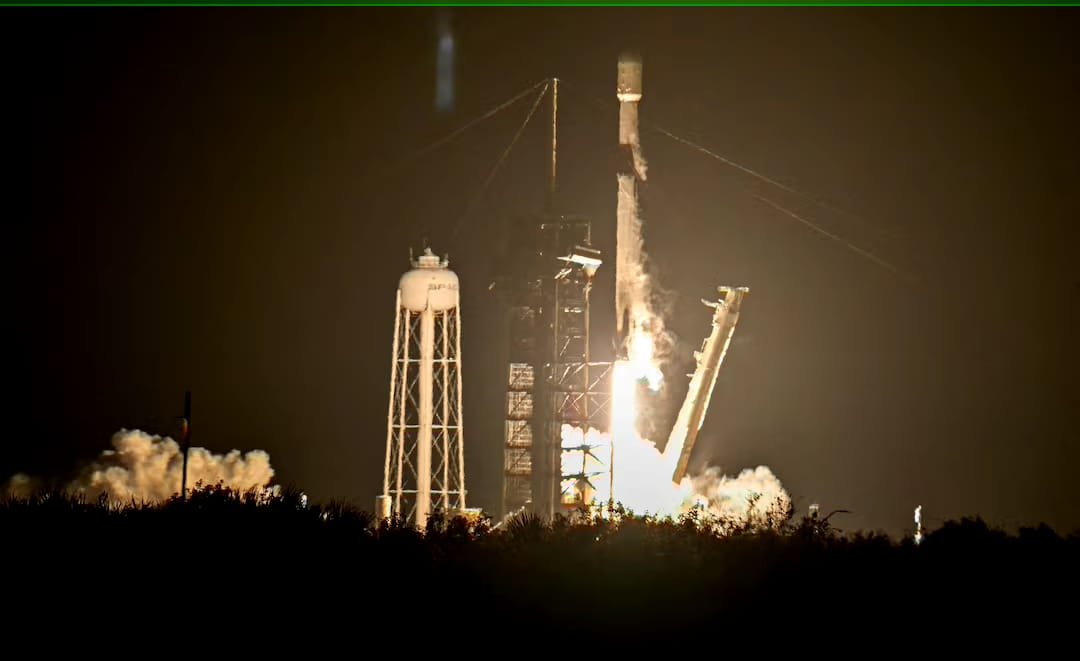
A discarded section of a SpaceX Falcon 9 rocket is expected to collide with the Moon in the early hours of Wednesday after spending more than a year drifting through space. According to Reuters, the object is the rocket’s second stage that helped launch Firefly Aerospace’s Blue Ghost lunar lander in January 2025. The impact is not part of a planned mission but the result of natural gravitational forces that gradually altered the rocket stage’s path.
The four-metric-ton rocket body is projected to strike the lunar surface at approximately 2:35 a.m. ET (0635 GMT) at a speed of around 5,400 miles per hour (8,690 kilometres per hour). Scientists expect the collision to send a cloud of lunar dust into space, although the resulting plume is likely to be too faint for most people on Earth to observe without specialised equipment.
Rocket Stage Was Left Behind After Lunar Mission
The object began its journey during the January 2025 launch that carried Firefly Aerospace’s Blue Ghost lunar lander toward the Moon. Unlike missions that place satellites into Earth orbit, lunar launches require significantly more energy, preventing the Falcon 9’s second stage from returning to Earth’s atmosphere after completing its task.
Normally, upper rocket stages either burn up during re-entry or fall into remote ocean areas after deploying their payloads. In this case, however, the additional velocity needed for the lunar mission left the stage in deep space. After exhausting its remaining fuel, the hardware became uncontrollable and continued orbiting the Earth-Moon system alongside thousands of other pieces of orbital debris.
Astronomers later calculated that the abandoned rocket stage was no longer following a stable orbit. Earlier this year, observations confirmed that its trajectory would eventually intersect with the Moon, making an impact unavoidable because the vehicle no longer had any propulsion or guidance capability.
Natural Forces Slowly Changed the Rocket’s Course
SpaceX said the impending impact was caused by natural cosmic influences rather than any operational decision. Over many months, a combination of solar activity and gravitational interactions gradually altered the rocket stage’s orbit until it was directed toward the Moon.
Julianna Scheiman, SpaceX’s director of NASA science and Dragon programs, told reporters that the object’s path resulted from the combined effects of solar activity and gravitational forces. Since the rocket stage had already vented its fuel and could no longer be controlled, there was no practical way to change its course once its lunar trajectory had been identified.
Current projections indicate the hardware will strike near Einstein Crater on the Moon’s western limb. Because this region is often difficult to observe from Earth, astronomers say the impact itself is unlikely to be clearly visible despite the dust cloud expected to form after the collision.
Scientific Community Sees Limited Research Opportunity
Although the impact is accidental, researchers believe it could still provide useful scientific observations. The collision is expected to excavate fresh lunar material, offering scientists another opportunity to study how impacts disturb the Moon’s surface and disperse dust in its low-gravity environment.
Astronomer Bill Gray, creator of widely used astronomy software, said the event could hold some scientific value despite being relatively minor. At the same time, he argued that the incident also serves as a reminder of the growing challenge posed by abandoned space hardware and the need for more careful disposal practices during future deep-space missions.
Rare Event Highlights Growing Space Debris Challenges
Impacts involving discarded spacecraft hardware are uncommon, particularly on the Moon. While Earth orbit contains thousands of inactive satellites and rocket components, only a small number of objects naturally evolve onto lunar collision paths. The unusual trajectory of the Falcon 9 stage has therefore attracted attention from both astronomers and space agencies monitoring long-term orbital debris.
The incident also underscores the increasingly complex task of managing hardware used for missions beyond Earth orbit. As governments and private companies launch more spacecraft to the Moon and deeper into the solar system, experts are paying closer attention to how mission equipment is disposed of after completing its primary objective.
Previous Lunar Impacts Provide Important Context
While accidental collisions involving discarded rocket hardware are rare, the Moon has experienced similar events in the past. In March 2022, a spent Chinese rocket stage struck the lunar surface after completing a test mission, drawing attention from astronomers tracking objects in deep space. More than a decade earlier, NASA deliberately crashed a rocket stage into the Moon as part of a scientific experiment designed to study material ejected from the impact site.
The U.S. space agency also intentionally directed stages of its Saturn V Moon rockets onto the lunar surface during the Apollo era. Those controlled impacts helped scientists measure seismic activity beneath the Moon’s surface and improved understanding of its internal structure. Unlike those missions, however, the Falcon 9 stage’s collision is an unintended consequence of orbital mechanics rather than a planned scientific operation.
Several Lunar Missions Have Ended in Crashes
The Moon has also witnessed a number of unsuccessful landing attempts in recent years. Russia’s Luna-25 spacecraft crashed during its 2023 mission after losing control before touchdown. Scientists believe the mission’s small plutonium-238 power source remains safely on the lunar surface without posing a significant risk.
India’s Chandrayaan-2 lander was also lost during its descent in 2019 after communication was interrupted shortly before landing. In the same year, Israel’s privately funded Beresheet spacecraft crashed while attempting to become the country’s first lunar lander. Among its payload were microscopic tardigrades, organisms known for surviving extreme environments, which are believed to remain at the crash site.
Future Lunar Exploration Raises New Concerns
The upcoming collision comes as international interest in the Moon continues to grow. Governments and private companies are preparing a new generation of robotic missions while planning long-term human exploration. As lunar traffic increases, preventing uncontrolled spacecraft and rocket hardware from creating hazards has become a more important issue for mission planners.
According to SpaceX, discussions are already underway with NASA on ways to reduce the likelihood of similar incidents in future missions. The agency’s Artemis programme aims to establish a sustained human presence on and around the Moon later this decade, making the protection of spacecraft, infrastructure and astronauts an increasingly important consideration.
Although this impact is not expected to threaten any current lunar missions or people on Earth, it highlights the broader challenge of responsibly managing space hardware after missions end. Experts say future deep-space exploration will require improved disposal strategies to minimise unintended impacts as activity around the Moon continues to expand.
The Falcon 9 rocket stage’s collision is therefore expected to serve not only as a rare astronomical event but also as a reminder of the long-term responsibilities that accompany modern space exploration. As more countries and commercial companies extend their reach beyond Earth orbit, careful planning for spacecraft disposal is likely to become an increasingly important part of future mission design.

Praveen Yadav is the Founder and Editor at The Nation Bulletin. With over 3 years of experience in digital journalism and news reporting, he covers national affairs, governance, and breaking current events with a commitment to factual accuracy and verified reporting.