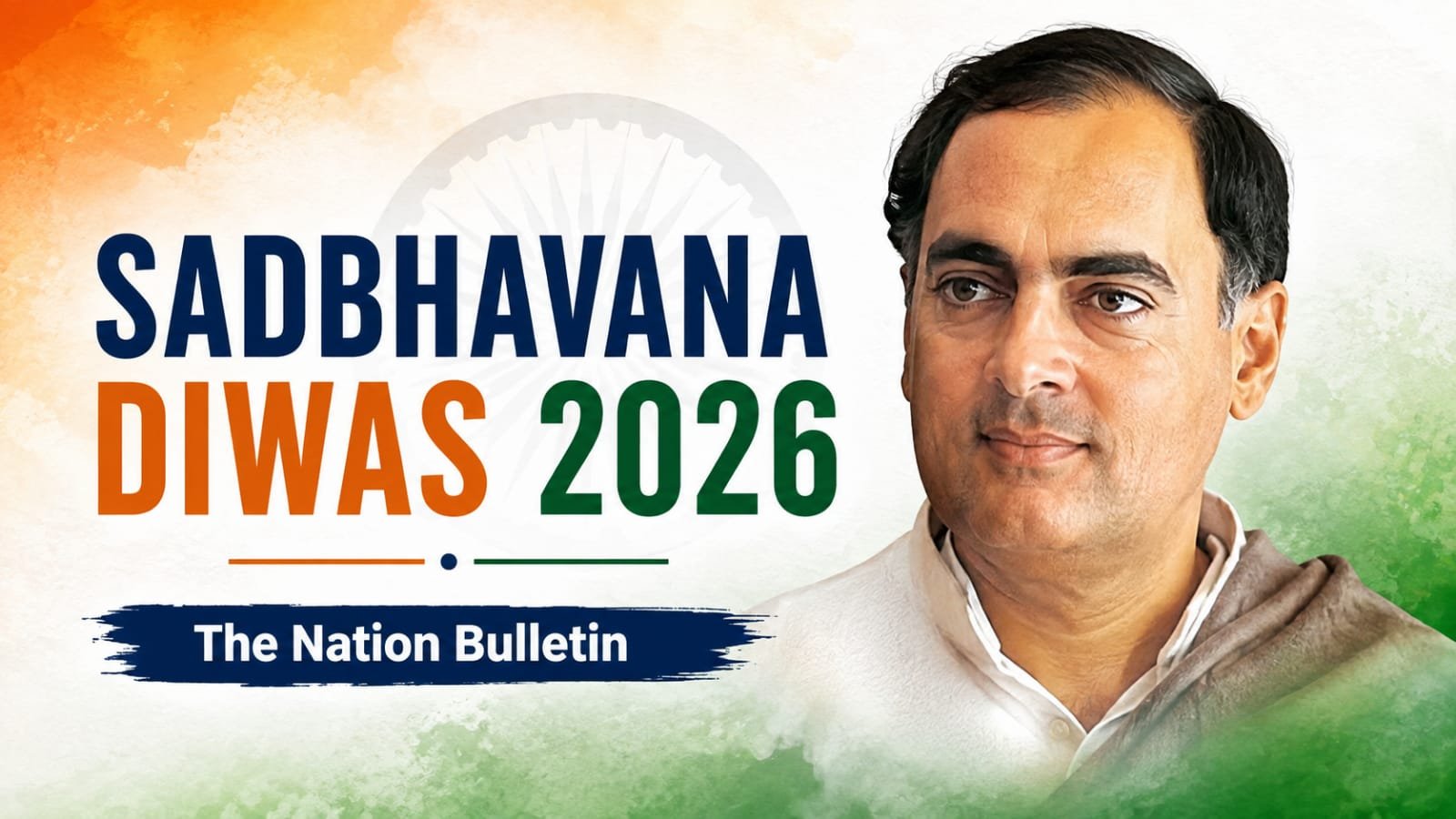
NEW DELHI, India — Sadbhavana Diwas 2026 will be observed across India on August 20 to mark the birth anniversary of former Prime Minister Rajiv Gandhi and reaffirm the values of national integration, communal harmony, peace and goodwill. The observance, also known as Harmony Day, encourages citizens to promote emotional unity and resolve differences through dialogue and constitutional means rather than violence.
Key Highlights
- Sadbhavana Diwas 2026 is being observed on August 20, Rajiv Gandhi’s birth anniversary.
- Rajiv Gandhi was born on August 20, 1944, and became India’s youngest Prime Minister at the age of 40.
- The 2026 theme has not been officially announced in the supplied material, while the observance continues to centre on harmony, peace and national integration.
- The day is associated with a pledge promoting unity across caste, religion, region and language.
Sadbhavana Diwas 2026 focuses on unity and harmony
The word Sadbhavana means goodwill and harmony. The annual observance highlights the importance of peaceful coexistence in a country marked by diverse religions, languages, regions, cultures and communities.
Public activities associated with the occasion can include cultural programmes, contests, community initiatives and environmental activities such as sapling plantation. The broader message is to strengthen social cohesion while encouraging peaceful methods of resolving disagreements.
Sadbhavana Diwas 2026 theme remains unannounced
No official theme for Sadbhavana Diwas 2026 has been provided in the supplied material. The central focus of the observance remains national integration, communal harmony, peace, goodwill and emotional unity among citizens.
The occasion also provides an opportunity to reflect on Rajiv Gandhi’s political legacy, particularly his emphasis on technology, education, youth participation, decentralisation and administrative modernisation.
Sadbhavana Diwas pledge promotes peaceful resolution
The Sadbhavana Diwas pledge calls on citizens and participants in official observances to work toward emotional unity and harmony regardless of caste, region, religion or language. It also rejects violence as a method of resolving differences.
“I take this solemn pledge that I will work for the emotional oneness and harmony of all the people of India regardless of caste, region, religion, or language.”
The pledge further commits participants to resolving differences through dialogue and constitutional means.
Rajiv Gandhi’s journey from pilot to Prime Minister
Rajiv Gandhi was born on August 20, 1944, in Bombay, now Mumbai. He was the son of former Prime Minister Indira Gandhi and grandson of India’s first Prime Minister, Jawaharlal Nehru.
Unlike several members of his family, Rajiv Gandhi initially stayed away from politics and worked as a commercial pilot with Indian Airlines. His entry into public life followed the death of his younger brother Sanjay Gandhi in 1980.
After Indira Gandhi was assassinated in 1984, Rajiv Gandhi became Prime Minister at the age of 40, making him the youngest person to hold the office. He remained Prime Minister until 1989.
Technology and education shaped Rajiv Gandhi’s legacy
Technology and telecommunications were among the defining areas of Rajiv Gandhi’s tenure. His government promoted computerisation and technological innovation at a time when concerns about automation and employment were widespread.
The establishment and strengthening of the Centre for Development of Telematics, along with the expansion of telephone services through STD and PCO networks, contributed to the development of India’s communications infrastructure.
Education was another major priority. His government established Indira Gandhi National Open University in 1985, while the National Policy on Education was introduced in 1986. The Jawahar Navodaya Vidyalaya system was also established in 1986 to provide residential schooling opportunities, particularly for talented students from rural areas.
Youth participation and decentralisation were key priorities
Rajiv Gandhi’s government also pursued measures aimed at expanding political participation among young Indians. The 61st Constitutional Amendment reduced the voting age from 21 to 18, allowing millions of younger citizens to participate directly in elections.
The 52nd Constitutional Amendment introduced anti-defection provisions aimed at addressing political defections and strengthening the stability of elected institutions.
His government also pushed for greater constitutional recognition and empowerment of Panchayati Raj institutions. Although the landmark constitutional amendments strengthening local self-government were enacted after his tenure, the initiatives pursued during his period in office contributed to the groundwork for later reforms.
Economic and foreign policy initiatives
Rajiv Gandhi’s administration sought greater efficiency, productivity and technological advancement in the economy while beginning to ease some regulatory constraints. These efforts preceded the broader economic liberalisation that India would undertake in the 1990s.
On foreign policy, he advocated international cooperation and peaceful coexistence. His 1988 action plan for global nuclear disarmament, presented at the United Nations, reflected India’s position on international peace and security.
Rajiv Gandhi’s death and Bharat Ratna honour
Rajiv Gandhi was assassinated on May 21, 1991, during an election campaign at Sriperumbudur in Tamil Nadu. He was 46 years old.
He was subsequently awarded the Bharat Ratna posthumously, India’s highest civilian honour. His legacy continues to be debated across political and historical contexts, but his emphasis on technology, education and youth participation remains an important part of India’s modern political history.
Rajiv Gandhi National Sadbhavana Award
The Rajiv Gandhi National Sadbhavana Award recognises contributions associated with peace, communal harmony and national integration. The supplied material states that the award was instituted in 1992, one year after Rajiv Gandhi’s assassination.
Recipients listed in the supplied information include Geeta Reddy for 2024, Md. Irfan Khan for 2023, Banasthali Vidyapith for 2020-2021, Gopalkrishna Gandhi for 2018, M. Gopala Krishna and Md. Azharuddin for 2017, Shubha Mudgal for 2016, Muzaffar Ali for 2014 and Amjad Ali Khan for 2013.
Why August 20 matters in India
Sadbhavana Diwas connects Rajiv Gandhi’s birth anniversary with a broader civic message about India’s diversity and the need for peaceful coexistence. The observance encourages citizens to look beyond differences of caste, religion, language and region and reinforce the bonds of national unity.
When is Sadbhavana Diwas 2026 observed?
Sadbhavana Diwas 2026 is observed on August 20, coinciding with Rajiv Gandhi’s birth anniversary.
What is the theme of Sadbhavana Diwas 2026?
No official 2026 theme is provided in the supplied material. The observance continues to emphasise national integration, communal harmony, peace, goodwill and emotional unity.
As India observes Sadbhavana Diwas 2026, the occasion serves both as a remembrance of Rajiv Gandhi and as a reminder of the continuing importance of harmony, dialogue and democratic participation in a diverse society.

Praveen Yadav is the Founder and Editor at The Nation Bulletin. With over 3 years of experience in digital journalism and news reporting, he covers national affairs, governance, and breaking current events with a commitment to factual accuracy and verified reporting.