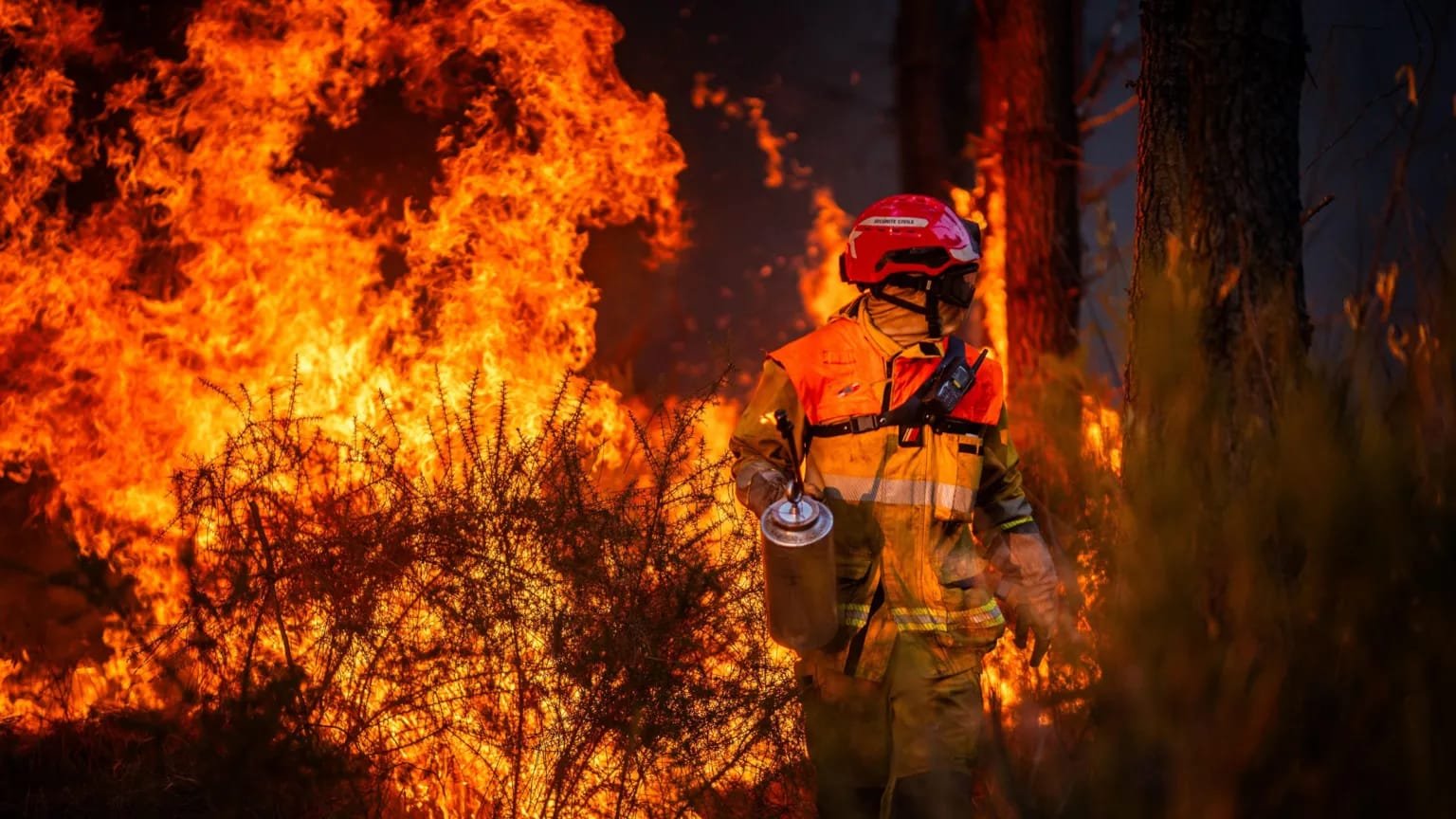
PARIS, France — France’s devastating wildfire season has triggered a wave of arrests and prosecutions as authorities investigate how fires began across the country, while lawyers and media reports question whether some suspects are being pursued too aggressively. More than 300,000 acres have burned this summer, with climate change, drought and human activity all emerging as major factors in the unprecedented destruction.
- France has recorded its most damaging wildfire season since World War Two.
- The interior ministry says 420 people have been arrested over suspected involvement in fires, including 166 minors.
- Experts say most fires are believed to be accidental rather than deliberate acts of arson.
- President Emmanuel Macron says France must adapt its forests to the structural effects of climate change.
Why France’s wildfires have become so destructive
A central factor behind the scale of this year’s fires is a changing climate. Rising temperatures and prolonged drought have left vegetation increasingly vulnerable to ignition and rapid fire spread.
French authorities also say human activity plays a major role. Government records indicate that nine out of 10 French wildfires are started by people, although that figure includes both deliberate and accidental ignition.
The distinction is important because investigators and prosecutors are now examining hundreds of cases while trying to determine whether individual fires were caused intentionally, through negligence or by ordinary activities that became dangerous under extreme conditions.
420 people arrested over suspected involvement
France’s interior ministry has announced 420 arrests involving people alleged to have started fires deliberately or accidentally. Among those arrested are 166 minors.
Some cases have resulted in immediate convictions. One man was sentenced to three years in prison after being found responsible for starting three fires in the Raon-L’Étape forest in the Vosges region.
In another case, a 23-year-old man was accused of deliberately starting 10 fires over five days in the southeastern Var region last month. If convicted, he faces a potential sentence of 15 years in prison and a €150,000 fine.
Questions raised over prosecutions
The government’s aggressive response has also prompted criticism from lawyers and sections of the French media. Muriel Gestas, a lawyer who has represented several people accused of arson, including two firefighters, said the number of arrests appeared excessive and questioned how many would ultimately result in convictions.
Reports have also highlighted cases involving people accused of throwing cigarette butts. A homeless man and a person with severe autism have reportedly received prison sentences in such cases, raising concerns over proportionality.
Le Monde has questioned whether authorities have had enough time to fully investigate the large number of cases. The newspaper also pointed to a lack of detailed information about the charges and whether prosecutors believe suspects acted intentionally, making comparisons with previous wildfire seasons difficult.
Authorities defend tough approach
Bordeaux prosecutor Renaud Gaudeul has defended the strict approach, arguing that seemingly minor actions can become life-threatening during extreme wildfire conditions.
“The conditions for a charge of endangering lives are met for those who throw a cigarette butt or light a barbecue in wooded areas. It only takes a tiny spark for it to start,” Gaudeul said, according to Le Monde.
The argument reflects the unusual conditions facing firefighters this summer. In severely dry vegetation, an action that might ordinarily carry limited risk can rapidly produce a major fire.
How investigators determine where a fire began
Determining the cause of a wildfire is complicated. Eric Dufayet, an officer who investigates fires, said investigators begin after the flames are extinguished by mapping the boundary between burned and unburned vegetation.
They then work backwards toward the likely point where the fire began. When winds have remained steady, the shape of the burned area can form a V pattern, helping investigators identify the direction in which the flames travelled.
Dufayet said investigators may also look for fingerprints or DNA when deliberate ignition is suspected. A person intentionally starting a fire may use more than one device, potentially leaving additional evidence behind.
Most fires are believed to be accidental
Despite the number of arson investigations, experts believe deliberate fire-setting represents only a small proportion of wildfires. Accidental causes can include construction activity, faulty electrical equipment, discarded cigarettes and barbecues.
Dufayet described a set of conditions associated with cigarette-related ignition, sometimes referred to as the “30” rule. He said temperatures of at least 30C, humidity of no more than 30%, winds below 30km/h and at least 30% of a cigarette remaining unburnt can create conditions capable of starting a fire.
During the current drought, he said those conditions can make ignition and rapid spread even easier.
Who deliberately starts wildfires?
Michel Lejoyeux, a professor of psychiatry and addictive behaviour at Paris 7 University, identifies three broad categories of people who start fires: those who act carelessly, those who have a perceived benefit from doing so and people with pyromania.
He said pyromania is a rare psychiatric disorder that is difficult to diagnose and accounts for only a small number of arson convictions. The condition involves an attraction to setting fires without the financial or retaliatory motives that can be present in other cases.
Gestas said alleged firefighter arson cases can involve different motivations. Some firefighters may want to appear as rescuers, while volunteers could potentially have financial motives linked to tax-free overtime, according to her assessment.
France faces another heatwave threat
The debate over arrests comes as the wider wildfire threat remains unresolved. Forecasts indicate that another heatwave could reach France within days, raising concerns about continued pressure on dry forests and emergency services.
President Emmanuel Macron has described this year’s fires as completely unprecedented and said the country must prepare for a different approach to forest management.
“We will have to replant and rebuild a different kind of forest because we must adapt to the structural conditions of climate change,” Macron said.
Macron has also argued that the immediate priority should remain national unity and dealing with the fires rather than conducting a full review of the government’s response.
Damage extends beyond burned forests
The consequences of the fires extend well beyond the areas directly consumed by flames. Hundreds of homes, tourism-dependent businesses and local economies have been affected, while smoke and deteriorating air quality have added another public-health and environmental concern.
The scale of the destruction has intensified questions over both individual responsibility and government preparedness. Authorities are pursuing people suspected of causing fires, while critics argue that the focus on arrests should not obscure the broader role of climate-driven heat and drought in making fires increasingly destructive.
What happens next
France faces the dual challenge of continuing investigations into wildfire causes while preparing for further extreme heat. Prosecutors will have to distinguish deliberate acts from accidental ignition as courts process the growing number of cases.
At the same time, the government faces pressure to assess whether its wildfire preparations and long-term forest policies are adequate for a changing climate. Macron has indicated that a broader review will come later, but for now officials are focused on managing the immediate threat.

Praveen Yadav is the Founder and Editor at The Nation Bulletin. With over 3 years of experience in digital journalism and news reporting, he covers national affairs, governance, and breaking current events with a commitment to factual accuracy and verified reporting.