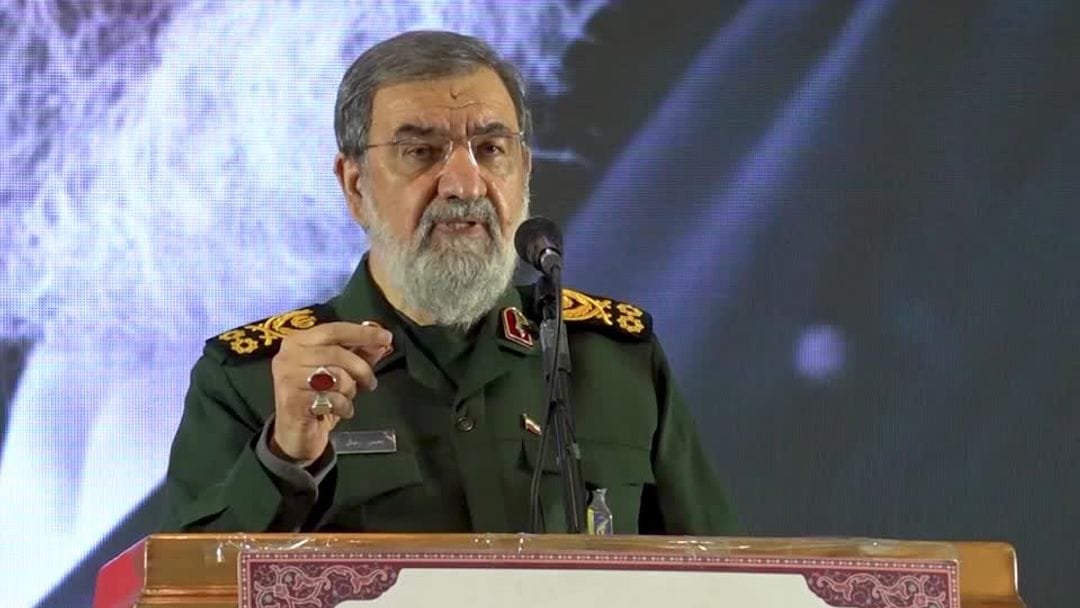
TEHRAN, Iran — Iran has appointed veteran Islamic Revolutionary Guard Corps commander Mohsen Rezaei as secretary of the Supreme National Security Council, placing a prominent hardliner and close ally of Supreme Leader Ayatollah Mojtaba Khamenei in a key position overseeing the country’s security and foreign-policy coordination.
- Mohsen Rezaei, 71, has been appointed secretary of Iran’s Supreme National Security Council.
- He previously commanded the Islamic Revolutionary Guard Corps for 16 years.
- Rezaei has publicly expressed skepticism toward negotiations with the United States.
- His military record includes a controversial role during the Iran-Iraq war.
Mohsen Rezaei takes key Iranian security role
Rezaei replaces Mohammad Baqer Zolqadr, who has been appointed political adviser to Mojtaba Khamenei. The Supreme National Security Council is chaired by President Masoud Pezeshkian and plays a central role in coordinating Iran’s security and foreign policy.
The appointment comes more than five months into the conflict between Iran and the United States, giving Rezaei a prominent role at a time when Tehran’s security and diplomatic decisions remain closely watched.
Alongside his new position, Mojtaba Khamenei has appointed Rezaei as his representative on the security council. The Supreme Leader cited Rezaei’s extensive military experience as a reason for the appointment.
Rezaei became IRGC commander at 27
Rezaei joined the Islamic Revolutionary Guard Corps after the 1979 Islamic Revolution and became its commander in 1981 at the age of 27. He remained in charge for 16 years, including most of the 1980-88 Iran-Iraq war.
During his tenure, he oversaw the expansion of the IRGC’s ground, naval and air capabilities. His career places him among the generation of commanders who emerged from Iran’s revolutionary underground and later became influential figures in the country’s security establishment.
After leaving the IRGC command, Rezaei remained active in Iranian politics. He has repeatedly contested presidential elections and served as vice president for economic affairs from 2021 to 2023 under hardline President Ebrahim Raisi.
Rezaei also holds a doctorate in economics from the University of Tehran.
Close ties to Mojtaba Khamenei
Rezaei was appointed military adviser to Mojtaba Khamenei in March, after Mojtaba became Iran’s Supreme Leader following the death of his father, Ayatollah Ali Khamenei, at the beginning of the U.S.-Israeli war on Iran.
Since the conflict began, Rezaei has made repeated public statements expressing strong opposition to negotiations and issuing warnings directed at the United States.
In April, he said a U.S. ground invasion would be an opportunity for Iran to capture American hostages and seek financial compensation for them. He also said at the time that he personally opposed extending a ceasefire.
In June, Rezaei questioned aspects of a memorandum of understanding intended to end the war. Later that month, he accused Washington of violating the agreement by creating tensions around the Strait of Hormuz.
From opposition activist to senior security figure
Rezaei’s involvement in Iran’s political struggle began before the Islamic Revolution. As a teenager, he joined opposition activity against the Pahlavi monarchy and was imprisoned by SAVAK, the Shah’s security service, in 1973.
He helped establish and develop the Mansouroun militant group, which operated against the monarchy during the 1970s. Several members of the organisation later became part of the senior leadership of the IRGC.
Controversial Iran-Iraq war record
Rezaei’s wartime record has also remained controversial inside Iran. Critics have questioned his role in costly military offensives that resulted in heavy Iranian casualties, including Operation Karbala-4 in December 1986.
The operation was intended to break through Iraqi defences toward Basra. Rezaei reignited debate over the episode in 2018 when he wrote that Karbala-4 had been conducted as a deception before Karbala-5.
He later clarified that Karbala-4 had initially been intended as a genuine offensive and that Iran subsequently used its failure as part of a deception strategy ahead of Karbala-5.
What is Mohsen Rezaei’s new role?
Rezaei is now secretary of Iran’s Supreme National Security Council, the body responsible for coordinating key security and foreign-policy matters. President Masoud Pezeshkian chairs the council.
Why is Rezaei considered a hardliner?
Rezaei has a long background in Iran’s Revolutionary Guard and has repeatedly expressed skepticism toward negotiations with Washington. His public comments during the conflict have reflected a strongly confrontational position toward the United States.

Praveen Yadav is the Founder and Editor at The Nation Bulletin. With over 3 years of experience in digital journalism and news reporting, he covers national affairs, governance, and breaking current events with a commitment to factual accuracy and verified reporting.