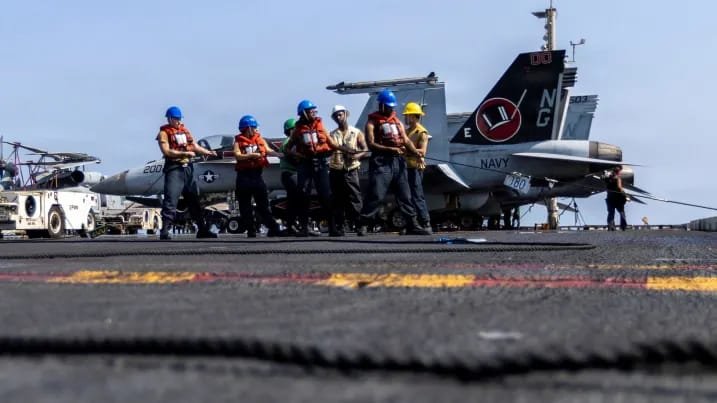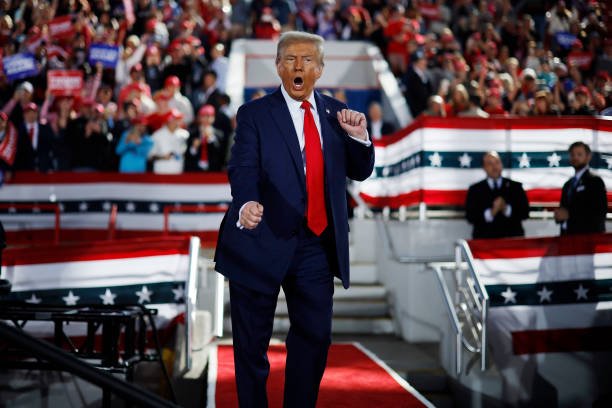
WASHINGTON, United States — US President Donald Trump has ordered the Pentagon to substantially reduce planned joint military exercises with South Korea, citing the cost of the drills, their message to North Korea and Seoul’s refusal to join a US effort to denuclearise Iran.
- Trump ordered a substantial reduction in upcoming US-South Korea military exercises.
- The exercises involving about 18,000 South Korean troops were scheduled to begin this week.
- Trump said the drills send an inappropriate and hostile signal to North Korea.
- The decision comes after North Korea resumed ballistic missile testing and warned against the exercises.
Why Trump wants to reduce the military exercises
Trump said he had instructed Secretary of War Pete Hegseth to reduce the exercises because cancelling them completely was no longer practical. He argued that the drills are expensive and that the United States bears much of the cost.
The US president also pointed to his relationship with North Korean leader Kim Jong Un. Trump said he was unhappy that Washington had previously agreed to participate in the exercises with South Korea.
Trump described the drills as a hostile signal to North Korea, which he said had been unthreatening and respectful during his presidency.
Iran denuclearisation disagreement adds to tensions
Trump also linked his decision to a recent conversation with the South Korean president. He said he had asked Seoul whether it wanted to join the United States in efforts to denuclearise Iran, but South Korea declined.
The president acknowledged that the issue was somewhat unrelated to the military exercises but included it in his explanation for the decision.
What the US-South Korea drills are designed to do
The 11-day Ulchi Freedom Shield exercises involve around 18,000 South Korean soldiers and are intended to strengthen the allies’ readiness to respond to potential threats from North Korea.
The US military has described the exercises as reinforcing the alliance’s role in regional peace and security and demonstrating the commitment of Washington and Seoul to defend their countries.
The planned training includes complex joint operations, including live-fire exercises designed to test precision targeting and manoeuvring. Forces were also expected to conduct a wet gap crossing and practise the distribution of prepositioned military equipment.
Decision comes after North Korea missile activity
Trump’s announcement comes shortly after North Korea resumed ballistic missile testing. South Korea, the United States and Japan detected a short-range ballistic missile launch earlier this month, the first such activity by Pyongyang since late June.
The missile landed in waters off North Korea’s eastern coast. North Korea has continued efforts to expand its nuclear and missile capabilities since high-level diplomacy between Trump and Kim collapsed in 2019.
Experts cited in the supplied report said Kim may view a larger weapons arsenal as a way to strengthen North Korea’s position in future negotiations with Washington.
North Korea warns against joint drills
North Korea warned on Friday that it could take unspecified “stern steps” against the United States and South Korea. It described the military exercises as a rehearsal for an aggressive war and accused them of increasing instability.
Such warnings have frequently accompanied major US-South Korean military exercises. Experts said Pyongyang has also used allied drills as a justification for weapons testing and efforts to strengthen domestic support for Kim’s leadership.
Trump’s past engagement with Kim Jong Un
Trump met Kim three times during his first presidential term to discuss North Korea’s nuclear programme. Their most recent meeting took place in 2019, when the diplomatic process eventually stalled.
Since returning to office, Trump has indicated an interest in reviving discussions with the North Korean leader. His latest announcement came one day after he posted a photograph of himself with Kim and described their relationship positively.
The decision to reduce the exercises could therefore affect both the US-South Korea security relationship and Trump’s broader approach to diplomacy with North Korea.
Frequently Asked Questions
How large are the US-South Korea military exercises?
The planned Ulchi Freedom Shield exercises were scheduled to run for 11 days and involve approximately 18,000 South Korean soldiers, with US and South Korean forces conducting complex joint training.
Why is North Korea opposed to the military exercises?
North Korea considers the drills preparation for an aggressive war and has warned that they increase regional instability. Pyongyang has historically issued strong warnings around major US-South Korean exercises.
Source attribution: Information supplied by the user, based on Associated Press reporting and the statements attributed to US President Donald Trump and the US military.

Praveen Yadav is the Founder and Editor at The Nation Bulletin. With over 3 years of experience in digital journalism and news reporting, he covers national affairs, governance, and breaking current events with a commitment to factual accuracy and verified reporting.