PRESTON, United Kingdom — Five Palestine Action activists convicted of causing criminal damage to a Barclays bank branch in northern England will not be sentenced under terrorism laws, Judge Robert Altham ruled at Preston Crown Court on Friday, ending the immediate possibility of terrorism-related sentencing in the case.
- Five activists convicted over damage to a Barclays branch will not be sentenced as terrorists.
- The group caused an estimated £212,000 ($290,000) in damage during a 2024 protest in Burnley.
- The activists said they were relieved by the ruling and argued terrorism sentencing should never have been considered.
- The five are due to receive their sentences for the criminal damage convictions on September 4.
Judge rules against terrorism sentencing
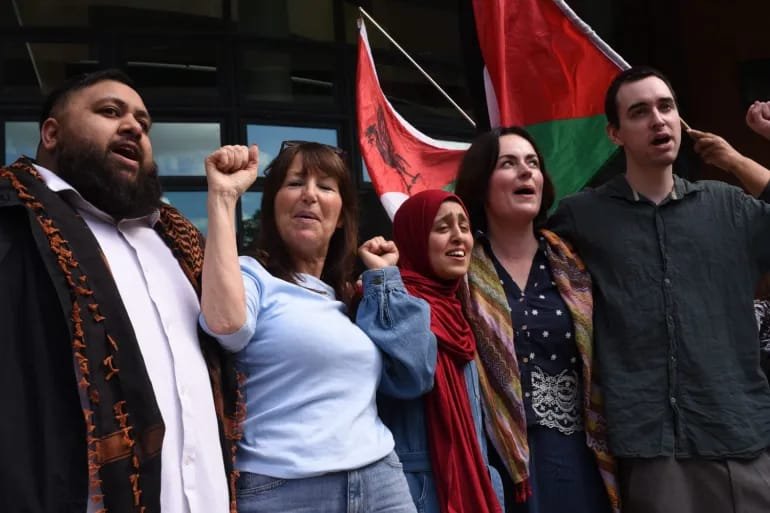
The ruling concerns Brendon O’Hagan, 28, Amanda Kelly, 31, Hmeera Atiqnisar, 31, Mohammed Malik, 28, and Alma Yaniv, 70. The five were convicted in June over damage caused to a Barclays branch in Burnley, Lancashire, in August 2024.
The activists were protesting against Barclays’ shareholdings in Israeli weapons manufacturer Elbit Systems when the bank premises were damaged. The reported damage was valued at £212,000.
Judge Altham’s ruling means the defendants will not be sentenced under terrorism provisions in connection with the offence. Their underlying convictions for criminal damage remain, with sentencing scheduled for September 4.
Activists say ruling is a victory
Supporters gathered outside Preston Crown Court as the ruling was announced on Friday. The crowd reportedly responded with cheers and pro-Palestine chants.
Dove Malik, the mother of defendant Mohammed Malik, described the decision as a victory for the defendants, Palestine and the right to protest.
“It’s a victory for us, it’s a victory for Palestine, it’s a victory for protesting … We are on the right side of history,” Malik told Al Jazeera.
The five activists also issued a joint statement expressing relief after learning that they would not face terrorism sentencing. They argued that their original trial concerned criminal damage and that neither they nor the jury had been informed that terrorism-related sentencing could later become an issue.
“We were on trial for charges of criminal damage, for damaging some windows and spraying red paint on a Barclays branch,” the activists said in their statement.
They also argued that the possibility of terrorism sentencing should never have been raised in their case.
How terrorism sentencing became an issue
At the time the five activists were convicted, Palestine Action had not been proscribed as a terrorist group, according to the supplied report. Neither the defendants nor the jury were aware during the trial that terrorism-related sentencing could potentially be considered.
Following the convictions, however, the trial judge had notified the defendants’ legal team that he intended to consider whether the offence had a “terrorist connection”. That development created the possibility of a sentence under terrorism-related provisions despite the original convictions being for criminal damage.
The issue had also arisen in another Palestine Action case. Four activists convicted of criminal damage at an Elbit Systems site near Bristol were sentenced as terrorists nearly two years after their protest, according to the supplied material.
Lawyer questions use of terrorist connection provisions
Criminal lawyer Raj Chada, of Hodge Jones & Allen, said laws concerning a “terrorist connection” have existed for years but argued that their recent use in these circumstances was highly unusual.
Chada said his firm had represented several Palestine Action activists and that, in its experience, the provisions appeared to have been used recently in cases involving Palestine Action activists whose alleged offences occurred before the organisation was proscribed.
He also said that, to his knowledge, the law had been used in relation to direct-action protest groups in the Filton case. His comments focused on the legal mechanism used by prosecutors to address the alleged offence rather than simply the status of the organisation involved.
Palestine Action ban remains a wider point of dispute
The case has unfolded against a broader dispute over the legal status of Palestine Action. According to the rights group Defend Our Juries, more than 3,500 people have been arrested for expressing support for Palestine Action since the organisation was proscribed in July 2025.
The arrests have included people involved in mass sit-ins in Parliament Square in London. Some demonstrators held signs expressing opposition to genocide and support for Palestine Action.
Rights groups have criticised the proscription, describing it as an excessive restriction on protest and calling for the government to reverse the ban. The issue has become a wider point of contention over the limits of protest and the use of counter-terrorism powers in the United Kingdom.
Amnesty calls for Palestine Action proscription to be lifted
Amnesty International UK also responded to Friday’s ruling. Kerry Moscogiuri, the organisation’s head, called for the proscription of Palestine Action to be lifted and criticised what she described as the misuse of broad counter-terrorism powers against direct-action protesters.
“We now need to see the proscription against Palestine Action lifted and an end to the misuse of sweeping counter terror powers against direct action protestors,” Moscogiuri said.
She also called for the government to begin reversing what she described as years of restrictions on the right to protest.
September sentencing now awaits the five activists
Friday’s ruling does not end the legal proceedings against the five activists. They remain convicted of criminal damage and are due to be sentenced on September 4.
The immediate question of whether they could receive terrorism-related sentences has now been settled by the court. The upcoming sentencing will instead determine the penalties arising from their criminal damage convictions.
The case has nevertheless drawn wider attention because it sits at the intersection of criminal law, protest rights and the government’s use of counter-terrorism legislation. The activists’ supporters and rights groups have welcomed the ruling, while the wider debate over Palestine Action’s proscription and the treatment of its supporters continues.

Praveen Yadav is the Founder and Editor at The Nation Bulletin. With over 3 years of experience in digital journalism and news reporting, he covers national affairs, governance, and breaking current events with a commitment to factual accuracy and verified reporting.