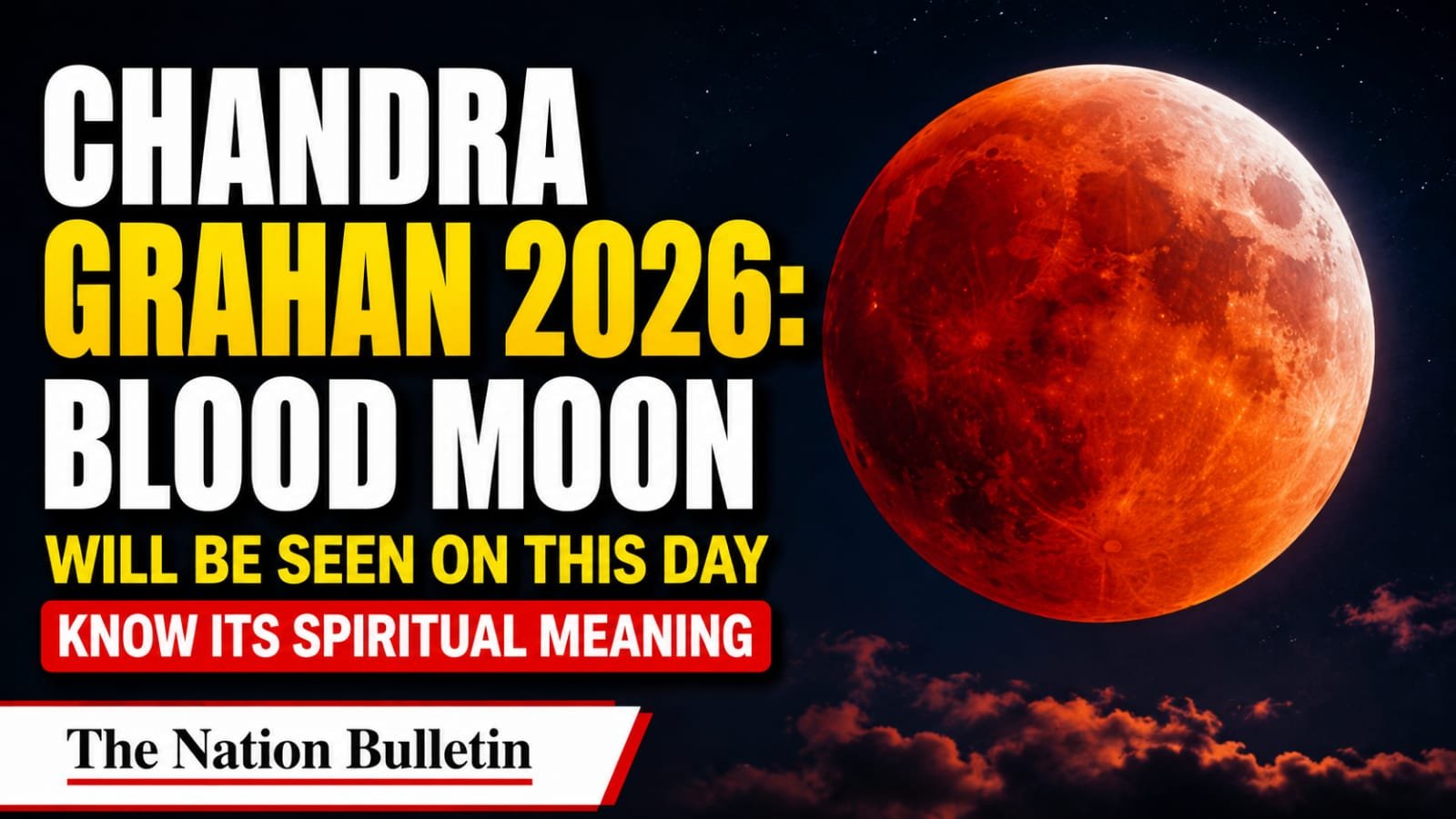
NEW DELHI, India — The Chandra Grahan 2026, occurring across August 27-28 depending on the local time zone, is expected to produce a dramatic red- and copper-coloured Moon during a deep partial lunar eclipse. Although widely described as a “Blood Moon,” the event is not a total lunar eclipse, with a thin portion of the lunar surface expected to remain directly illuminated.
- Key Highlights:
- The deep partial lunar eclipse will occur on August 27-28, depending on the location and time zone.
- At maximum eclipse, 96.2% of the Moon will be immersed in Earth’s darkest shadow, according to the supplied information.
- The eclipse will be visible across parts of the Americas, Europe, Africa and western Asia, weather permitting.
- The event is not expected to be normally visible from India, according to the supplied information.
Why the August 2026 Chandra Grahan May Look Like a Blood Moon
The August 2026 event is expected to be one of the most striking lunar displays of the year because much of the Moon will enter Earth’s umbra, the darkest central part of the planet’s shadow.
At the deepest stage of the eclipse, 96.2% of the Moon will be immersed in the umbra, according to Time and Date information included in the supplied material. Only a thin sliver of the lunar surface will remain directly illuminated by sunlight.
The portion covered by Earth’s shadow may appear rusty, reddish or copper-coloured. This dramatic appearance is why the event is commonly associated with the popular term “Blood Moon.”
Is the August 2026 Eclipse Really a Blood Moon?
A Blood Moon is more accurately associated with a total lunar eclipse, when the entire lunar disc enters Earth’s umbra. The August 27-28 event does not reach that stage, making its correct astronomical classification a deep partial lunar eclipse.
However, the distinction may not make the spectacle any less dramatic for observers. With most of the Moon expected to enter the Earth’s darkest shadow, a large part of the lunar surface may develop a deep reddish-orange appearance.
The event is being described as the deepest partial lunar eclipse visible anywhere on Earth until December 31, 2028, according to the supplied information. That makes the August eclipse a significant skywatching event despite falling just short of totality.
Where will the August 27-28 lunar eclipse be visible?
The eclipse will be visible, at least partially, across North and South America, Europe, Africa and parts of western Asia, provided weather conditions allow observation. A lunar eclipse can be seen from locations where the Moon is above the horizon.
North and South America are expected to have some of the best viewing opportunities, with the entire eclipse visible across much of those regions.
Observers in Europe and Africa will experience the event before dawn on August 28. In some locations, the Moon will be setting during the later stages of the eclipse, requiring viewers to look toward the western horizon.
The supplied information states that the eclipse will not normally be visible from India. As a result, religious restrictions traditionally associated with locally visible eclipses, including Sutak practices, should not automatically be applied in the same way as in locations where the Grahan can actually be observed.
Spiritual meaning of Chandra Grahan in Hindu tradition
Chandra Grahan carries strong spiritual symbolism in Hindu tradition. The Moon is associated with the mind, emotions, peace, memory and motherly energy, and many believers view an eclipse as a period when emotional and mental energy may become unsettled.
Traditional astrology also connects eclipses with Rahu and Ketu, known as the lunar nodes. An old story describes Rahu attempting to consume the Sun or the Moon, resulting in the temporary darkness associated with an eclipse.
For this reason, Chandra Grahan is often viewed as a period for introspection rather than celebration or material pursuits. The eclipse is also traditionally linked with the idea of examining and releasing old anger, emotional attachments and recurring fears.
Why prayer and meditation are observed during Chandra Grahan
Many Hindu families traditionally spend the eclipse period in prayer, meditation and mantra chanting. These practices are believed to help focus the mind and reduce disturbing thoughts during the Grahan.
Devotees may chant mantras associated with Shiva, Vishnu or the Moon. Some also recite the Mahamrityunjaya Mantra or the mantra of their personal Ishta Devata.
The spiritual significance attached to the event varies among individuals and families, but the supplied information describes Chandra Grahan as a period traditionally associated with reflection and conscious examination of emotional patterns.
A major skywatching event before 2028
The August 27-28 eclipse stands out because of the exceptionally large portion of the Moon expected to pass through Earth’s darkest shadow. While it will not become a total lunar eclipse, the remaining illuminated section is expected to be only a narrow sliver at maximum eclipse.
Skywatchers in regions where the event is visible will have the opportunity to witness the Moon’s changing appearance as Earth’s shadow moves across the lunar surface. For those who miss the event, the supplied information indicates that another lunar eclipse of comparable spectacle will not occur until December 31, 2028.
For observers positioned in favourable regions and with clear skies, the deep partial eclipse is expected to offer a striking view of a Moon transformed by Earth’s shadow into shades of red, orange and copper.

Praveen Yadav is the Founder and Editor at The Nation Bulletin. With over 3 years of experience in digital journalism and news reporting, he covers national affairs, governance, and breaking current events with a commitment to factual accuracy and verified reporting.