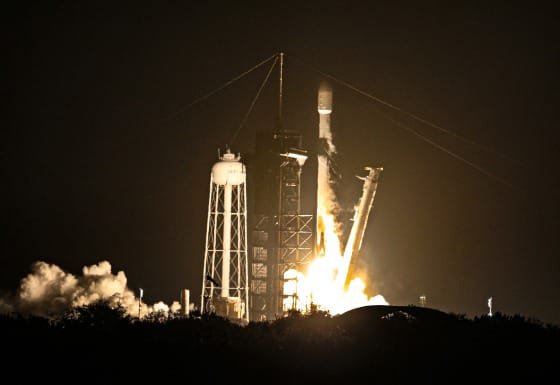
A SpaceX Falcon 9 rocket stage that spent more than a year drifting through space has struck the Moon after veering off its intended path, according to scientists who tracked the object. While the impact itself was not directly observed, astronomers say telescope observations and orbital tracking provide strong evidence that the rocket collided with the lunar surface exactly as predicted.
The rocket’s upper stage, which launched Firefly Aerospace’s Blue Ghost and ispace’s Resilience lunar landers from NASA’s Kennedy Space Center in Florida on January 15, 2025, eventually lost its planned trajectory after completing its mission. Scientists said a combination of solar activity and gravitational forces gradually altered its orbit, placing it on a collision course with the Moon.
The impact is believed to have occurred on Wednesday at an estimated speed of around 5,400 mph. Researchers expect the collision to have created a new crater near Einstein Crater, a rugged region located close to the boundary between the Moon’s near side and far side.
Scientists Say Telescope Data Confirms the Lunar Impact
Although no camera captured the exact moment of impact, scientists say the available evidence leaves little room for doubt.
A research team led by Boston University scientist Carl Schmidt used observations from the European Southern Observatory’s Very Large Telescope in Chile to study the event. According to Schmidt, the telescope detected a stream of sodium and lithium extending into space for several minutes immediately after the expected collision time.
The material is believed to be part of a debris plume produced when the four-ton rocket stage slammed into the lunar surface.
“We don’t have images of the impact,” Schmidt said, adding that telescope observations provide clear evidence of the crash.
Scientists noted that such chemical signatures are consistent with material thrown into space following a high-speed impact.
Space-Tracking Experts Had Predicted the Crash
Even before telescope observations became available, astronomers who regularly monitor abandoned spacecraft had concluded that the collision was unavoidable.
Retired astrophysicist Jonathan McDowell reported that observations made on Tuesday night showed the Falcon 9 upper stage travelling directly toward the Moon. Based on its trajectory, experts expected the impact to occur near Einstein Crater.
“There’s no doubt in my mind” that the rocket is now scattered across the lunar surface near Einstein Crater, McDowell said.
McDowell explained that the object’s speed and trajectory made the impact inevitable once it entered its final approach.
Crash Was Accidental, Says SpaceX
SpaceX emphasized that the lunar collision was not intentional.
According to SpaceX Vice President Julianna Scheiman, the company is working closely with NASA to reduce the chances of similar incidents in future missions. She explained that natural forces, including changes in solar activity and gravitational interactions, gradually pushed the spent rocket stage onto a path that ultimately intersected with the Moon.
The Falcon 9 upper stage had already completed its primary mission after successfully sending Firefly Aerospace’s Blue Ghost lander and ispace’s Resilience lander toward the Moon before becoming an uncontrolled object in deep space.
Ground Observations Proved Challenging
Scientists had expected that confirming the impact from Earth would be extremely difficult. The estimated collision site lies near the Moon’s western limb, close to the boundary between its near side and far side. Because of this location, astronomers knew any flash or dust cloud created by the impact would be difficult to detect with ground-based telescopes.
Dutch astronomer Marco Langbroek was among several researchers who attempted to observe the event using telescopes. Despite carefully timing the observation, he reported that no visible impact flash or dust plume could be seen from his location.
“We knew this would be a long shot,” Langbroek said, while adding that he had no doubt the rocket had reached the lunar surface.
Scientists explained that the lack of a direct visual observation does not contradict the evidence gathered from orbital tracking and spectroscopic observations. Instead, it highlights how challenging it is to witness impacts occurring on the Moon from Earth, particularly near the edge of the visible lunar disk.
NASA Orbiter Expected to Capture the Impact Crater
The strongest visual confirmation is now expected to come from NASA’s Lunar Reconnaissance Orbiter (LRO), which regularly maps the Moon’s surface in high resolution.
Researchers expect the spacecraft to fly over the predicted impact location in the coming days. Once new images become available, scientists will compare them with earlier photographs of the same region in an effort to identify a newly formed crater created by the Falcon 9 upper stage.
If confirmed, the crater will provide valuable scientific data about high-speed impacts on the lunar surface while also helping researchers better understand how abandoned spacecraft behave after completing deep-space missions.
Blue Ghost Succeeded While Resilience Was Lost
The Falcon 9 upper stage had completed its mission shortly after launching from Cape Canaveral on January 15, 2025. It successfully placed Firefly Aerospace’s Blue Ghost and ispace’s Resilience lunar landers onto their transfer trajectories before becoming an inactive object in space.
The two missions ultimately had very different outcomes. Firefly Aerospace’s Blue Ghost successfully completed its lunar landing, becoming the first privately built spacecraft to achieve a successful soft landing on the Moon. In contrast, ispace’s Resilience mission ended unsuccessfully after the lander crashed during its landing attempt.
After completing its deployment duties, the Falcon 9 upper stage remained in space with no further propulsion capability. Over the following months, natural gravitational influences and solar activity gradually altered its orbit until the Moon intercepted its path.
Growing Concern Over Space Debris Reaching the Moon
The latest impact has renewed concerns among scientists about the increasing amount of human-made debris reaching the Moon. While Earth’s atmosphere burns up many abandoned spacecraft and rocket stages, the Moon has virtually no atmosphere to provide such protection. As a result, objects left drifting through space can eventually collide with its surface, creating new craters and scattering debris over large areas.
Researchers say the issue is likely to become more significant as lunar missions increase over the coming years. Government agencies and private companies are planning frequent launches to the Moon, raising the possibility that uncontrolled spacecraft and spent rocket stages could become a larger challenge for future exploration.
This is not the first time an unintended rocket impact has been recorded. In 2022, a Chinese rocket stage unintentionally struck the Moon after completing its mission. Scientists also believe that several other rocket components may have hit the lunar surface in previous decades without being detected, largely because tracking technology and observational capabilities were more limited at the time.
Future Lunar Missions Could Face New Challenges
The Moon is expected to become one of the busiest destinations in space over the next decade. NASA is preparing a series of robotic and human missions under its Artemis programme, while commercial companies continue developing spacecraft designed to transport cargo, equipment and astronauts to the lunar surface.
SpaceX and Blue Origin have been selected to provide lunar landing systems for future Artemis missions. SpaceX is advancing development of its Starship vehicle through ongoing test flights in Texas, while Blue Origin continues work on its Blue Moon lunar lander.
According to current mission planning, one or both commercial landing systems are expected to participate in Artemis III, which will include a docking demonstration before astronauts attempt humanity’s first crewed lunar landing since the Apollo era. NASA is currently targeting a crewed Moon landing as early as 2028, subject to mission readiness.
Experts Call for Better Space Traffic Management
Scientists believe the latest incident highlights the growing need for improved tracking and disposal of spacecraft operating beyond Earth orbit. As lunar exploration accelerates, experts say stronger coordination between national space agencies and private companies will become increasingly important to prevent unnecessary impacts.
Jonathan McDowell warned that accidental collisions of this kind may become unacceptable once regular robotic missions, scientific instruments and eventually astronauts begin operating across multiple locations on the Moon. Large impacts could spread dust and debris over considerable distances, potentially affecting future landing sites and scientific experiments.
“Things are going to get a lot busier near the Moon. At that point an impact like this on the lunar surface plowing up huge amounts of dust going for hundreds of miles around is not going to be acceptable,” McDowell said.
Scientists now await detailed images from NASA’s Lunar Reconnaissance Orbiter, which could provide the first direct visual confirmation of the newly formed impact crater and help researchers better understand the consequences of accidental spacecraft collisions on the Moon.

Praveen Yadav is the Founder and Editor at The Nation Bulletin. With over 3 years of experience in digital journalism and news reporting, he covers national affairs, governance, and breaking current events with a commitment to factual accuracy and verified reporting.