Global drugmakers are using obesity-awareness campaigns across Chinese cities to reach potential patients, navigating restrictions that prevent prescription medicines from being advertised directly to consumers.
SHANGHAI, China — Drugmakers competing in China’s rapidly expanding weight-loss market are promoting obesity awareness through metro stations, gyms, social media and sporting events, even as regulations prohibit direct-to-consumer advertising of prescription medicines. The campaigns by companies including Novo Nordisk, Eli Lilly, Pfizer and Innovent Biologics are drawing attention from experts who say some messaging could come close to crossing the line into drug advertising.
Key Highlights
- China restricts drug companies from directly advertising prescription medicines to consumers.
- Weight-loss companies are using public health and obesity-awareness campaigns to reach potential patients.
- Hospital staff say social media and recommendations from family and friends are influencing patients to request specific weight-loss medicines.
China’s obesity market draws major drugmakers
China’s National Health Commission has said the proportion of people who are overweight or obese could exceed 65% by 2030, creating a major potential market for weight-management treatments.
Novo Nordisk, Eli Lilly, Pfizer and Chinese company Innovent Biologics are competing with once-weekly GLP-1 weight-loss injections. Lilly led once-weekly GLP-1 sales on Alibaba’s Tmall and JD.com during the second quarter, according to Jefferies.
Weight-loss campaigns appear across public spaces
Because prescription medicines cannot be advertised directly to consumers, companies can instead provide public information about specific diseases and encourage people to consult doctors. Such campaigns cannot mention product names, but they can still draw attention to health conditions linked to obesity.
One Lilly-branded banner at a Shanghai metro station urged commuters to pay attention to a father’s snoring and seek medical help. Snoring can be a symptom of sleep apnea, a condition strongly associated with being overweight.
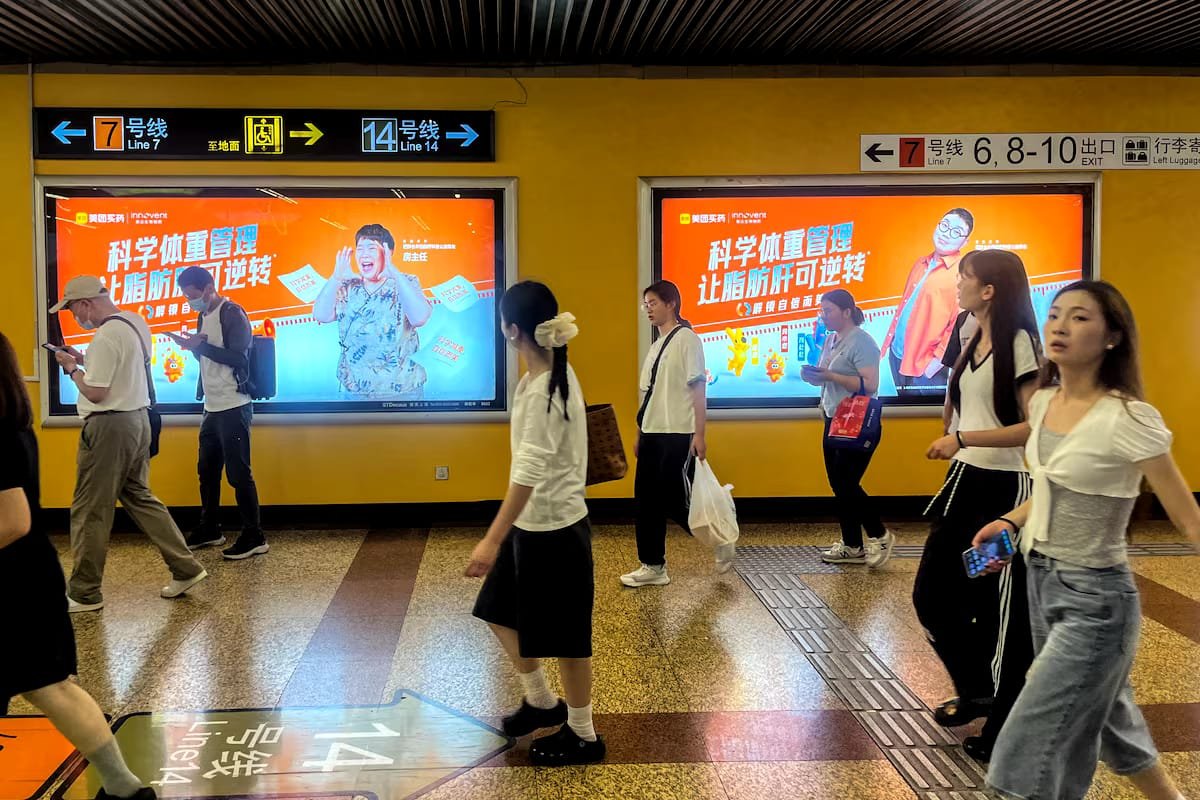
Other campaigns have promoted “scientific weight management” and the potential reversal of fatty liver disease. At a football stadium in Suzhou, an Innovent-related message was repeatedly displayed during a July match, according to a social media post reviewed by Reuters.
Drugmakers expand outreach beyond hospitals
Pfizer has also used health-focused events to engage with consumers. Gym chain Supermonkey promoted a partnership with Pfizer for a “healthy weight loss party” during June and July, where participants attended a session focused on developing healthier habits.
These communication strategies stand out because pharmaceutical companies do not typically promote prescription treatments for conditions such as hypertension and cancer in comparable public settings, said Jia Hepeng, a science communication professor at Soochow University.
Patients increasingly ask for medicines by name
Hospital employees in Shanghai and Guangzhou told Reuters that social media campaigns, together with recommendations from friends and relatives, have influenced some patients to seek particular weight-loss drugs by name.
Zhao Xiaolong, an endocrinologist at the Shanghai Public Health Clinical Center, said patients initially requested Novo Nordisk’s semaglutide, known as Wegovy, more frequently. Requests for Lilly’s tirzepatide, sold as Mounjaro, and Innovent’s mazdutide, sold as Xinermei, have recently become more common, he said.
Competition intensifies in China’s GLP-1 market
Novo launched the first once-weekly GLP-1 treatment for weight management in China in late 2024. Lilly followed in January 2025, Innovent in July 2025, while Pfizer’s Xianweiying received its first prescriptions in April.
J.P. Morgan estimates that China’s market for GLP-1 weight-management therapies could grow to 30 billion yuan, or about $4 billion, over the next five to seven years, compared with an estimated 3 billion to 4 billion yuan currently.
Companies rethink how they communicate with consumers
Novo Nordisk Greater China President Cai Yan said Chinese doctors had told the company that its communications were weaker than those of some competitors. She said the company was looking at ways to make its public information more accessible and expand communication beyond doctors and hospitals.
Novo and state broadcaster CCTV also held a health exhibition in Beijing last month featuring group dancing and information about GLP-1 therapies. The company said its approach is focused on obesity education rather than promoting a specific medicine.
Experts question where awareness ends and advertising begins
Medical and legal experts said some campaigns could potentially cross the boundary between disease awareness and prescription-drug advertising. Chen Zhenggang, a partner at DeHeng Law Offices, said Innovent and Meituan subway billboards could lead consumers to associate the companies with a particular prescription weight-loss product.
The billboards did not name Innovent’s Xinermei or mazdutide, but featured a mascot called “Madudu,” a name that appeared similar to the product’s branding.
J.P. Morgan analyst Yang Huang said companies were attempting to remain compliant while also operating in a market where they ultimately want to sell medicines. The balance between public education and commercial promotion is therefore becoming increasingly important as competition grows.
Lilly said its educational activities do not promote specific medicines and are consistent with China’s health strategies. Pfizer, Innovent, Meituan and China’s market regulator declined to comment or did not respond to Reuters requests.

Praveen Yadav is the Founder and Editor at The Nation Bulletin. With over 3 years of experience in digital journalism and news reporting, he covers national affairs, governance, and breaking current events with a commitment to factual accuracy and verified reporting.