RBI Grade B Interview 2026 is the final stage for candidates who qualify the Phase II examination. A focused preparation strategy covering RBI functions, economic developments, technical subjects, personal questions, job responsibilities, mock interviews and professional presentation can help candidates approach the interview with greater confidence.
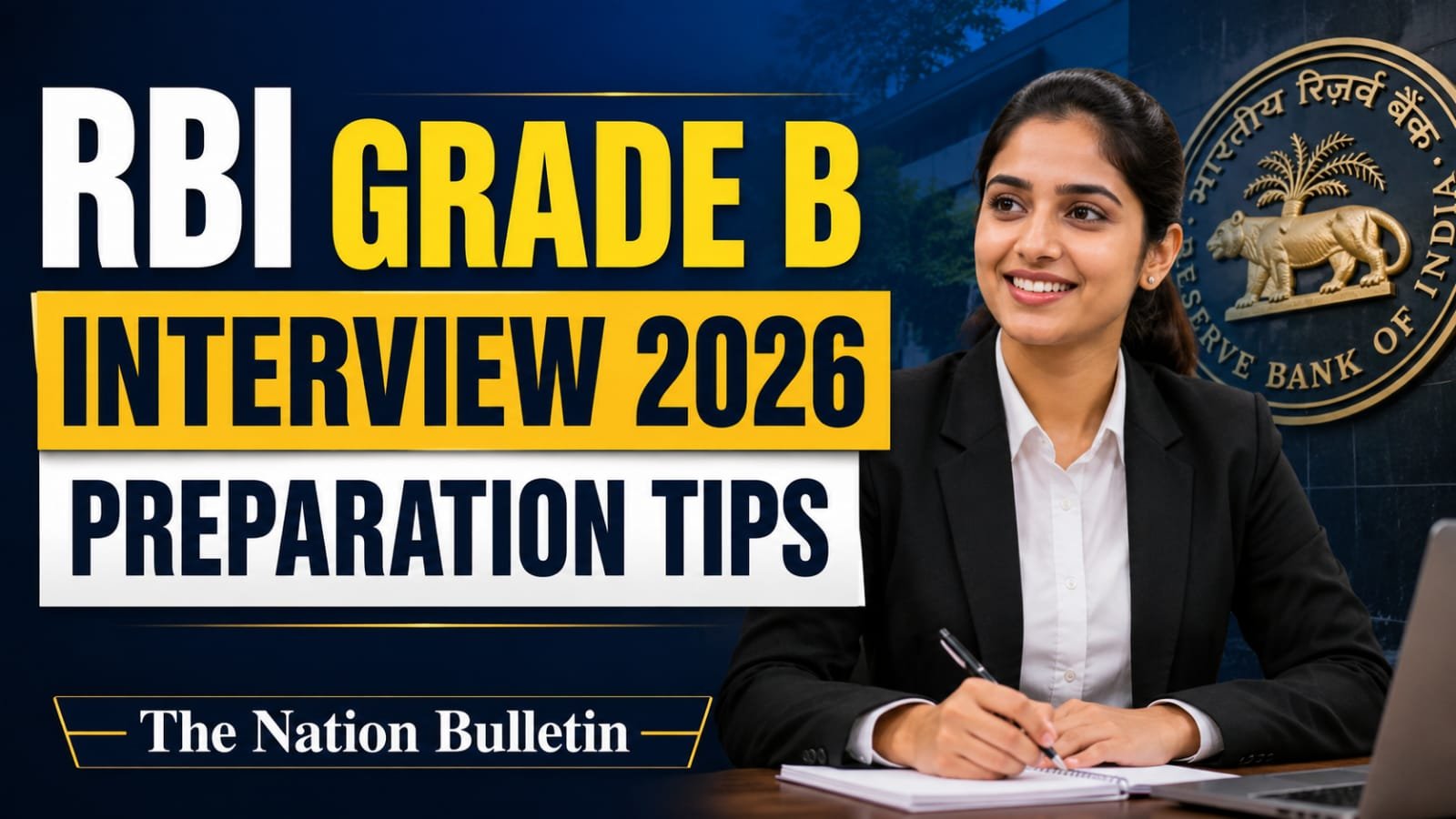
NEW DELHI, India — RBI Grade B Interview 2026 preparation requires candidates to demonstrate more than textbook knowledge. The interview assesses communication skills, analytical ability, banking and financial knowledge, awareness of economic developments, personality and overall suitability for the role of a Grade ‘B’ officer in the Reserve Bank of India.
Key Highlights
- The RBI Grade B Interview 2026 is the final stage after qualification in Phase II.
- Candidates should revise RBI’s history, organisational structure, monetary policy, regulatory functions and foreign exchange role.
- Current affairs preparation should cover RBI publications, economic indicators, government policies and recent financial developments.
- Technical revision should include Economic & Social Issues (ESI), Finance & Management (FM) and English Writing Skills.
- Mock interviews can help candidates improve communication, confidence and the ability to give balanced responses.
- Professional formal attire and a clear understanding of the RBI Grade B job profile are also important aspects of preparation.
RBI Grade B Interview Preparation 2026: Know the RBI
A strong understanding of the Reserve Bank of India should form the foundation of interview preparation. Candidates should begin by revising the RBI’s establishment in 1935 and its evolution.
The organisational structure should also be studied, including the roles of the Governor, Deputy Governors and different departments. Candidates should understand how these parts of the institution contribute to its overall functioning.
Monetary policy is another important area. Aspirants should understand the RBI’s role in controlling inflation while supporting economic growth, along with the institution’s regulatory responsibilities in supervising banks and NBFCs.
Foreign exchange should also be covered, particularly the RBI’s role in managing foreign exchange reserves and exchange rates. Candidates should additionally remain familiar with recent RBI policies, reforms and initiatives.
Stay Updated With Current Affairs and Economic News
Economic and current-affairs questions are an important part of interview preparation. Candidates should develop a regular reading habit and follow major developments in the economy, banking and financial sectors.
- Daily news reading: Follow newspapers such as The Hindu, Indian Express or Economic Times for current developments.
- RBI publications: Read RBI reports, circulars and press releases to understand recent policies and regulatory developments.
- Economic indicators: Track GDP, inflation, fiscal deficit and employment trends.
- Digital platforms: Use relevant YouTube channels, podcasts and forums for additional economic insights.
- Discussions: Participate in study groups or online communities to discuss current affairs and economic issues.
- Government policies: Revise recent reforms and initiatives relating to banking, finance, agriculture and infrastructure.
Revise the RBI Grade B Technical Portion
Candidates should expect questions connected to the technical portion they studied for the Phase II examination. Revision should therefore begin with the fundamental areas that form part of the preparation.
Economic & Social Issues (ESI), Finance & Management (FM) and English Writing Skills should be reviewed carefully. Standard textbooks and reliable online resources can be used to strengthen conceptual understanding.
Phase II preparation notes can also serve as an efficient revision source. Instead of relying only on fresh study material, candidates should revisit their existing notes and concentrate on important concepts they have already covered.
Prepare for Frequently Asked Interview Questions
The interview can include questions about the candidate’s background, motivation, understanding of the RBI and knowledge of economic and financial concepts. Preparing structured responses in advance can help candidates answer clearly without sounding rehearsed.
Personal Background Questions
- Please introduce yourself.
- Where are you from, and what can you tell us about your hometown?
- Can you share your interests and hobbies?
- Who is your role model, and what qualities have you adopted from them?
Motivation and Career Choice
- What attracted you to the banking industry?
- Why do you want to join the Reserve Bank of India?
RBI and Banking Sector Questions
- What are the basic facts related to the RBI?
- Can you explain the different departments within the RBI and their functions?
- What are the RBI’s core responsibilities, and which one interests you the most?
- How does the RBI generate revenue?
Economic and Financial Questions
- What is a SWOT analysis?
- How can the government raise funds without increasing income tax?
- Can you differentiate between fiscal deficit and revenue deficit?
- What is a Non-Performing Asset (NPA), and how should India address its NPA issue?
- What are the various types of inflation?
Professional Dress Matters at the Interview
Professional attire can contribute to a positive first impression and should reflect the seriousness of the position. Candidates should select formal clothing that is neat, comfortable and appropriate for the interview environment.
Guidelines for Men
- Choose a light-coloured, full-sleeved formal shirt with dark-coloured trousers.
- Wear black formal shoes with matching socks.
- Use a black formal belt with a simple buckle.
- A tie and blazer are optional and can be selected according to personal comfort and weather conditions.
Guidelines for Women
- A plain cotton saree in a light colour or salwar-kameez with minimal embroidery can be worn.
- Dark-coloured trousers with a light-coloured formal shirt are another option.
- Choose closed-toe flats or low-heeled shoes.
- Keep jewellery and makeup minimal for a professional appearance.
General Grooming Tips
- Keep hair neat and nails trimmed.
- Choose clothing that is comfortable and allows easy sitting and movement.
- Avoid flashy colours or patterns and prefer neutral, solid colours.
Understand the RBI Grade B Officer Job Profile
Questions about the position and its responsibilities are commonly relevant during preparation. Candidates should therefore understand the broad duties associated with an RBI Grade B officer.
Currency Management: The role involves responsibilities connected with the issuance and circulation of currency.
Financial Supervision: RBI officers work in areas involving regulation and supervision of banks and financial institutions to support financial stability.
Economic Analysis: Research and economic analysis can support the formulation and implementation of monetary policies.
Public Awareness: RBI-related responsibilities can also involve educating people about RBI policies and financial literacy.
Mock Interviews Can Improve Confidence
Regular mock interviews can help candidates become more comfortable answering questions under interview conditions. They also provide an opportunity to identify weaknesses in communication, improve confidence and practise giving balanced and thoughtful responses.
Thorough preparation combined with repeated practice can also help candidates manage nervousness. The objective should be to understand the subject matter well enough to respond naturally rather than memorising fixed answers.
Frequently Asked Questions
What is the RBI Grade B interview?
The RBI Grade B interview is the final stage of the selection process after Phase II, where candidates are assessed on knowledge, personality, communication and suitability for the role.
How can I prepare for the RBI Grade B interview?
Preparation should cover RBI functions, current affairs, economic developments, technical subjects, commonly asked questions, job responsibilities and mock interview practice.
What kind of questions are asked in the RBI Grade B interview?
Questions can cover personal background, motivation, RBI functions, banking awareness, economic and financial concepts and the candidate’s suitability for the role.
What should candidates wear for the RBI Grade B interview?
Candidates should choose professional formal attire. The suggested options include light-coloured formal shirts with dark trousers for men and sarees, salwar-kameez or formal western wear for women.
What are the key responsibilities of an RBI Grade B officer?
The responsibilities highlighted include currency management, financial supervision, economic research and public awareness related to RBI policies and financial literacy.
How can candidates stay calm during the interview?
Thorough preparation and regular mock interview practice can help reduce nervousness and improve confidence during the RBI Grade B Interview.
With preparation spread across institutional knowledge, technical concepts, current affairs, personal questions, professional presentation and role-specific responsibilities, candidates can approach the RBI Grade B Interview 2026 with a structured strategy rather than relying on last-minute revision.

Praveen Yadav is the Founder and Editor at The Nation Bulletin. With over 3 years of experience in digital journalism and news reporting, he covers national affairs, governance, and breaking current events with a commitment to factual accuracy and verified reporting.