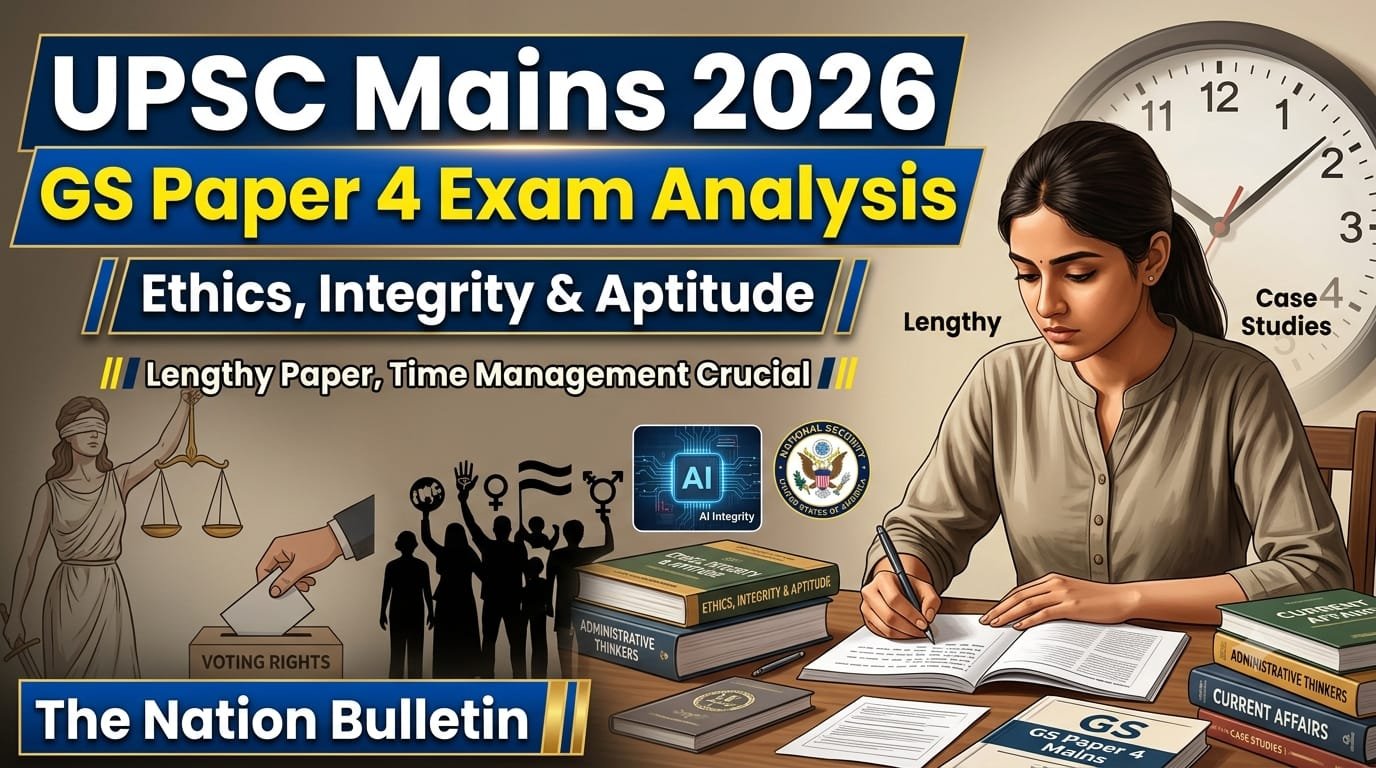
UPSC Mains 2026 GS Paper 4 was rated moderate by candidates, with time management emerging as a major challenge, particularly in the lengthy case studies section.
NEW DELHI, India — The Union Public Service Commission (UPSC) conducted the UPSC Mains 2026 GS Paper 4 examination on August 23, 2026, with candidates describing the paper as moderate but lengthy. Feedback after the examination indicated that managing the three-hour duration was difficult, especially while attempting questions in both sections of the paper.
Key Highlights
- UPSC Mains 2026 GS Paper 4 was conducted on August 23 in the afternoon session from 2:30 PM to 5:30 PM.
- The 250-mark descriptive paper consisted of Section A theoretical questions and Section B case studies.
- Candidates found Section A relatively direct, while Section B was considered longer and more challenging because of its case studies.
- Questions covered areas including caste, voting rights, transgender rights, financial inclusion, national security, women’s reservation and AI integrity.
- Time management was identified as one of the biggest challenges during the examination.
UPSC Mains 2026 GS Paper 4 Difficulty Level
The overall UPSC Mains 2026 GS Paper 4 difficulty level was described as moderate in the feedback shared by candidates after the examination. Although the questions were not considered uniformly difficult, the length of the paper made it challenging to complete all answers comfortably within the allotted time.
The paper tested candidates on Ethics, Integrity and Aptitude through a descriptive format. With 250 marks to be attempted in three hours, candidates had to balance answer quality with speed throughout the examination.
UPSC Mains 2026 GS Paper 4 Review
The paper was divided into two broad sections with different demands on candidates. Section A contained theoretical questions and was viewed as comparatively simple because several questions were direct and could be approached with clear conceptual understanding.
Section B presented a greater challenge. Candidates encountered case studies that required careful analysis, decision-making and consideration of ethical issues. The longer nature of this section added pressure for those who had already spent significant time on theoretical answers.
UPSC Mains GS Paper 4 Question Paper Analysis 2026
The questions reported from the examination covered a wide range of themes connected with ethics, governance, society and public administration. Topics mentioned in the analysis included the symbolic relationship between nature and spirit, education and motivation, Gandhi’s movement, caste and the right to vote.
The paper also included themes related to transgender rights, the structure of civil services, financial inclusion, national security, women’s reservation and AI integrity. A case study involving a business project based on forest land required candidates to consider the ethical issues involved.
Other reported elements included a Shakespeare quote and questions connected with decision-making. The range of topics required candidates to apply ethical concepts across different social, administrative and contemporary contexts.
What Candidates Can Learn From the Paper
The feedback from the examination highlights the importance of building strong conceptual clarity before attempting Ethics and Integrity questions. Aspirants can strengthen preparation by learning clear definitions of important terms and connecting them with simple examples from everyday life.
Developing a collection of personal examples and examples from daily news can also help candidates make their answers more practical. The preparation approach suggested in the analysis includes practising both rule-based and outcome-based ways of examining ethical situations.
Case Study Preparation and Time Management
Case studies require a structured approach because candidates must identify the people involved, understand the central ethical problem and arrive at an appropriate course of action. Practising this process repeatedly can help reduce the time required to organise an answer during the examination.
Answer-writing practice should also be conducted under timed conditions. The candidate feedback from GS Paper 4 shows that knowing the subject alone may not be sufficient when the paper is lengthy, making speed and time allocation important parts of preparation.
UPSC Mains 2026 GS Paper 4: Key Preparation Takeaways
- Prepare clear definitions for important ethics-related concepts.
- Use relevant real-life and daily-news examples while practising answers.
- Develop both rule-based and outcome-based approaches to ethical problems.
- Follow a structured method for identifying stakeholders, problems and solutions in case studies.
- Use suitable quotes and Indian values where they strengthen an answer.
- Practise full-length answer writing with a timer to improve completion speed.
UPSC Mains 2026 GS Paper 4 Exam Details
| Exam Detail | Information |
|---|---|
| Exam | UPSC Civil Services Main Examination 2026 |
| Paper | General Studies Paper IV (Paper V – Ethics, Integrity, and Aptitude) |
| Conducting Authority | Union Public Service Commission (UPSC) |
| Exam Date | August 23, 2026 |
| Exam Timing | 2:30 PM to 5:30 PM |
| Total Marks | 250 |
| Duration | 3 Hours |
| Format | Descriptive |
| Sections | Section A: Theoretical Questions; Section B: Case Studies |
| Overall Difficulty | Moderate |
Frequently Asked Questions
What was the UPSC Mains 2026 GS Paper 4 difficulty level?
The paper was rated moderate by candidates who shared feedback after the examination, although its length created significant time-management pressure.
When was the UPSC Mains GS Paper 4 exam held?
The examination was conducted on August 23, 2026, from 2:30 PM to 5:30 PM.
How many marks was UPSC Mains GS Paper 4?
The descriptive paper carried 250 marks and had a three-hour duration.
What was the pattern of UPSC Mains GS Paper 4?
The paper had two sections: Section A consisted of theoretical questions, while Section B focused on case studies.
Which topics were reported in the UPSC Mains GS Paper 4 2026 analysis?
Reported topics included caste, right to vote, transgender rights, civil services structure, financial inclusion, national security, women’s reservation, AI integrity and ethical issues involving forest land projects.
The August 23 examination feedback therefore points to a paper where conceptual preparation needed to be matched with efficient answer writing. For future aspirants, the experience particularly underlines the value of timed practice alongside regular preparation of ethics concepts, examples and case-study frameworks.

Praveen Yadav is the Founder and Editor at The Nation Bulletin. With over 3 years of experience in digital journalism and news reporting, he covers national affairs, governance, and breaking current events with a commitment to factual accuracy and verified reporting.