Samsung has positioned the Galaxy S26 FE as an entry point into its Galaxy S26 family, combining a 3nm Exynos 2500 processor, a 4,900mAh Silicon-Carbon battery, a 6.7-inch AMOLED display and a seven-year software support commitment.
Samsung Galaxy S26 FE was officially announced on August 27, 2026, with its global market rollout scheduled to begin on September 4, 2026. The Fan Edition model targets the upper mid-range to premium sub-flagship segment, bringing several flagship-oriented technologies into a lower-priced position within the Galaxy S26 ecosystem.
Key Highlights
- The Galaxy S26 FE uses Samsung’s 3nm Exynos 2500 deca-core processor with the Xclipse 950 GPU.
- The phone combines a 4,900mAh Silicon-Carbon battery with a slim 7.4mm chassis and support for 45W wired charging.
- Samsung lists Android 17, One UI 9, Galaxy AI features, seven generations of OS upgrades and seven years of security updates.
Samsung Galaxy S26 FE specifications and hardware architecture
The Galaxy S26 FE is built around Samsung’s Exynos 2500 system-on-chip, manufactured on a 3nm process node. The processor uses a 10-core architecture divided into four clusters for different performance and efficiency workloads.
| Component | Architecture | Clock Speed |
|---|---|---|
| Prime Core | 1x ARM Cortex-X925 | 3.30GHz |
| Upper Mid Cluster | 2x ARM Cortex-A725 | 2.74GHz |
| Lower Mid Cluster | 5x ARM Cortex-A725 | 2.36GHz |
| Efficiency Cluster | 2x ARM Cortex-A520 | 1.80GHz |
| GPU | Samsung Xclipse 950 with AMD RDNA architecture | — |
The Cortex-X925 prime core handles peak single-threaded workloads, while the A725 clusters are designed for sustained performance, concurrent processing and background tasks. The Xclipse 950 graphics subsystem supports hardware ray tracing, variable rate shading and modern 3D rendering workloads.
Samsung has also integrated a vapor chamber cooling structure to distribute heat across the chassis during extended workloads. The phone comes with 8GB LPDDR5X RAM and storage options of 128GB, 256GB and 512GB. Storage is non-expandable and there is no MicroSD card slot.
6.7-inch AMOLED display and slim chassis
The Galaxy S26 FE features a flat 6.7-inch Dynamic LTPO AMOLED 2X display with a resolution of 1080 x 2340 pixels, a 120Hz adaptive refresh rate and approximately 385 pixels per inch. The panel supports 10-bit colour output, HDR10+ and up to 1,900 nits of high brightness mode.
The phone measures 161.6mm x 76.9mm x 7.4mm and weighs 193 grams. Its body uses an Armor Aluminum frame and Corning Gorilla Glass Victus+ protection, while the device carries an IP68 rating for dust and water resistance.
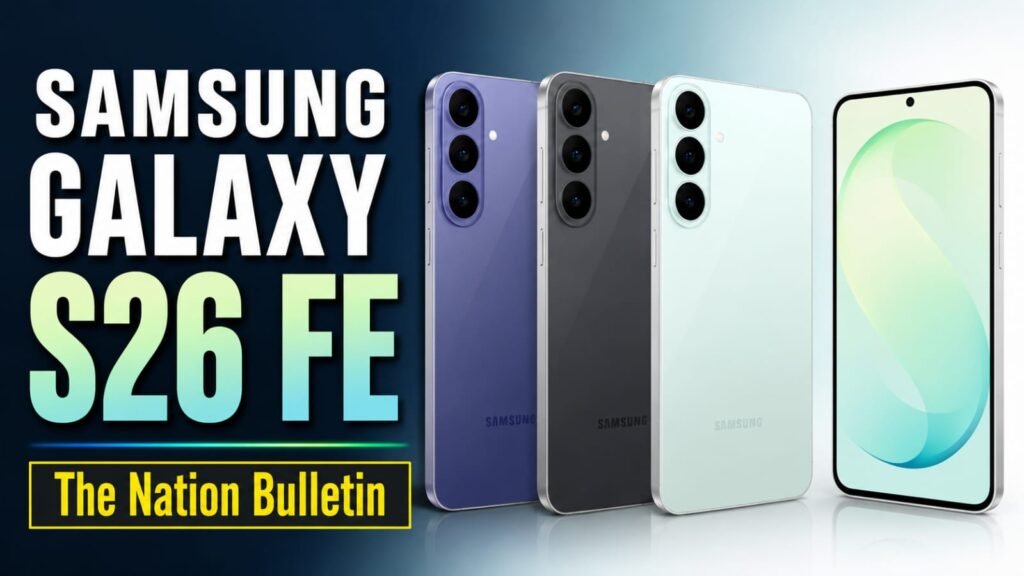
Samsung lists Blueberry, Graphite and Pistachio as the available colour options. The design uses narrow display bezels and a centred punch-hole front camera.
Galaxy S26 FE camera system
The rear camera setup consists of a 50MP primary camera, a 12MP ultra-wide camera and an 8MP telephoto camera. The main sensor uses an f/1.8 aperture, a 24mm equivalent focal length, Dual Pixel PDAF and optical image stabilisation.
The 12MP ultra-wide camera has an f/2.2 aperture and a 123-degree field of view. The 8MP telephoto camera uses an f/2.4 aperture, a 75mm equivalent focal length, PDAF and OIS, delivering 3x optical zoom and up to 30x digital zoom.
On the front, the Galaxy S26 FE uses a 12MP f/2.2 camera with a 26mm equivalent focal length and an 85-degree field of view. The front camera supports 4K video recording at up to 60fps.
Video features and computational photography tools
The supplied specifications list 8K video recording at 24/30fps and 4K recording at up to 60/120fps. Samsung also includes computational video features such as My FanCam, which tracks and centres selected subjects, and Super Steady with Horizontal Lock for correcting rotational movement during high-motion recording.
For low-light photography, the phone uses Samsung’s Nightography processing, which combines multiple raw exposures to reduce chromatic noise in darker conditions.
4,900mAh Silicon-Carbon battery and charging
The Galaxy S26 FE uses a non-removable 4,900mAh Silicon-Carbon Lithium-Ion battery. The Silicon-Carbon anode design is intended to provide higher energy density while allowing the battery to fit inside the device’s 7.4mm profile.
| Power Feature | Specification |
|---|---|
| Battery | 4,900mAh Silicon-Carbon Lithium-Ion |
| Wired Charging | 45W Super Fast Charging 2.0 |
| Charging Standards | USB Power Delivery 3.0 and QC 2.0 |
| 30-Minute Charge | Approximately 69% under nominal thermal conditions |
| Wireless Charging | 15W Qi / Qi2 compatible |
| Reverse Charging | Wireless PowerShare |
Wireless PowerShare can be used for compatible smartwatches, earbuds and other supported peripherals.
Android 17, One UI 9 and Galaxy AI
The Galaxy S26 FE debuts with Android 17 and Samsung’s One UI 9. Samsung provides seven generations of Android OS upgrades and seven years of security updates.
The software package includes Galaxy AI tools, Google Gemini Omni, Circle to Search, Now Brief and Photo Assist. The system uses the Exynos 2500 NPU for on-device artificial intelligence workloads alongside cloud-based computational resources where supported.
The supplied information also lists generative video compilation through multimodal Gemini Omni tools, while Now Brief provides contextual automated summaries and Photo Assist supports generative image manipulation.
Connectivity, audio and biometric features
The Galaxy S26 FE supports 5G SA/NSA, 4G LTE Advanced, VoLTE and Vo5G. It supports dual Nano-SIM cards along with software eSIM functionality.
Local connectivity includes Wi-Fi 6E, Bluetooth 5.4 and NFC. The phone also supports GPS, GLONASS, Galileo, BeiDou and QZSS positioning systems.
Other hardware features include a USB Type-C 3.2 Gen 1 port, an optical in-display fingerprint sensor, stereo speakers with Dolby Atmos tuning, USB-C audio output, a barometer, gyroscope and geomagnetic sensors.
Samsung Galaxy S26 FE full specifications
| Specification | Details |
|---|---|
| Model Identifiers | SM-S741B, SM-S741B/DS |
| Display | 6.7-inch Dynamic LTPO AMOLED 2X, 1080 x 2340, 120Hz, 1,900 nits HBM |
| Processor | Samsung Exynos 2500 Deca-Core |
| RAM | 8GB LPDDR5X |
| Storage | 128GB, 256GB, 512GB |
| Rear Cameras | 50MP + 12MP ultra-wide + 8MP telephoto |
| Front Camera | 12MP |
| Battery | 4,900mAh Silicon-Carbon |
| Charging | 45W wired, 15W wireless, reverse Wireless PowerShare |
| Software | Android 17 with One UI 9 |
| Protection | Armor Aluminum, Gorilla Glass Victus+, IP68 |
| Colours | Blueberry, Graphite, Pistachio |
Samsung Galaxy S26 FE price and availability
Global sales are scheduled to begin on September 4, 2026. Pricing varies by market and configuration.
| Market | 128GB | 256GB | 512GB |
|---|---|---|---|
| United States | $699.99 | $799.99 | — |
| European Union | €699.00 / €799.00 | €899.00 | €1,099.00 |
| United Kingdom | £699.00 | £799.00 | £949.00 |
| India (Projected) | ₹69,990 – ₹75,999 | ||
In North America, the base model is priced at $699.99, creating a $100 gap below the standard Galaxy S26, according to the supplied material. In India, the projected range of ₹69,990 to ₹75,999 places the phone below the cited ₹79,999 entry threshold for the base Galaxy S26.
Samsung’s market strategy for the Galaxy S26 FE
Samsung’s Fan Edition strategy uses selected hardware trade-offs to maintain a lower price position while retaining premium features. The Galaxy S26 FE is listed with 8GB of RAM compared with 12GB on the standard Galaxy S26, while the telephoto camera uses an 8MP sensor.
At the same time, the device retains a 6.7-inch 120Hz display, 45W charging, 3nm silicon and a seven-year software support commitment. The combination of Samsung’s in-house semiconductor strategy, Silicon-Carbon battery technology and long-term software support forms the central market position of the Galaxy S26 FE as it prepares for its September 4 global rollout.

Praveen Yadav is the Founder and Editor at The Nation Bulletin. With over 3 years of experience in digital journalism and news reporting, he covers national affairs, governance, and breaking current events with a commitment to factual accuracy and verified reporting.