Spain reinforced security at its border with Morocco on Friday after an unprecedented surge of migrants into the Spanish enclave of Ceuta, as Prime Minister Pedro Sánchez travelled to the territory to meet security officials and regional authorities. The scale of the crossing remains disputed, with different estimates emerging as Spanish authorities work to establish official figures.
Ceuta’s leader, Juan Jesus Vivas, said around 60,000 people were estimated to have crossed into the enclave over the past few days, a figure equivalent to more than half of its population. Earlier, Spanish state television TVE had put Thursday’s arrivals at between 2,000 and 3,000 people.
A figure of more than 49,000 crossings in 24 hours was also published on the Spanish Department of National Security’s website, citing the Interior Ministry. The statement was subsequently removed. Spain’s Interior Ministry said the figure was not its official data and that it would provide its own figures later on Friday.
Ceuta border crisis triggers emergency response
The mass movement of people towards Ceuta prompted Spain and Morocco to reinforce the border on Friday. Spanish soldiers and police were deployed around the enclave, while Moroccan authorities strengthened security at crossing points and used water cannon to push back groups attempting to reach the border.
Although the main crossing appeared blocked, groups of migrants continued looking for alternative routes around the border fence. Some attempted to move along the coast, while others prepared to swim into the Spanish territory.
Moroccan security forces repeatedly turned back groups making coordinated attempts to cross during the night. Migrants were also seen regrouping on roads, hills and open spaces across Ceuta.
The rush was accompanied by clashes and damage in the area. The remains of a bus and seven cars that had been damaged during confrontations with crowds were reported near the crossing.
Death toll also remains subject to differing reports
Vivas said the death toll linked to the crossings had risen to 34. Separately, the supplied Reuters report said Spain’s Interior Ministry had estimated that around 49,000 people crossed by land and sea over 24 hours and that at least 19 bodies had been found in the water.
Because the supplied coverage contains different estimates for both the number of crossings and fatalities, the figures should be treated as provisional pending clarification from Spanish authorities.
Sánchez says situation was unexpected
Sánchez addressed the situation during his visit to Ceuta, saying the sudden surge had broken a broader trend of declining irregular migration into Spain.
“Last year … a reduction of illegal immigration was recorded of around 40%, therefore, what happened yesterday breaks with a pattern we had seen consistently that was reducing illegal flows of migration.”
The Spanish prime minister described the development as unexpected and said his government would defend Ceuta’s security with the same determination it would use in Madrid.
Asked when migrants could be returned to Morocco, Sánchez said the process would happen “as soon as possible”. He said Spanish authorities had spoken with Moroccan officials and that Morocco was willing to cooperate with repatriations.
Spain considers legal changes after Supreme Court ruling
The surge has also raised questions about the legal process for returning migrants intercepted while attempting to reach Ceuta or Melilla, another Spanish autonomous city on Morocco’s northern coast.
Spain’s Supreme Court ruled earlier in July that migrants intercepted at sea while trying to reach the two enclaves cannot be summarily returned under their special border-rejection regime. Territorial Policy Minister Angel Victor Torres said the ruling could have been among the factors contributing to the sudden increase in arrivals.
Sánchez said the government may need to modify aspects of the law to make repatriations at the border more efficient while respecting the applicable legal framework.
A spokesperson for Spain’s Guardia Civil described the change in the pattern of arrivals as dramatic, saying there had previously been a slow flow since the Supreme Court ruling but that the situation had suddenly escalated.
Political pressure grows on Sánchez government
The crisis has quickly become a major political issue in Spain. The conservative People’s Party has criticised the government’s migration policy, while right-wing and far-right opposition figures have blamed Sánchez for the situation.
People’s Party leader Alberto Núñez Feijóo described the situation as desperate and said the government was facing a national security crisis. Ceuta Mayor Juan Jesus Vivas, also a member of the People’s Party, had earlier called on the national government to declare an emergency over the arrivals.
Vox leader Santiago Abascal described the crossings as an “invasion” in social media posts and also criticised the Sánchez government.
Spain’s Socialist government has defended its migration policy while arguing that immigrants contribute to the country’s economy. The government has also backed a mass amnesty that led hundreds of thousands of people to seek citizenship during the past year.
Immigration is expected to remain a major political issue ahead of Sánchez’s re-election campaign next year.
Sánchez calls for cooperation with Morocco and other countries
During his remarks in Ceuta, Sánchez stressed that Spain could not address irregular migration on its own and said cooperation with countries of origin and transit was necessary to reduce irregular flows.
“I can understand the situation Ceuta is going through right now, but it’s clear that if we want to … reduce irregular immigration, we need to cooperate with the countries of origin and of transit.”
His comments came as Spanish and Moroccan authorities worked together to strengthen controls around the enclave following the mass crossing.
EU voices concern over dangerous crossings
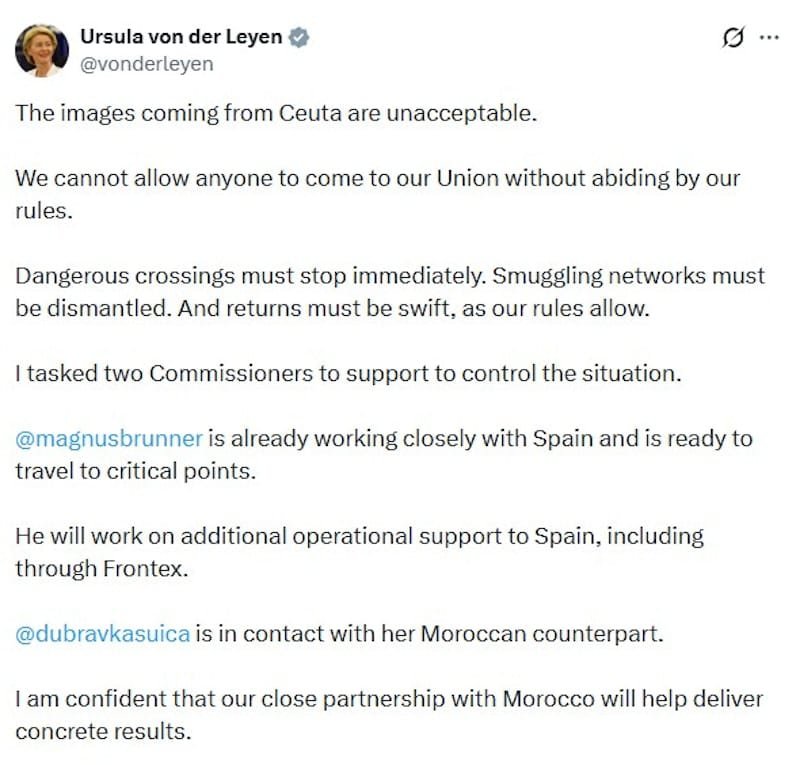
The situation has also triggered concern at the European level. European Commission President Ursula von der Leyen said dangerous crossings must stop immediately.
Von der Leyen said the EU’s Commissioner for Internal Affairs and Migration, Magnus Brunner, was working with Spain, while Commissioner for the Mediterranean and Demography Dubravka Šuica was in contact with Moroccan authorities.
The scale of the incident has also caused political divisions in Europe, with Italy threatening to suspend Spain from the European Union’s internal open-border scheme.
Why Ceuta is strategically important
Ceuta is a Spanish-held territory extending into the Mediterranean from Morocco. Along with Melilla, it represents the European Union’s only land borders with Africa.
Both Spanish autonomous cities periodically experience attempts by migrants to cross into European territory. Each is home to around 85,000 people, making the reported scale of the latest movement particularly significant for Ceuta.
The latest surge involved attempts to cross by both land and sea, with people seeking routes around the border fence and others trying to reach the enclave by water.
What happens next at the Ceuta border
Spain’s immediate priorities are border security, establishing the verified number of arrivals and deaths, and determining how migrants can be returned in accordance with Spanish and European law. Madrid is also seeking cooperation from Morocco to facilitate repatriations.
At the same time, the Spanish government faces pressure from opposition parties over migration policy and from European partners concerned about the wider implications of the crisis.
The conflicting estimates released during the fast-moving situation mean the final scale of Thursday’s crossing will depend on official figures from Spain’s Interior Ministry. For now, the episode represents a major challenge for Ceuta, Spain’s migration policy and relations with Morocco.
Source: Reuters

Praveen Yadav is the Founder and Editor at The Nation Bulletin. With over 3 years of experience in digital journalism and news reporting, he covers national affairs, governance, and breaking current events with a commitment to factual accuracy and verified reporting.