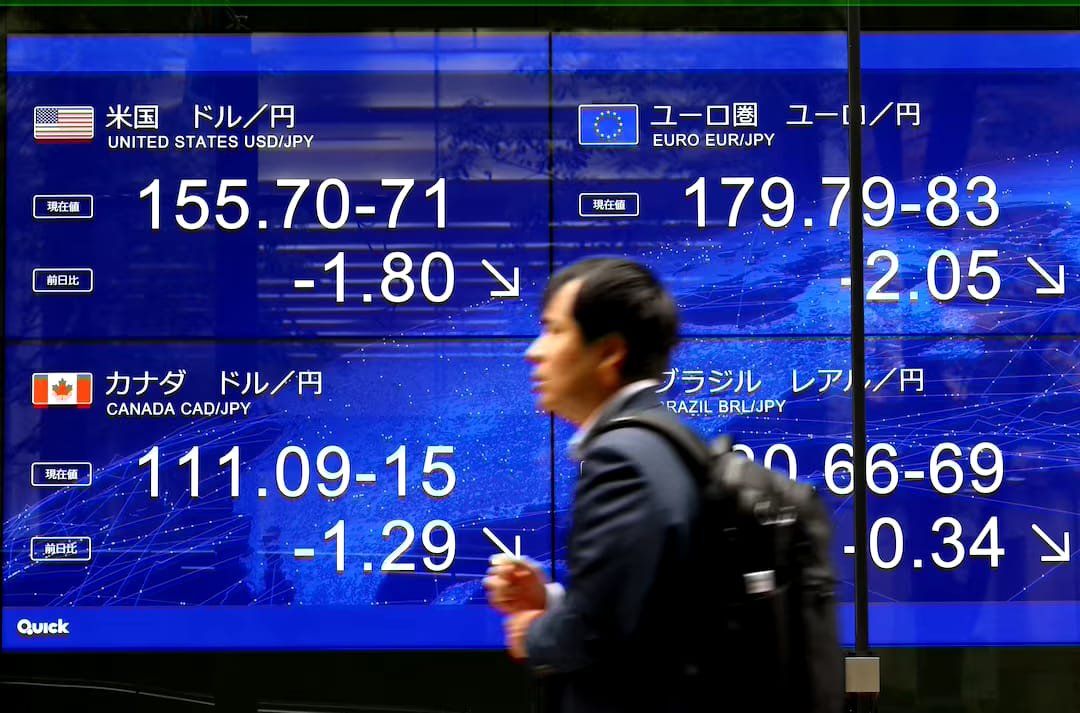
TOKYO, Japan — Japanese business executives are calling for greater stability in currency markets as a persistently weak yen raises import costs and makes earnings forecasts and investment decisions more difficult. Their concerns highlight the growing pressure on Japan’s import-dependent economy even as some exporters and companies with overseas earnings benefit from the weaker currency.
- Japanese executives are warning that yen volatility is complicating business planning.
- The yen recently fell to nearly 164 per U.S. dollar, its weakest level in 40 years.
- Higher energy, food and material costs are adding pressure to domestic demand.
- Business leaders say excessive currency volatility is making investment and earnings forecasts harder to manage.
Weak yen raises pressure on Japanese companies
The yen’s prolonged weakness has become an increasing concern for Japanese businesses that rely heavily on imported raw materials. While a cheaper currency can improve the competitiveness of exporters and increase the value of overseas earnings, it also raises the domestic cost of imported goods.
Kenichiro Fujimoto, chief financial officer of Mitsubishi Electric, told Reuters that economic problems affecting Japan also affect companies. He cautioned that a weak yen should not automatically be viewed as a sign of economic strength.
“A weak yen does not necessarily mean all is well.”
Higher prices for energy, materials and food can weigh on household and domestic demand, potentially complicating Japan’s efforts to move away from decades of deflation.
Executives seek calmer currency markets
Japanese corporate leaders are also concerned about rapid exchange-rate movements rather than simply the yen’s absolute value. Sharp fluctuations can alter earnings assumptions and make it harder for companies with international operations to determine future investment plans.
Makoto Tanaka, CFO of Mitsui & Co, said market stability was a priority. The trading house reported record first-quarter earnings, helped by the weaker yen increasing the value of overseas income.
“More than anything I’d like the market to stabilise and volatility to come down.”
The comments underline the complicated impact of currency movements on major Japanese companies: the same weak yen that can strengthen overseas earnings can simultaneously increase costs and uncertainty at home.
Import costs challenge the traditional weak-yen benefit
Norihiko Ishiguro, chairman of the Japan External Trade Organization, said Japanese companies import almost all of their raw materials. As a result, the benefits of a weaker yen for exports can eventually be offset by higher input costs.
“At a certain exchange rate costs actually increase, so we can’t say exporters always win from a weak yen.”
This dynamic has become particularly important as Japan faces higher costs for essential imports. Businesses that depend on overseas supplies can experience rising expenses even when their international sales become more valuable in yen terms.
Companies reconsider currency assumptions
Currency volatility is also forcing companies to reassess the exchange rates used in their financial planning. Yoshihiro Shimazu, CFO of Mitsubishi Corp, said the company would revise its current assumption of 150 yen to the dollar if necessary because of the high level of volatility.
The need to repeatedly adjust assumptions can complicate decisions involving capital expenditure, overseas operations and earnings expectations. For companies operating across multiple markets, unpredictable exchange rates can make longer-term planning particularly difficult.
Yen hits 40-year low
The yen fell to almost 164 per U.S. dollar in July, marking a 40-year low. The move prompted a joint Japan-U.S. currency intervention that subsequently lifted the Japanese currency by around 5%.
The intervention highlighted the concern surrounding excessive yen weakness and its broader economic consequences. Japanese officials and businesses are now watching whether the currency can maintain a more stable trajectory.
Businesses question return to stronger yen levels
A Japan External Trade Organization survey published in March found that 120 to 124 yen per dollar was the most desirable exchange-rate range among the companies surveyed, with nearly one-fifth selecting that range. Only 11% preferred an exchange rate above 150 yen per dollar.
However, some executives are becoming less confident that the yen will return to those stronger levels. Fujimoto said Japan’s economic fundamentals and the lack of recovery in the trade balance could make a return to 120 to 130 yen per dollar less likely.
For Japanese companies, the debate is therefore shifting beyond whether the yen is simply strong or weak. The focus is increasingly on achieving a more predictable currency environment that allows businesses to manage costs, earnings expectations and investment decisions with greater certainty.

Praveen Yadav is the Founder and Editor at The Nation Bulletin. With over 3 years of experience in digital journalism and news reporting, he covers national affairs, governance, and breaking current events with a commitment to factual accuracy and verified reporting.