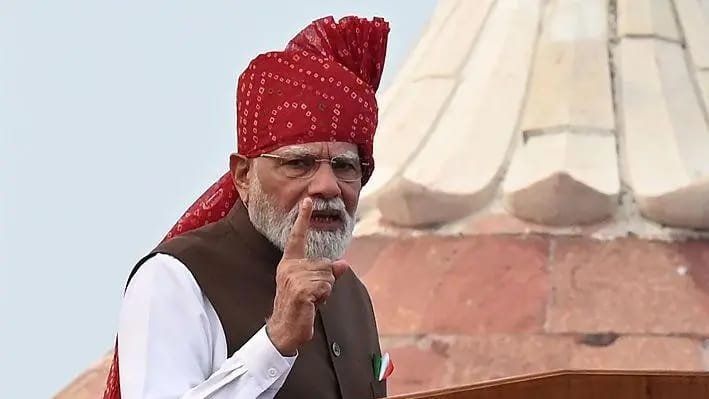
NEW DELHI, India — Prime Minister Narendra Modi used his Independence Day address from the Red Fort to place young Indians at the centre of his vision for a developed India, announcing free online coaching for competitive examinations and AI training for one crore youngsters. However, his nearly 75-minute speech did not directly mention the recent youth protests over paper leaks, recruitment irregularities or the Gen-Z-led demonstrations that had drawn attention across the country.
- Major youth announcements: The government will develop a national network of free online coaching for competitive examinations.
- AI training plan: One crore young Indians are to receive AI-skills training over the next year.
- No direct reference to protests: Recent demonstrations over examination and recruitment issues were not directly mentioned in the address.
- ‘Dimaagi Naxal’ remark: PM Modi used the term while discussing what he described as a continuing ideological challenge after the decline of armed Naxalism.
PM Modi’s Focus on India’s Youth
Prime Minister Narendra Modi devoted significant attention to young Indians during his Independence Day speech, repeatedly presenting them as both the driving force and the biggest beneficiaries of the country’s development ambitions.
He said that young people would have a major role in India’s journey towards becoming a developed nation and argued that national development goals needed to be closely connected with the aspirations of the country’s youth.
One of the key announcements concerned the growing pressure on families to send students to coaching centres for competitive examinations. The Prime Minister said the rising cost of coaching had become a burden, particularly for poor and middle-class families.
To address this issue, he announced plans for a broad national network of free online coaching. The initiative is expected to use India’s digital public infrastructure, teachers and existing resources to provide students with access to preparation material without requiring them to leave their families for coaching.
One Crore Youths to Receive AI Training
Artificial intelligence was another major part of the Prime Minister’s message to young Indians. He announced that one crore youngsters would receive AI-skills training over the coming year.
The stated objective is to equip India’s youth to play a leading role in the rapidly expanding AI sector. PM Modi also pointed to the country’s startup ecosystem, saying the number of registered startups had crossed 2.5 lakh.
The announcement places AI skills alongside traditional education and competitive examination preparation as an important part of the government’s broader youth-focused agenda.
Why Were Recent Exam Protests Not Directly Mentioned?
Despite the emphasis on young people, the speech did not directly refer to the recent protests surrounding examination paper leaks and alleged irregularities in recruitment processes.
According to the supplied report, thousands of young people had taken to social media and the streets to express concerns about the fairness of examination and recruitment systems. Their argument was broader than an individual examination: years of preparation and significant family expenditure could be undermined when questions were raised about the integrity of recruitment procedures.
The recent protests also attracted attention because of the participation of India’s Gen-Z population. A generation often described as politically disengaged had become increasingly vocal about questions involving education, employment and its future.
A July 2026 protest at Delhi’s Jantar Mantar over a paper-leak issue also received considerable attention. However, neither that demonstration nor the Gen-Z movement was directly named in the Independence Day address.
Political Analysts See a Strategic Omission
Author, journalist and political analyst Nilanjan Mukhopadhyay described the absence of a direct discussion on these issues as a possible strategic omission.
According to Mukhopadhyay, the announcements on free coaching, AI training and youth participation in the census address some of the visible symptoms of the concerns facing young people, but do not directly address questions surrounding administrative failures, examination integrity and alleged paper-leak networks.
He also argued that the recent youth movement was not limited to examinations or paper leaks. In his assessment, it reflected wider concerns about what the future holds in a country where secure employment and certainty around educational qualifications remain major concerns for young people and their families.
Was There an Indirect Message to Gen-Z?
Senior journalist and political analyst Sharad Gupta offered a different interpretation of the Prime Minister’s language. He said political speeches by PM Modi often communicate certain messages indirectly rather than through explicit references.
According to Gupta, the repeated use of the word “youth” could be viewed as an indirect reference to the younger generation without explicitly naming the Gen-Z protests.
He also pointed to the wider political effort to communicate with younger audiences, arguing that the absence of the term “Gen-Z” itself did not necessarily mean that the concerns of that generation were completely outside the government’s political messaging.
Mukhopadhyay, however, argued that political vocabulary around young people’s movements had evolved rapidly in recent months, while the language used by the Prime Minister had not changed to the same extent.
What Did PM Modi Mean by ‘Dimaagi Naxal’?
Another part of the Independence Day speech that attracted attention was the Prime Minister’s use of the term “dimaagi Naxal”. While discussing the government’s fight against armed Naxalism, PM Modi said that armed Naxalism had been pushed back but warned about what he described as an ideological form of Naxalism seeking opportunities to promote violence and disorder.
He called for such people to be identified and isolated and linked the issue to the need to bring India’s younger generation into the mainstream of the country’s development.
Sharad Gupta compared the expression with terms such as “urban Naxal” and “andolanjeevi” that have previously featured in political discourse. His interpretation was that the phrase could potentially be applied to people involved in opposition movements or protests.
Nilanjan Mukhopadhyay also questioned how broadly the expression could eventually be interpreted, suggesting that its political meaning could extend beyond the specific context in which it was used.
Free Coaching as the Government’s Youth Message
The free coaching announcement was presented as an attempt to reduce the financial pressure associated with competitive examinations. PM Modi specifically highlighted the burden placed on middle-class families by the growing culture of coaching.
Sharad Gupta argued that unemployment and the wider employment crisis cannot be resolved overnight. In his view, announcements such as free coaching provide a more immediate policy response to young people’s concerns than addressing the much larger structural problem of employment.
The supplied report also referred to an Economic and Political Weekly article that interpreted the free-coaching announcement as an attempt to respond to anger among young people and their families following recent protests and alleged police action.
Youth, Employment and the Question of Trust
The debate surrounding the speech goes beyond the individual announcements. The recent protests had raised a question of trust between young people and institutions responsible for conducting examinations and recruitment.
For students preparing for competitive examinations, the issue is not limited to the cost of coaching. The integrity of the examination process can determine whether years of preparation translate into a genuine opportunity for employment.
That is why the absence of a direct reference to examination and recruitment controversies became significant for the analysts quoted in the supplied report. While the Prime Minister offered new opportunities in coaching and AI skills, the speech did not directly address the grievances that had brought young protesters onto the streets.
FAQ
What youth schemes did PM Modi announce on Independence Day 2026?
PM Modi announced a national network of free online coaching for competitive examinations and said that one crore young Indians would receive AI-skills training over the next year.
Did PM Modi mention the Gen-Z protests in his Red Fort speech?
No direct reference to the Gen-Z movement or the recent examination and recruitment protests was made in the speech, according to the supplied report. The Prime Minister instead spoke about youth in broader terms and announced initiatives related to coaching, AI and the census.
What Happens Next?
The Independence Day address has placed youth skills, AI training and access to competitive-examination preparation prominently within the government’s development narrative. At the same time, the questions raised by recent examination and recruitment protests remain an important part of the broader discussion about opportunities, institutional trust and the future expectations of young Indians.
For the government, the challenge outlined by the debate around the speech is therefore wider than providing coaching or technical training. The concerns expressed by young protesters also involve confidence in the systems through which education and employment opportunities are distributed.

Praveen Yadav is the Founder and Editor at The Nation Bulletin. With over 3 years of experience in digital journalism and news reporting, he covers national affairs, governance, and breaking current events with a commitment to factual accuracy and verified reporting.


