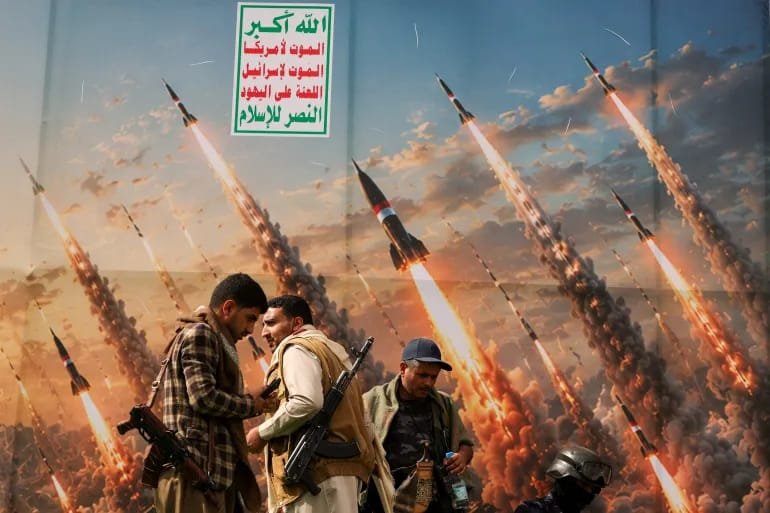
Missile and drone attacks launched by Yemen’s Houthi movement against government military positions have significantly escalated tensions in the country, raising concerns that the years-long conflict could enter a new and more violent phase. The strikes, which targeted military camps in Hadramout and Marib on Thursday, left at least 30 government soldiers dead and 15 others injured, according to reports cited by Al Jazeera.
The attacks marked the first major Houthi strikes against government military positions inside Yemen in several years and have renewed fears that the fragile period of relative calm following the 2022 United Nations-sponsored truce may be coming to an end.
Houthis Claim Large-Scale Military Strike
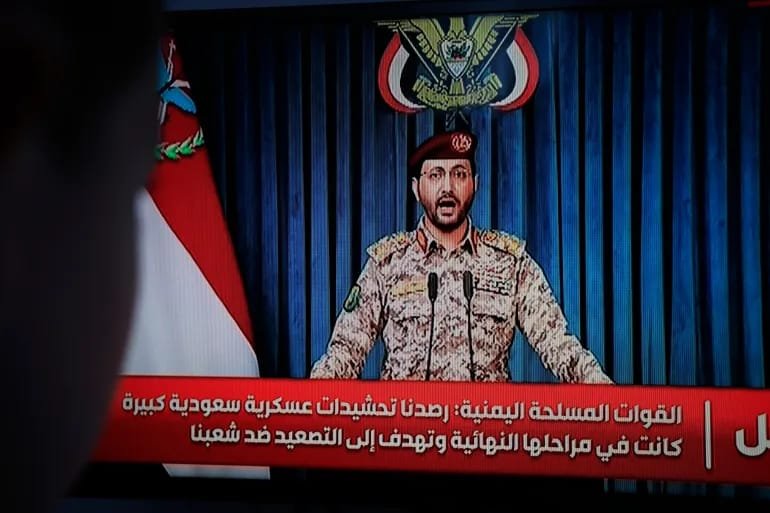
Houthi military spokesperson Yahya Saree said the attacks were carried out after the group detected what he described as a large Saudi military mobilisation aimed at escalating the conflict. In a televised statement, Saree claimed the operation killed “hundreds” of government troops and destroyed numerous military camps and weapons depots. Those claims have not been independently verified.
The Houthis also said they remain on high alert amid expectations that pro-government forces could launch retaliatory operations following Thursday’s attacks.
Conflict Shows Signs of Renewed Escalation
Yemen’s civil war began after the Houthis and their allies seized the capital, Sanaa, in September 2014. A Saudi-led coalition intervened in March 2015 in support of the internationally recognised Yemeni government. While large-scale fighting has eased in recent years, tensions have continued beneath the surface.
According to the report, government forces and allied southern factions have strengthened their positions since the United Arab Emirates reduced its military role in Yemen in 2025. At the same time, the Houthis have expanded their involvement in wider regional tensions linked to the conflict involving the United States, Israel and Iran.
Last month, the group announced a naval blockade targeting Saudi ports and carried out attacks in the strategically important Bab al-Mandeb Strait, adding another dimension to the regional security situation.
Analysts Warn of a Dangerous Turning Point
Several analysts interviewed by Al Jazeera said the latest attacks could represent a decisive shift in Yemen’s conflict, with both sides moving closer to open warfare after years of relative military restraint.
Abdul Rahman Saleh, a resident of Sanaa, said civilians are once again living with the realities of war as explosions return to the capital and casualty reports increase.
“It is no longer a potential threat. It has become a reality. We have repeatedly heard explosions over the past days in Sanaa. We watch the figures of deaths and injuries on the news. Parties boast of their deadly attacks on their media outlets,” Saleh told Al Jazeera.
He said the situation reminded many Yemenis of the period before the 2022 ceasefire, adding that both sides appeared determined to retaliate rather than pursue compromise.
Experts See End of ‘Neither Peace Nor War’
Fuad Mussed, a Yemeni researcher specialising in political and military affairs, said the latest strikes indicate that the Houthi movement has made a strategic decision to pursue broader military confrontation.
“The Houthis’ message is clear: opting for escalation both inside Yemen and beyond,” Mussed told Al Jazeera.
According to Mussed, the group has simultaneously expanded attacks against government forces while continuing operations targeting ships in the Red Sea and sites inside Saudi Arabia. He argued that the prolonged period of “neither peace nor war” that followed the 2022 truce may now be ending.
Ahmed Nagi, a senior analyst at the International Crisis Group, said there remains a possibility that both sides could return to a policy of containment. However, he warned that each new military escalation makes de-escalation increasingly difficult.
“Based on what we are seeing today, the indicators pointing toward renewed conflict are stronger than those pointing toward de-escalation,” Nagi told Al Jazeera.
Government Figures Say Peace Prospects Are Fading
Leaders aligned with Yemen’s internationally recognised government said the latest attacks have further weakened hopes for a negotiated settlement. Sheikh Othman Majali, a member of the Saudi-backed Presidential Leadership Council, said lasting peace and stability cannot be achieved while the Houthi movement continues its military campaign.
Speaking to the government-run Yemen TV channel, Majali said confronting the Houthis remained essential to restoring security and rebuilding the country.
Yemeni political commentator Saddam Al-Huraibi also argued that Thursday’s attacks sent a clear signal that military confrontation had become the Houthis’ priority rather than political negotiations.
“Yemenis have been waiting for the Houthis and the Yemeni government to reach a peace deal or implement a peace roadmap for years. Now the Houthis have opened a real war, which shatters all peace prospects,” Al-Huraibi told Al Jazeera.
He claimed the movement had used years of negotiations to strengthen its military capabilities, enabling it to conduct operations not only inside Yemen but also against targets linked to Saudi Arabia and Israel. Al-Huraibi further argued that continued restraint by Saudi Arabia and the Yemeni government could be interpreted by the Houthis as a sign of weakness.
Marib Emerges as the Key Battlefield
Attention is increasingly focused on Marib province, where clashes have intensified in recent days. The energy-rich region, which contains significant oil and gas resources, has long been regarded as one of the most strategically important areas in Yemen’s conflict.
Adel Dashela, a researcher at the Sanaa Center for Strategic Studies, said recent attacks suggest the Houthis may be preparing for a broader offensive aimed at securing control of Marib’s energy infrastructure.
“Based on today’s escalation and the attacks on government camps in Hadramout and Marib, it is evident that the Houthi group is heading toward a major military escalation targeting the oil and gas regions in Marib,” Dashela told Al Jazeera.
He said current developments point towards the possibility of a large-scale ground conflict unless an unexpected diplomatic breakthrough changes the situation.
The Houthi movement also stated that it would not accept what it described as any Saudi military presence inside Yemen, saying it considers itself entitled to respond to actions it believes threaten the country’s sovereignty and security.
Pressure Grows for a Stronger Response
While Dashela said the Houthis currently possess significant missile capabilities, he warned that a full-scale war would likely become far more destructive than previous rounds of fighting, with heavy losses expected on all sides.
Despite the latest escalation, analysts say Saudi Arabia and the Yemeni government continue to prioritise containment rather than an immediate large-scale military response. Ahmed Nagi of the International Crisis Group said both sides appear to be testing how long that strategy can remain effective while reinforcing military positions and strengthening alliances along frontline areas.
Nagi cautioned that continued Houthi attacks could eventually force a stronger military response, narrowing the opportunities for restraint and increasing the likelihood of renewed large-scale fighting.
Current Outlook
The latest missile and drone attacks have significantly altered Yemen’s security landscape, ending years of relative military calm and increasing fears of a wider conflict. While diplomatic options have not completely disappeared, analysts interviewed by Al Jazeera say continued escalation on both sides is making a return to negotiations increasingly difficult. With Marib emerging once again as a strategic flashpoint and military activity intensifying across multiple fronts, the risk of a broader phase in Yemen’s long-running war appears to be growing.

Praveen Yadav is the Founder and Editor at The Nation Bulletin. With over 3 years of experience in digital journalism and news reporting, he covers national affairs, governance, and breaking current events with a commitment to factual accuracy and verified reporting.