MECCA, Saudi Arabia — Saudi Arabia, Turkey and Pakistan signed a joint defence agreement in Mecca on August 7, 2026, committing to treat an armed attack on any one of the three countries as an attack on all. The pact comes as escalating conflict across the Middle East has increased security concerns for Gulf states and raised questions over the reliability of existing regional security arrangements.
- Mutual defence: An armed attack on any one of the three signatories will be regarded as an attack on all.
- Defence commitments unclear: The joint statement did not specify what military obligations each country would undertake in the event of an attack.
- Nearly a year of negotiations: The agreement follows negotiations that had been underway for almost a year, according to Reuters reporting in January.
- Three major Muslim powers: The pact brings together Turkey, Saudi Arabia and Pakistan, which have significant military, economic and strategic influence.
What the Mecca Joint Defence Agreement says
The agreement, formally described as the Mecca Joint Defence Agreement, is intended to strengthen collective deterrence against acts of aggression. Its central provision states that an armed attack against any of the three countries would be regarded as an attack against all three.
However, the joint statement stopped short of explaining how the provision would operate in practice. It did not outline specific military commitments or clarify what actions the signatories would be required to take if one member came under attack.
That ambiguity leaves the precise scope of the mutual defence arrangement unclear. The agreement establishes a shared security principle, but the supplied statement does not specify whether an attack would automatically trigger a particular military response from the other two countries.
Turkey says pact is defensive
Turkish Vice President Cevdet Yilmaz said the agreement was not directed against any particular country. A Turkish official also described the arrangement as purely defensive and said it did not cancel or replace existing agreements that the three countries have with other states.
The clarification comes as regional tensions have intensified and Saudi Arabia faces heightened security concerns. The agreement therefore carries both a defence dimension and significant political symbolism for the three governments.
Saudi Arabia rejects idea of a military axis
Saudi deputy minister for public diplomacy Rayed Krimly said the agreement should not be interpreted as an attempt to create a military axis or a sectarian bloc.
Krimly also said the accord was not connected to nuclear ambitions or an arms race. His comments sought to distinguish the agreement from the creation of a broader military grouping based on religious or nuclear considerations.
Why the agreement carries wider regional significance
The pact brings together three countries with different but substantial strategic capabilities. Turkey has NATO’s second-largest military, Saudi Arabia is home to Islam’s holiest sites and is among the world’s leading oil exporters, while Pakistan is the only nuclear-armed Muslim country.
Abdulaziz Sager, chairman of the Saudi-based Gulf Research Center, described the meeting as a sign that influential Muslim and regional powers are becoming more willing to coordinate on security issues during a period of heightened uncertainty.
“Three of the Muslim world’s most influential states are convening at a moment of heightened uncertainty, demonstrating a growing willingness among regional and middle powers to coordinate more closely on security matters,” said Abdulaziz Sager.
Sager said the trilateral framework could increase the countries’ combined diplomatic and defence weight and contribute to the development of a security architecture driven more by regional powers.
Saudi Arabia’s security concerns
For Saudi Arabia, the agreement comes against the backdrop of prolonged instability across the Middle East. The supplied material says the conflict has put pressure on the kingdom’s oil exports and ambitious development plans while raising questions about the dependability of its longstanding security relationship with the United States.
The agreement also follows concerns over attacks affecting Gulf states and energy routes. Saudi Arabia has announced a maritime defence coalition aimed at protecting regional shipping and energy routes, with both Pakistan and Turkey expressing support for the initiative.
Pakistan’s longstanding military relationship with Saudi Arabia
The new agreement builds on military cooperation that has existed between Saudi Arabia and Pakistan for decades. Pakistan has provided training and technical assistance to Saudi forces, while its military has previously deployed personnel and equipment to the kingdom.
The supplied report says Pakistan has deployed about 8,000 troops, fighter jets, drones and an air-defence system to Saudi Arabia. Pakistan has also opened negotiations with Kuwait on providing security in exchange for energy cooperation and investment.
Despite its close defence relationship with Riyadh, Pakistan did not respond militarily to the attacks on Saudi Arabia mentioned in the supplied material. Islamabad has also played down suggestions that its nuclear deterrent could be extended to allies. Last year, it described atomic weapons as “not on the radar” in relation to its pact with Saudi Arabia.
Turkey and Pakistan deepen defence cooperation
Turkey and Pakistan already have established military links, including exchanges involving warships and training aircraft. Saudi Arabia is also a major purchaser of Turkish drones, giving the three countries an existing foundation for defence cooperation beyond the new agreement.
The latest pact therefore does not emerge in isolation. It formalises a broader pattern of military and security relationships among the three countries while adding a collective-defence provision to their cooperation.
Regional conflicts add pressure to security arrangements
The agreement was signed amid a period of severe instability in the Middle East. The supplied material describes nearly three years of conflict following the October 7, 2023 Hamas attack on Israel, with Israel subsequently waging war in Gaza, invading southern Lebanon and seizing territory in Syria.
The report also says Israel has conducted two air campaigns against Iran, while Tehran has fired on Saudi Arabia, Kuwait, Bahrain, Qatar, the United Arab Emirates, Oman, Jordan and Israel.
Against that backdrop, Saudi Arabia has faced direct security and economic concerns, while Turkey and Pakistan, despite being on the fringes of the Middle East, have sought to avoid significant direct attacks and remain concerned about conflicts that could affect their own security and economies.
Agreement follows months of negotiations
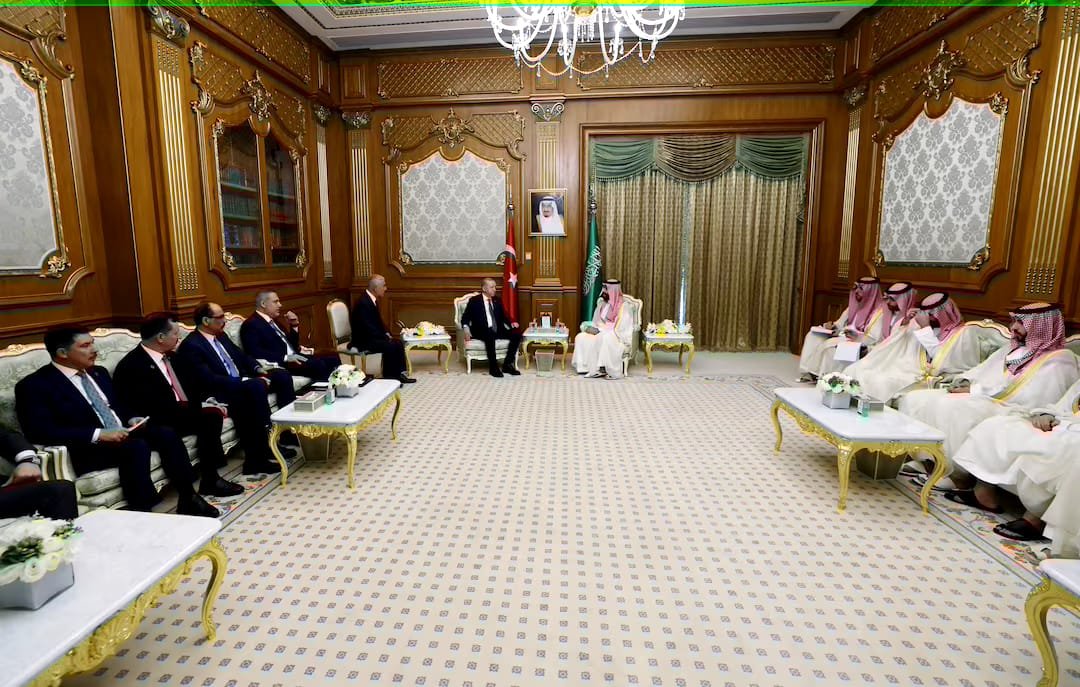
The defence agreement follows nearly a year of negotiations, according to Reuters reporting from January. It was signed in Mecca by Saudi Crown Prince Mohammed bin Salman, Turkish President Tayyip Erdogan and Pakistani Prime Minister Shehbaz Sharif.
The timing gives the agreement additional significance because it brings together the leaders of three strategically important Muslim-majority countries at a moment when regional security arrangements are under intense pressure.
How analysts view the pact
Burcu Ozcelik, senior research fellow for Middle East Security at the RUSI think tank, said the agreement was focused on counterbalancing Iranian influence in the region and strengthening deterrence against Israel rather than preparing for direct confrontation with Tehran.
“I think the objective is very much the opposite,” Ozcelik said.
Her assessment presents the agreement as an effort to strengthen deterrence and regional security rather than an immediate move toward military confrontation with Iran.
International reactions
Israeli Prime Minister Benjamin Netanyahu’s office declined to comment on the agreement, according to the supplied report.
India’s Foreign Ministry said the country was closely following the development. Iran had not immediately commented on the agreement at the time of the report.
Key facts about the three-country defence pact
| Country | Role in the agreement | Key detail from the supplied report |
|---|---|---|
| Saudi Arabia | Signatory | Major oil exporter and host of Islam’s holiest sites |
| Turkey | Signatory | Has NATO’s second-largest military |
| Pakistan | Signatory | Only nuclear-armed Muslim country |
What happens next?
The immediate significance of the agreement will depend on how its mutual-defence provision is interpreted and implemented. The joint statement establishes that an armed attack against one signatory would be treated as an attack against all three, but it does not specify the military response expected from the other members.
For now, the agreement strengthens the formal security relationship among Saudi Arabia, Turkey and Pakistan while leaving the practical details of their defence obligations unspecified. Its political impact will also depend on how the three countries balance the new framework with their existing agreements and wider regional relationships.
Frequently Asked Questions
What is the Mecca Joint Defence Agreement?
The Mecca Joint Defence Agreement is a defence pact signed by Saudi Arabia, Turkey and Pakistan on August 7, 2026. It states that an armed attack against any one of the three countries will be regarded as an attack against all.
Does the agreement specify an automatic military response?
No. The supplied joint statement does not specify the military obligations of each country or clarify what particular action would be required if one signatory were attacked.
Source Attribution
This article is based solely on the Reuters material supplied for publication, including reporting by Timour Azhari, Ariba Shahid, Tuvan Gumrukcu and Samia Nakhoul, with additional reporting by Daren Butler, Maha El-Dahan, Ramy Ayyub, Menna Alaa El Din and Saurabh Sharma; writing by Angus McDowall and editing by Sharon Singleton.
Editorial note: The article has been independently structured and written from the supplied source material. No additional facts, statistics, statements or events have been introduced.

Praveen Yadav is the Founder and Editor at The Nation Bulletin. With over 3 years of experience in digital journalism and news reporting, he covers national affairs, governance, and breaking current events with a commitment to factual accuracy and verified reporting.