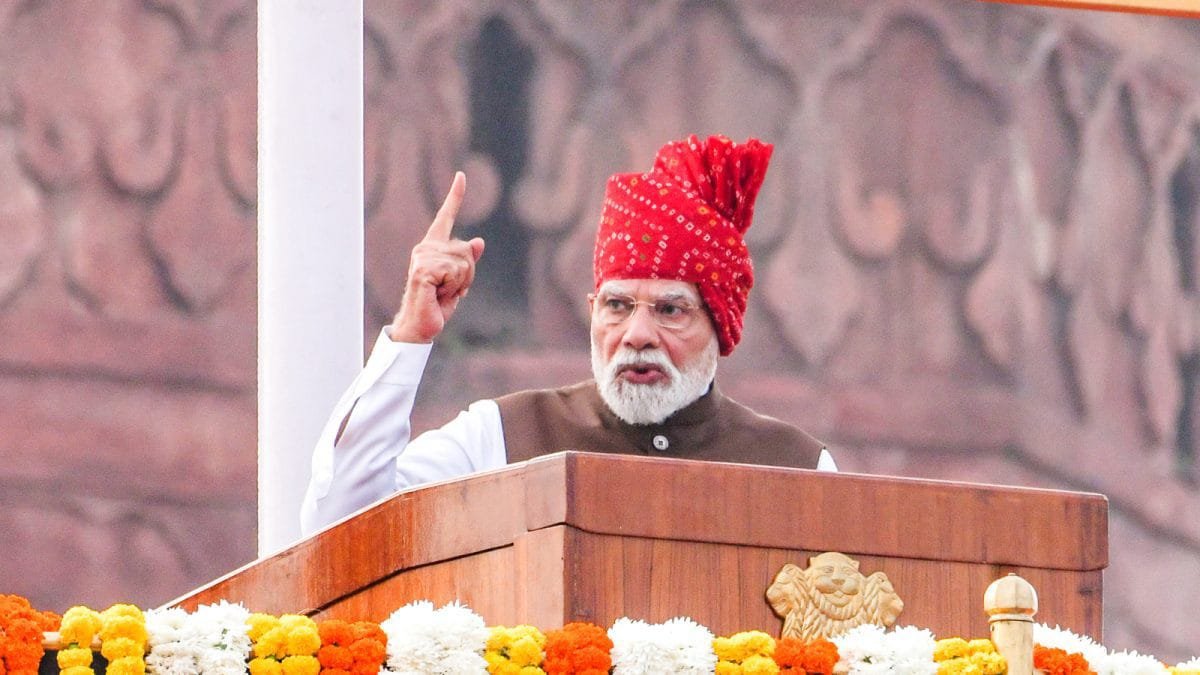
NEW DELHI, India — Prime Minister Narendra Modi used his 80th Independence Day address from the Red Fort on Saturday to present an ambitious roadmap for building a Viksit Bharat by 2047, calling for a fundamental shift in India’s work culture, pace of development, economic ambition and approach to reforms.
Addressing the nation, PM Modi said India could no longer afford limited ambitions and urged citizens, governments, businesses, farmers, workers, women and young people to contribute to a national development effort. He said the next five to seven years would be particularly important for completing work that had remained unfinished for decades.
- Sapt Dhara: PM Modi outlined seven development streams covering manufacturing, agriculture, technology, connectivity, defence, the green and blue economy, and soft power.
- AI skills: The Prime Minister announced a plan to train one crore young Indians in artificial intelligence skills over the next year.
- Reform push: He called for faster reforms across governments, industry, agriculture and society as India moves towards its 2047 target.
- Global ambitions: PM Modi called for Indian companies, technology firms, banks and other institutions to achieve greater international prominence.
PM Modi calls for bigger ambitions for Viksit Bharat 2047
The central message of the address was that India’s development ambitions must match the scale of the country’s potential. PM Modi said the nation needed to change not only the speed at which it works but also the way it thinks about development and national capability.
He said tasks that had remained incomplete for five to seven decades would need to be addressed during the next five to seven years. The Prime Minister expressed confidence in India’s youth, women, farmers and workers, describing them as critical contributors to the country’s next phase of development.
The 2047 target, which coincides with the centenary of India’s independence, was presented as a collective national objective rather than a responsibility limited to the Union government.
Sapt Dhara becomes framework for India’s next leap
A major feature of the Independence Day address was the introduction of Sapt Dhara, described by PM Modi as seven streams of strength that can drive India’s next phase of development.
The seven areas are manufacturing, agriculture and food production, technology and innovation, Gati Shakti, defence, the green and blue economy, and India’s soft power.
The Prime Minister placed manufacturing at the beginning of the framework and called for India to develop complete value chains, covering components, design, production and finished goods. He said Indian industry must become competitive on cost, quality and scale while developing a reputation for precision and reliability.
He also urged manufacturers and MSMEs to focus on user-friendly products, attractive packaging and international standards. The broader objective, he said, should be to make India a trusted destination within global supply chains.
Agriculture must move from farms to global markets
Agriculture and food production formed the second stream of Sapt Dhara. PM Modi called for a stronger connection between Indian farms and international markets, with greater emphasis on processing, branding and exports.
He identified millets, spices, fruits, flowers and traditional Indian foods as products with the potential to develop global brands. The Prime Minister also stressed chemical-free farming and the importance of meeting international quality requirements.
His emphasis on exports reflects the broader argument that Indian farmers should benefit from expanding international market access and that agricultural production should increasingly be connected with value addition and global demand.
Technology and innovation at the heart of the roadmap
Technology and innovation were identified as the third stream. PM Modi said the emergence of artificial intelligence, quantum technology, robotics, space technology and data centres had created a new technological landscape for India.
He argued that India should not limit itself to becoming a large consumer market for technologies developed elsewhere. Instead, the country should build its own innovation ecosystem and take Indian digital technologies to international markets.
The Prime Minister also set an aspiration for Made-in-India 6G technology to reach users across the world. India’s experience with digital public infrastructure was highlighted as an example of technology developed at scale.
One crore youth to receive AI skills training
Young Indians were placed at the centre of the technology agenda through a major announcement from the Red Fort. PM Modi said the government would train one crore young people in AI skills over the next year.
The initiative was presented as a way of preparing India’s youth for a rapidly changing global economy in which artificial intelligence is expected to influence a wide range of industries and professions.
PM Modi also pointed to India’s startup ecosystem, noting that the country has more than 2.5 lakh registered startups. He highlighted the ₹1 lakh crore Innovation Fund along with initiatives involving skills, drones and the space sector.
Gati Shakti to strengthen India’s connectivity network
Gati Shakti, the fourth stream, focuses on building faster and more seamless connectivity across the country. PM Modi referred to high-speed rail, highways, inland waterways, airports and multimodal logistics as components of this approach.
He also called for a broader understanding of the role played by ports. Rather than treating ports simply as points for loading and unloading cargo, he said they should become engines of economic activity and port-led development.
The emphasis on integrated connectivity is closely linked to the wider goal of making Indian manufacturing and exports more competitive by improving the movement of goods and reducing logistical barriers.
Defence self-reliance becomes a strategic priority
Defence self-reliance was the fifth stream in the Prime Minister’s framework. PM Modi said India needed to move beyond being a defence market and develop the capability to emerge as a global supplier.
He called for greater domestic capability in next-generation defence technologies, including drones, counter-drone systems and hypersonic technologies. Cybersecurity was also identified as an important area where Indian youth could contribute to national capabilities.
PM Modi said India’s defence exports had increased substantially and that Indian weapons were reaching around 100 countries. The broader message was that domestic defence production should combine national security requirements with an expanding international presence.
Green and blue economy seen as new sources of growth
The sixth stream combines the green and blue economies. PM Modi called for India to develop global-scale capabilities in green hydrogen, renewable energy, energy storage, green mobility and green manufacturing.
He also highlighted opportunities linked to India’s long coastline, particularly fisheries, coastal tourism and ocean technology. According to the Prime Minister, the blue economy could create both economic opportunities and employment while expanding India’s ability to respond to global challenges.
The green economy, meanwhile, was presented not only as an environmental priority but also as a potential source of new industries, technologies and jobs.
India’s soft power gets a wider economic role
The seventh stream is India’s soft power. PM Modi identified yoga, Ayurveda, holistic healthcare and the Heal in India initiative as areas through which India could strengthen its international presence.
He expanded the discussion beyond traditional cultural diplomacy, pointing to handicrafts, films, VFX, animation, gaming and digital content as part of India’s growing creative economy.
Tourism was another part of this strategy. The Prime Minister called for stronger efforts to attract international visitors and suggested that India should position itself as a destination for major sporting events, concerts and other global activities.
PM Modi sets targets for Indian companies to go global
The Prime Minister also challenged Indian businesses and institutions to raise their global ambitions. He asked why India could not have 50 companies among the Fortune 500 within the next decade.
He similarly called for an Indian bank to enter the ranks of the world’s five largest banks and said Indian pharmaceutical companies should aspire to global top-five positions.
Law firms, rating agencies, consulting companies, accounting firms and technology companies were also mentioned as sectors where Indian organisations could seek international leadership.
PM Modi argued that India already possesses talent, capability and linguistic strength, and that these advantages should be converted into a stronger global presence for Indian brands.
‘Reform Express’ to accelerate the development agenda
Reforms were another major theme of the address. PM Modi said India’s policies, regulations and systems must reflect the aspirations of 2047 rather than conditions inherited from an earlier era.
He described reform as a matter of conviction and said the next phase would require changes across the Centre, state governments, industry, society, producers and farmers.
The Prime Minister said the country had already embarked on what he called the “Reform Express” and would move towards another level of reforms. He also stressed that India could not afford to lose momentum after deciding its development direction.
Semiconductors and critical minerals linked to self-reliance
Aatmanirbhar Bharat remained an important part of the economic and technological vision. PM Modi argued that India needed stronger domestic capabilities rather than excessive dependence on foreign sources for strategically important goods and technologies.
Semiconductor manufacturing was cited as a key example. The Prime Minister said three semiconductor plants had begun production and that additional facilities were expected to become operational in the coming years.
Critical minerals were also highlighted as essential for future technologies. PM Modi referred to the National Critical Minerals Mission and the Critical Minerals Corridor as part of efforts to secure supplies required by emerging industries.
100 GW nuclear power target for 2047
Energy security was presented as increasingly important as India expands data centres, artificial intelligence, semiconductor manufacturing and other energy-intensive sectors.
PM Modi said India was targeting 100 GW of nuclear power capacity by 2047 and had set a target of beginning five new nuclear reactors within the decade.
He also highlighted progress in renewable energy, piped gas infrastructure and railway electrification. The Prime Minister pointed to India’s entry into hydrogen-powered rail transport as another example of the country’s technological ambitions.
Solar energy and hydrogen technology highlighted
India’s clean-energy expansion was another part of the address. PM Modi highlighted the growth of solar power capacity and the progress of the PM Surya Ghar Muft Bijli Yojana.
According to the Prime Minister, solar systems had been installed in 50 lakh homes under the scheme. He said the expansion of household solar power could reduce electricity costs and create opportunities for households generating surplus electricity.
He also highlighted India’s first hydrogen-powered train, describing it as the longest and most powerful train of its kind. The reference formed part of his broader argument that India should develop and deploy new technologies domestically.
Global crises strengthen the case for self-reliance
PM Modi used the experience of the COVID-19 pandemic, wars and disruptions in global supply chains to reinforce the importance of domestic capabilities.
He said global shocks had demonstrated the vulnerability created by excessive dependence on external sources for critical resources. Fertilisers, medicines, energy and technology were among the areas he identified as requiring greater resilience.
He cited the difference between international and domestic fertiliser prices as an example of the support provided to Indian farmers. The Prime Minister said urea costing around ₹3,000 internationally was being supplied to Indian farmers for ₹300, while DAP costing around ₹5,000 in global markets was being supplied at ₹1,350.
Free online coaching announced for competitive exams
Education and access to opportunities also featured prominently in the address. PM Modi announced a programme to provide free online coaching to young people preparing for competitive examinations.
He said the high cost and pressure associated with coaching had become a concern for middle-class families. The proposed network would bring together India’s digital public infrastructure, teachers and technology to expand access to preparation resources.
The announcement places digital education alongside AI training as part of the government’s broader focus on strengthening the capabilities of young Indians.
Sports talent hunt linked to 2036 Olympic ambition
India’s sporting ambitions were also connected with the long-term development vision. PM Modi said India was moving forward as a strong contender to host the 2036 Olympic Games and would host the Commonwealth Games in 2030.
He announced a nationwide talent identification campaign aimed at children between five and 15 years of age. The campaign would seek promising athletes in villages, cities and schools and provide specialised training to those identified.
The Prime Minister said identifying talent early would be important if India is to build the sporting strength required for future international competition.
Women’s economic participation receives fresh emphasis
Women’s participation in the economy and national development was another prominent element of the speech. PM Modi pointed to women’s growing presence in aviation, fighter aircraft, sports, STEM education, the armed forces and semiconductor manufacturing.
He said the government had exceeded its earlier target of creating three crore Lakhpati Didis and was now working towards a target of six crore Lakhpati Didis.
The Prime Minister also appealed to political parties to move forward with women’s reservation, calling for 33% representation for women in the Lok Sabha and state legislative assemblies at the earliest.
100-week campaign announced for a drug-free India
PM Modi called drug abuse a serious challenge for India’s youth and urged families and communities to participate in the campaign for a Nasha Mukt Bharat.
The 100-week programme involves MY Bharat volunteers, NGOs, social and cultural organisations and spiritual leaders. The Prime Minister described the effort as a collective responsibility rather than an issue that can be addressed by government agencies alone.
PM Modi urges youth to help with Census exercise
The Prime Minister also called on young people to assist their families in participating accurately in the Census exercise.
He said Census information was important for government policy, welfare schemes and long-term national planning. PM Modi urged young people to review the information with family members and use the digital process carefully so that details are recorded accurately.
Mission Sudarshan Chakra and modern civil defence
National security featured prominently as PM Modi discussed the changing nature of warfare. He said modern conflicts could potentially threaten critical infrastructure such as refineries, banks and data centres.
He said work on Mission Sudarshan Chakra was progressing rapidly and argued that India’s civil defence systems needed to be modernised to address contemporary risks.
The Prime Minister announced plans for a large voluntary civil defence force capable of supporting the country during modern emergencies. The proposal was presented as part of a broader effort to strengthen national preparedness.
Naxalism and Maoist violence discussed in security message
PM Modi also spoke about the government’s efforts against Naxalism and Maoist violence. He said areas that had previously faced violence were increasingly seeing development and the presence of the national flag.
He recalled the sacrifices made by security personnel during the years of violence and said the government had maintained a sustained effort since 2014 to eliminate the threat.
At the same time, the Prime Minister warned against what he described as ideological forces capable of promoting violence and anarchy, urging young people to remain connected with the broader development effort.
Social security and healthcare remain part of the development vision
PM Modi said economic progress must reach people at the bottom of the social and economic pyramid. He highlighted the expansion of social security coverage and the role of Ayushman Bharat in providing healthcare support.
He said people above the age of 70 were eligible for healthcare coverage of up to ₹5 lakh under the scheme. According to the Prime Minister, the programme had helped families avoid approximately ₹2 lakh crore in spending on medicines and medical procedures.
The focus on healthcare and social protection was presented alongside economic and technological development as part of a broader vision of inclusive growth.
From Panch Pran to the Viksit Bharat mission
As he concluded the address, PM Modi returned to the themes of national duty, collective responsibility and the Panch Pran. He called for the country to move beyond a mentality shaped by colonial-era thinking while drawing inspiration from the sacrifices and contributions of India’s freedom fighters.
The Prime Minister said national interest should remain above individual interest and urged citizens to translate aspirations into concrete capabilities and results.
His Independence Day address therefore combined economic targets, technological ambitions, social programmes, national security priorities and global aspirations within a single long-term framework. The emphasis throughout was on increasing the pace of implementation while creating the capabilities India would need to compete globally.
What happens next for Viksit Bharat 2047?
The roadmap outlined from the Red Fort places the coming years at the centre of India’s effort to achieve developed-nation status by 2047. Manufacturing, agriculture, technology, connectivity, defence, clean energy and soft power have been identified as interconnected areas requiring sustained progress.
The proposed AI training programme for one crore youth, the push for semiconductor manufacturing, the nuclear energy target, the reform agenda and the expansion of India’s global business ambitions represent some of the most significant elements of the roadmap presented by the Prime Minister.
The broader challenge now lies in converting these announcements and targets into sustained implementation across governments, businesses, institutions and communities. PM Modi’s message from the Red Fort was that India’s next leap would require not only larger ambitions but also faster execution and stronger national capabilities.
What is Sapt Dhara in PM Modi’s Independence Day address?
Sapt Dhara is the seven-stream development framework presented by Prime Minister Narendra Modi. Its areas are manufacturing, agriculture and food production, technology and innovation, Gati Shakti, defence, the green and blue economy, and India’s soft power.
What major AI initiative did PM Modi announce?
PM Modi announced that one crore young Indians would be trained in artificial intelligence skills over the next year. The initiative is intended to strengthen the ability of young people to participate in the emerging global AI ecosystem.
What is India’s nuclear power target for 2047?
The Prime Minister said India is targeting 100 GW of nuclear power capacity by 2047 and plans to begin five new nuclear reactors within the decade.
What did PM Modi say about the 2036 Olympics?
PM Modi said India is moving forward as a strong contender to host the 2036 Olympic Games. He also announced a talent identification campaign for children aged five to 15 to develop future sporting talent.

Praveen Yadav is the Founder and Editor at The Nation Bulletin. With over 3 years of experience in digital journalism and news reporting, he covers national affairs, governance, and breaking current events with a commitment to factual accuracy and verified reporting.