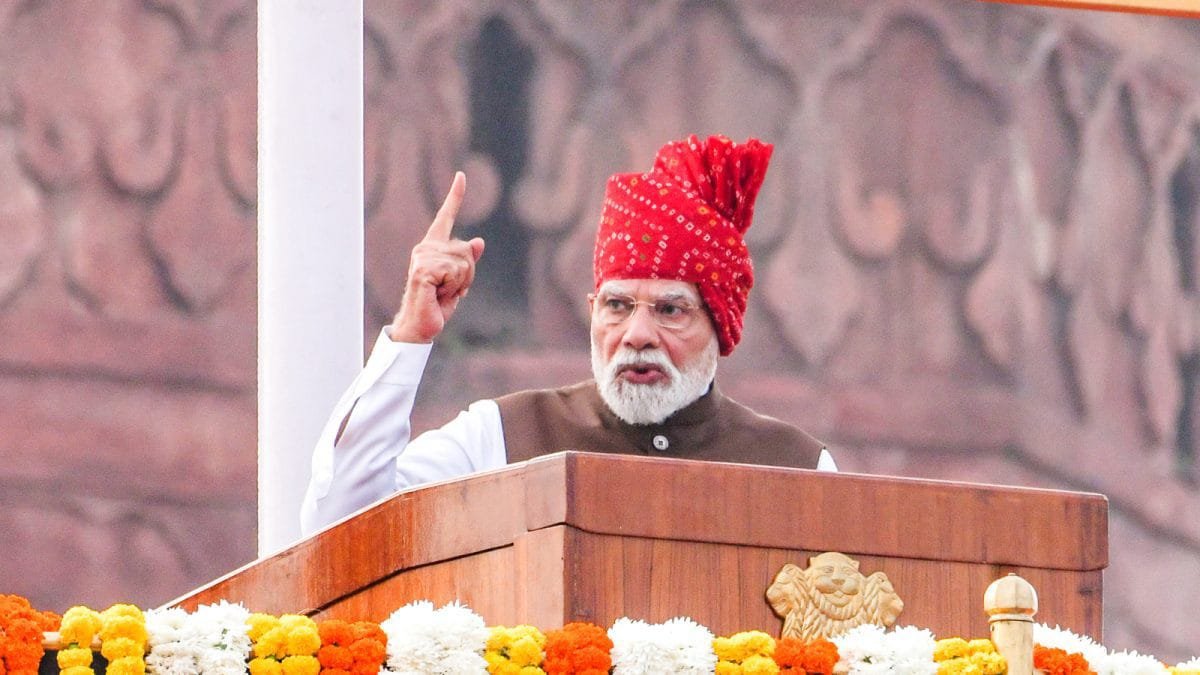
NEW DELHI, India — Prime Minister Narendra Modi, in his 80th Independence Day address from the Red Fort on Saturday, highlighted what he described as a broad transformation of India over the past 12 years, pointing to gains in manufacturing, digital infrastructure, energy, education, healthcare, social security and opportunities for young people.
PM Modi said the expansion of domestic capabilities had strengthened India’s ability to respond to major global disruptions, including the COVID-19 pandemic, geopolitical conflicts and supply-chain pressures. He presented the progress as a foundation for the country’s ambition of becoming a Viksit Bharat by 2047.
- Manufacturing: Defence production rose nearly fourfold, electronics manufacturing nearly sevenfold and mobile phone production 35 times, according to PM Modi.
- Digital economy: Internet users and patents granted increased nearly fourfold, while digital transactions expanded around 100 times.
- Energy: Solar capacity rose from about 2 GW to 160 GW, while piped gas and railway electrification expanded sharply.
- Social development: Social security coverage increased from around 25 crore people before 2014 to approximately 100 crore.
Manufacturing expansion strengthens self-reliance push
Manufacturing formed a major part of the Prime Minister’s assessment of India’s progress. PM Modi said defence production had increased nearly fourfold over the past 12 years, while Khadi and Village Industries production had risen nearly fivefold.
Electronics manufacturing, according to the Prime Minister, expanded nearly sevenfold. Production of modern railway coaches increased 21 times, while mobile phone production grew 35 times.
PM Modi linked these developments with the broader Aatmanirbhar Bharat and Make in India approach, arguing that stronger domestic production was essential for reducing dependence on external sources and building national capabilities.
Digital economy expands alongside innovation
India’s digital transformation was another area highlighted in the Independence Day address. PM Modi said the number of internet users had increased nearly fourfold, creating a much larger digital base for businesses, consumers and young entrepreneurs.
The Prime Minister also said patents granted had increased fourfold and digital transactions had grown around 100 times. He linked the expansion of affordable digital connectivity and infrastructure with new opportunities in entrepreneurship, employment and innovation.
The digital economy was presented as an important part of India’s transition towards a more technology-driven development model, particularly as artificial intelligence, data infrastructure and emerging technologies gain importance.
Basic services delivered at a faster pace
PM Modi also pointed to changes in the pace at which basic amenities were being delivered to households. He said tap-water connections were being provided annually at a rate nearly 15 times faster than before.
The annual pace of LPG connections, according to the Prime Minister, had increased nearly sixfold, while construction of toilets for poor households had accelerated fourfold. The pace of providing pucca houses to poor families had increased threefold.
He also highlighted governance reforms, including the abolition of hundreds of obsolete laws and the expansion of modern public transport and metro networks to additional cities.
Semiconductors become key pillar of technological self-reliance
The development of semiconductor manufacturing was highlighted as a significant change in India’s industrial capabilities. PM Modi said the country previously lacked major semiconductor manufacturing facilities, while three plants have now been initiated and production has started reaching export markets.
Additional semiconductor plants are expected to become operational in the coming years, according to the Prime Minister. The expansion is intended to strengthen India’s role in global technology supply chains and reduce vulnerabilities associated with dependence on imported components.
Critical minerals emerge as strategic priority
PM Modi also underlined the importance of critical minerals for India’s future industrial and technological requirements. He referred to the National Critical Mineral Mission and the Critical Mineral Corridor announced in the Budget.
India has also entered into agreements with several countries to strengthen access to critical mineral resources, he said. Such minerals are increasingly important for advanced technologies and industrial applications, making their availability a strategic consideration for future growth.
Energy security gains greater importance
The Prime Minister said energy security would become increasingly important as India expands artificial intelligence, semiconductor manufacturing and data centres, all of which require substantial electricity.
He highlighted the SHANTI Act as an important development in the nuclear energy sector and said India had crossed a significant milestone in fast breeder nuclear technology. According to PM Modi, this technological capability would support greater self-reliance in nuclear fuel.
India is also targeting 100 GW of nuclear power capacity by 2047 and has set a target of starting five new nuclear reactors within the decade, according to the broader roadmap outlined in the address.
Offshore exploration receives fresh push
PM Modi described a major change in India’s approach to offshore exploration, saying nearly 99% of the country’s offshore area had previously been classified as a “No-Go Area”.
According to the Prime Minister, these areas have now been opened for exploration, shifting the approach from a “No-Go Area” to a “Go-Ahead Area”. He said the move could help India explore and potentially discover new oil and gas reserves.
The initiative was presented as part of a broader effort to strengthen domestic energy resources and reduce vulnerabilities arising from external energy dependence.
Solar capacity rises to 160 GW
India’s energy infrastructure has expanded across several areas, PM Modi said. City gas distribution has grown from fewer than 70 cities in 2014 to around 700 cities, while piped cooking gas connections have increased from roughly 20-22 lakh households to nearly 1.75 crore.
Solar power has recorded an even sharper increase. PM Modi said solar capacity had risen from approximately 2 GW in 2014 to around 160 GW.
He also highlighted the PM Surya Ghar Muft Bijli Yojana, saying solar systems had been installed in 50 lakh households. According to the Prime Minister, participating families can benefit from lower or zero electricity bills and may generate additional income by selling surplus electricity.
Railways advance electrification and hydrogen technology
Railway electrification was cited as another example of accelerated infrastructure development. PM Modi said only around 30% of the railway network had been electrified by 2014 after nearly 90 years of work.
He said India had since moved towards near-complete electrification. The expansion is expected to reduce dependence on diesel while supporting a cleaner railway system.
The Prime Minister also highlighted the development of India’s first Made-in-India hydrogen train, describing it as the longest and most powerful hydrogen-powered train of its kind.
India’s resilience tested by global crises
PM Modi said the capabilities developed over the past decade had been tested by a series of major global disruptions, including the COVID-19 pandemic, the Russia-Ukraine conflict and conflicts in West Asia.
He argued that preparations in areas such as energy, fertilisers and essential supplies had helped India manage the impact of these disruptions. The experience, according to the Prime Minister, reinforced the importance of building domestic capabilities in strategically important sectors.
Fertiliser prices and support for farmers
Fertiliser affordability was cited as one example of government intervention during periods of international price volatility. PM Modi said the international price of a bag of urea had reached around ₹3,000, while Indian farmers were receiving it for less than ₹300.
He similarly said DAP was priced at more than ₹5,000 internationally but was being provided to Indian farmers for ₹1,350. The Prime Minister said such measures were intended to protect farmers from sharp fluctuations in global prices.
Free trade agreements create export opportunities
PM Modi said India had entered into free trade agreements with around 40 countries since 2014, opening additional opportunities for Indian producers and exporters.
He identified agriculture, fisheries, textiles, MSMEs and other sectors as areas that could benefit from greater international market access. Businesses, he said, should use these opportunities while ensuring that Indian products meet global standards for quality, cost and competitiveness.
Youth placed at the centre of India’s development
The Prime Minister described young Indians as central to the Viksit Bharat vision and highlighted initiatives aimed at expanding opportunities in technology, entrepreneurship, skills and innovation.
He referred to Startup India, the ₹1 lakh crore research fund, Digital India, Skill India, the opening of the space sector to private participation, the National Drone Policy and Khelo India.
PM Modi also announced a plan to train one crore young people in artificial intelligence skills over the next year, positioning AI capability as an important component of India’s future workforce.
Higher education and medical education expand
Education infrastructure was another area highlighted by the Prime Minister. He said India had fewer than 350 universities during 2004-2014, while nearly 650 new universities had been added during the subsequent decade.
The number of medical colleges, according to PM Modi, had increased from fewer than 400 before 2014 to around 850. He also highlighted the National Education Policy 2020, introduced after a gap of 35 years.
More than 10,000 Atal Tinkering Labs have also been established, he said, with the aim of encouraging children to develop early interest in technology, innovation and problem-solving.
Startup ecosystem, space and AI create new opportunities
India’s startup ecosystem has expanded significantly, with around 2.5 lakh registered startups, according to PM Modi. He also pointed to the emergence of private space companies and their work involving indigenous rockets and satellites.
Artificial intelligence was described as another emerging area of opportunity. The Prime Minister referred to India’s hosting of the AI Impact Summit and emphasised the need to prepare young people for an economy increasingly shaped by advanced technologies.
Bioeconomy grows from ₹60,000 crore to ₹20 lakh crore
PM Modi highlighted the rapid expansion of India’s bioeconomy. He said its value had increased from approximately ₹60,000 crore in 2014 to nearly ₹20 lakh crore.
The Prime Minister linked this growth with new opportunities in employment, research, entrepreneurship and innovation. The bioeconomy was presented as one of the emerging sectors capable of contributing to India’s broader technology and industrial development.
Electric vehicle sales show rapid growth
Electric mobility was another indicator cited in the address. PM Modi said annual electric vehicle sales had risen from around 1.5 lakh towards the end of the previous decade to approximately 25 lakh in 2025-26.
He connected the expansion of electric mobility with India’s wider shift towards clean energy and green transportation. The growth of EV adoption also forms part of the emerging industrial opportunities associated with the energy transition.
Aviation sector and indigenous aircraft manufacturing
The Prime Minister said India’s aviation sector was generating employment through the expansion of airports and air routes. He also highlighted growth in the aircraft maintenance, repair and overhaul sector.
PM Modi pointed to efforts towards indigenous aircraft manufacturing and said the Made-in-India C-295 defence transport aircraft had successfully completed its flight.
SVAMITVA scheme unlocks rural economic potential
PM Modi highlighted the SVAMITVA scheme as an initiative aimed at strengthening the economic potential of rural property ownership. He said around 3.25 crore families had benefited through property cards.
According to the Prime Minister, these property records had helped unlock economic potential worth around ₹140 lakh crore in rural areas. He said villagers could use documented assets to access bank loans and pursue self-employment and entrepreneurship opportunities.
Defence exports increase more than 50 times
Defence exports were another area where PM Modi cited substantial growth. He said Indian defence exports had increased more than 50 times and that Indian defence equipment was now reaching around 100 countries.
The Prime Minister linked this expansion with the development of domestic manufacturing capabilities and India’s growing role in international defence markets.
Women-led development gains momentum
Women’s economic participation was highlighted as an important component of India’s transformation. PM Modi said the government had achieved its target of creating three crore Lakhpati Didis.
He said women from different social and economic backgrounds, including rural, Dalit, backward and tribal communities, had benefited from the initiative. The Prime Minister described women-led development as an important part of the country’s wider economic transformation.
Social security coverage reaches around 100 crore
PM Modi also highlighted the expansion of social security coverage. According to the Prime Minister, around 25 crore people were covered by social security mechanisms before 2014, while the figure has now increased to approximately 100 crore Indians covered under one or more social security schemes.
He presented the expansion as evidence of a wider social protection system designed to ensure that more sections of the population receive support through government schemes.
Ayushman Bharat provides financial protection
Healthcare was another major component of the social development narrative. PM Modi highlighted Ayushman Bharat and said beneficiary families had avoided an estimated ₹2 lakh crore in medical expenditure through the programme.
The Prime Minister said such support had provided financial protection to poor and middle-class families while strengthening India’s broader social security architecture.
12 years of transformation form foundation for 2047 goal
PM Modi said the changes recorded across manufacturing, digital technology, energy, infrastructure, education, healthcare, social security and youth development had strengthened the foundation for India’s next phase of growth.
The Prime Minister’s assessment linked these developments with the broader Viksit Bharat objective, arguing that the capabilities built during the past 12 years must now support faster progress and more ambitious national targets.
The address therefore placed the emphasis on converting expanded infrastructure, industrial capacity, digital systems and social coverage into sustained economic momentum. PM Modi’s message was that the gains of the past period should become the starting point for a larger development effort aimed at 2047.
What happens next for India’s development roadmap?
The next phase of the Viksit Bharat vision will depend on continued progress across the sectors highlighted by the Prime Minister, including manufacturing, semiconductors, energy, education, digital infrastructure, healthcare and social security.
The government’s focus on domestic capabilities is also expected to remain closely linked with technological development, critical minerals, clean energy and export opportunities. The AI training target for one crore youth adds another dimension to the effort to prepare India’s workforce for emerging industries.
PM Modi’s Independence Day address ultimately presented the transformation of the past 12 years as a platform for the country’s next development leap, with greater self-reliance, innovation and expanded opportunities positioned as key elements of the journey towards Viksit Bharat by 2047.
What areas did PM Modi highlight as evidence of India’s transformation?
PM Modi highlighted manufacturing, digital infrastructure, energy, education, healthcare, social security, defence exports, electric mobility, startups and opportunities for young people as major areas of change.
What did PM Modi say about India’s solar capacity?
According to the Prime Minister, India’s solar energy capacity increased from approximately 2 GW in 2014 to around 160 GW.
How has India’s social security coverage changed?
PM Modi said social security coverage had expanded from around 25 crore people before 2014 to approximately 100 crore Indians covered under one or more social security schemes.
What AI initiative was announced for young Indians?
The Prime Minister announced a programme to train one crore young Indians in AI skills over the next year as part of efforts to prepare the workforce for emerging technologies.

Praveen Yadav is the Founder and Editor at The Nation Bulletin. With over 3 years of experience in digital journalism and news reporting, he covers national affairs, governance, and breaking current events with a commitment to factual accuracy and verified reporting.


