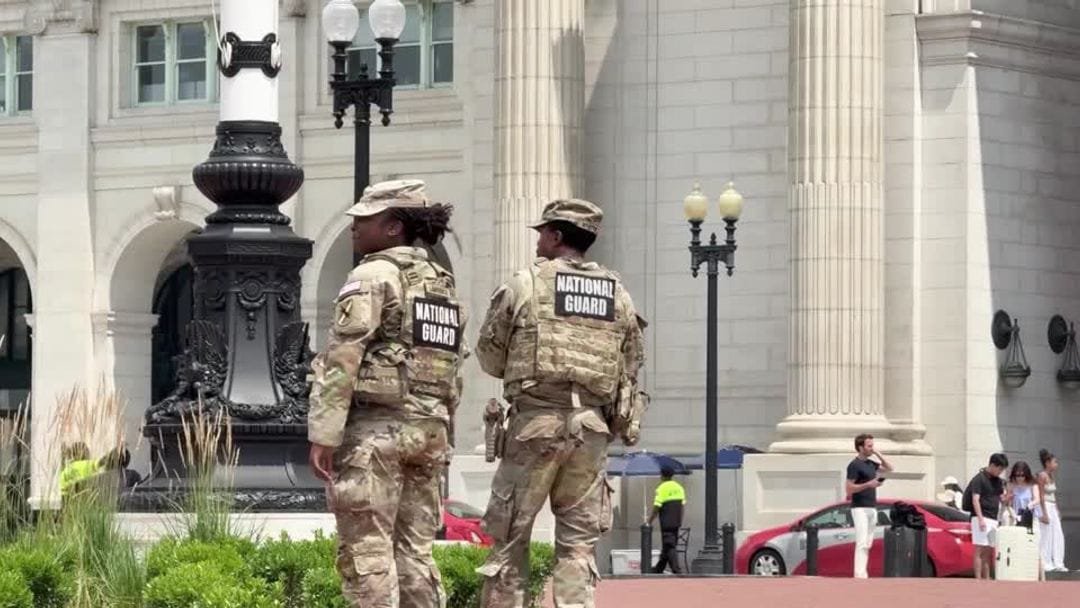
WASHINGTON, United States — Thousands of National Guard troops deployed to Washington under President Donald Trump have played a limited role in the city’s criminal cases, according to a Reuters review of publicly available court records. The review found that soldiers were mentioned in about 1.3% of criminal prosecutions filed in the District of Columbia Superior Court during the year-long deployment.
- Reuters identified 217 criminal cases in which police records mentioned National Guard involvement.
- Soldiers directly stopped suspects in 62 cases and assisted police in another 43.
- About 82% of Washington’s murders over the past five years occurred in neighborhoods where Reuters found no court-record reference to National Guard law enforcement activity.
- The Trump administration has projected a deployment cost of about $1.4 billion through 2029.
National Guard deployment has produced limited crime arrests
The approximately 4,500 soldiers currently deployed in Washington outnumber the city’s roughly 3,200 police officers. Despite that presence, Reuters found that the troops appeared in only a small share of criminal cases handled by the District’s Superior Court.
The review examined publicly available charging documents and compared incidents involving soldiers with crime information and demographic data from across Washington. The findings indicated that National Guard personnel were more frequently involved in relatively minor incidents than serious violent crimes.
Among the cases reviewed were incidents involving alleged shoplifting, fare evasion and other low-level offenses. Soldiers also sometimes intervened in fights or assaults before police arrived.
Where National Guard troops have been most active
Reuters found that the soldiers were more commonly mentioned in cases from wealthier and predominantly white areas, particularly around central Washington and subway stations. Those locations generally have lower levels of violent crime than some other parts of the capital.
The review found no reference in the examined court records to National Guard personnel carrying out law-enforcement activity in neighborhoods where approximately 82% of the city’s 859 murders over the previous five years occurred.
Salim Adofo, an outreach coordinator with the Anacostia Coordinating Council, said the findings reflected his experience in a lower-income part of Washington.
“I haven’t seen them all year,” he said.
Troops have limited law-enforcement authority
Although the guardsmen have been deputized as U.S. Marshals, government records indicate that their law-enforcement powers remain limited. The Defense Department has described their duties as “presence patrols”, intended primarily to provide a visible deterrent.
Soldiers can detain people suspected of crimes but must turn to police officers for formal arrests. Reuters found 35 cases in which National Guard personnel were witnesses to crimes, including incidents where they waited for police to arrive.
In some cases, soldiers provided information to officers about suspected drug activity, public urination, public exposure and other incidents. Community groups also reported seeing large groups of soldiers stationed outside subway stations at night to help enforce a city curfew.
Some incidents raised questions about the deployment
One police report reviewed by Reuters described an incident in which around 15 National Guard members were nearby while police officers intervened in an assault outside a nightclub. The guardsmen were described as being on routine patrol and did not intervene.
Another case involved Keon Jones, who was found unresponsive after a fight near a waterfront area. Soldiers called emergency services and told police they initially believed he was intoxicated. Jones was later found to have suffered severe stab wounds and died in hospital.
His aunt, Evelyn Jones, questioned whether more could have been done to assist him.
“They could have done more to help him,” she said.
National Guard personnel have also been targeted
The deployment has not been without risks for the soldiers themselves. Reuters found 62 cases involving allegations that people pushed, punched or threatened National Guard personnel, while nine people were accused of spitting on soldiers.
In one case, a man was accused of attempting to grab a soldier’s pistol while the soldier was trying to detain him over alleged theft. Another individual was charged after allegedly threatening soldiers with a bazooka.
Two off-duty soldiers were also arrested by Washington police in separate incidents involving alleged violations of the city’s firearms laws. The U.S. Attorney’s Office later dropped both cases.
Cost of Washington troop deployment reaches billions
The Trump administration told Congress that the deployment initially cost approximately $1.65 million per day, before the number of troops was doubled during the summer. The city’s most recent police budget was described in the Reuters report as roughly $1.5 million per day.
The administration plans to continue the deployment through the end of Trump’s presidency in 2029, with an estimated cost of approximately $1.4 billion. The government has not specified how many soldiers will remain deployed throughout that period.
Crime has fallen in some areas, but attribution is difficult
Assessing the National Guard’s effect on Washington crime is complicated by the simultaneous deployment of hundreds of additional federal agents who largely performed local policing functions.
Washington’s homicide count fell for a third consecutive year. However, murders also declined in cities that did not receive comparable military deployments or additional federal agents.
Meanwhile, violent crime reported by Washington police between January and mid-August was marginally higher than during the same period a year earlier, rising by about 4%, according to the supplied Reuters report.
A May study by the nonpartisan Niskanen Center found that the deployment was associated with fewer vehicle thefts but did not find an impact on violent crime.
Supporters and critics offer different assessments
Charles Stimson, a senior fellow at the pro-Trump Heritage Foundation, argued that the visible presence of soldiers could discourage criminal activity. Critics, however, questioned whether military personnel were the appropriate tool for routine policing.
Retired Gen. Randy Manner, formerly the National Guard Bureau’s second-in-command, said soldiers were not well prepared for everyday police work and could be more expensive than increasing the number of police officers.
The White House did not respond to Reuters’ questions about the soldiers’ work. Spokeswoman Lauren Bis said Trump’s efforts had reduced crime, improved the appearance of the city and enhanced quality of life. Washington Mayor Muriel Bowser, who has described the deployment as “problematic”, declined to comment, as did the city’s police department.
What happens next with the Washington deployment?
The Trump administration intends to maintain the National Guard presence in Washington through 2029. The deployment has also expanded beyond conventional patrols, with troops taking on a summer assignment guarding the Lincoln Memorial Reflecting Pool.
The wider debate is likely to remain focused on whether the large military presence provides a measurable public-safety benefit compared with its cost and whether troops are being deployed in areas where serious violent crime is most concentrated.
How many National Guard troops are deployed in Washington?
The supplied Reuters report says approximately 4,500 National Guard soldiers are currently deployed in Washington, a force larger than the city’s roughly 3,200 police officers.
How much will the Washington National Guard deployment cost?
The Trump administration has told Congress that it expects the deployment to cost about $1.4 billion through 2029.

Praveen Yadav is the Founder and Editor at The Nation Bulletin. With over 3 years of experience in digital journalism and news reporting, he covers national affairs, governance, and breaking current events with a commitment to factual accuracy and verified reporting.