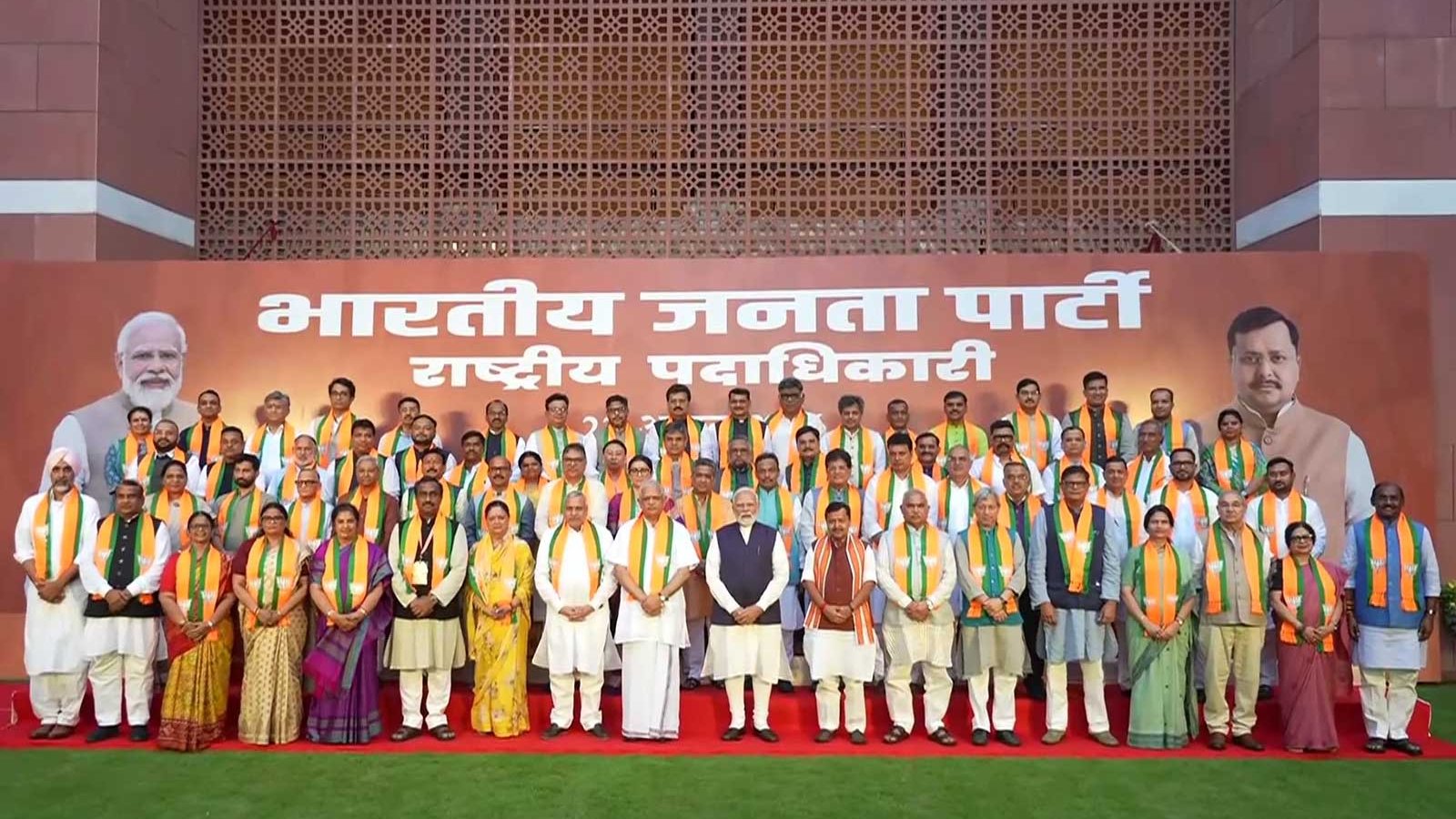
New Delhi, India — Prime Minister Narendra Modi on Saturday posed for a group photograph with the newly appointed Bharatiya Janata Party (BJP) national office-bearers at the party headquarters in New Delhi, shortly after the party passed a resolution on the honour and historical legacy of Vande Mataram.
- Key Highlights:
- PM Narendra Modi met the newly appointed BJP national office-bearers at the party headquarters.
- The BJP passed a resolution opposing the Congress decision to restrict Vande Mataram to its first two stanzas at party programmes.
- The BJP announced a nationwide awareness campaign on the National Song’s history and significance.
- The party said it would organise a special awareness drive among young people focused on Vande Mataram and the freedom struggle.
PM Modi meets new BJP office-bearers
Modi arrived at the BJP headquarters in New Delhi on Saturday evening, where he posed for a group photograph with the party’s newly appointed national office-bearers. His visit came against the backdrop of the BJP’s resolution concerning Vande Mataram and the political debate over its use at party programmes.
The BJP has announced a nationwide campaign intended to raise awareness about the history and significance of the National Song. The party said the campaign would focus on its association with India’s freedom movement and its place in the country’s national consciousness.
BJP resolution targets Congress decision
In its resolution, the BJP strongly condemned the Congress Working Committee’s decision to re-adopt its 1937 resolution concerning the singing of Vande Mataram. The Congress position limits the song’s use at its programmes to the first two stanzas.
The BJP said it would oppose the decision and seek to protect what it described as the honour, dignity and legacy of the complete six-stanza version of the National Song.
The party characterised Vande Mataram as an expression of reverence for Bharat Mata, a slogan associated with the freedom struggle and an enduring symbol of India’s national consciousness.
Reference to 1950 Constituent Assembly decision
The BJP resolution also referred to the 1950 Constituent Assembly declaration and legislation passed by Parliament in 2026 that, according to the party, provides statutory protection to the National Song at par with Jana Gana Mana.
The BJP argued that the Congress Working Committee’s decision cannot override either the Constitution or Parliament’s legislation. It said the political compromise reached in 1937 should not take precedence over the constitutional decision of 1950 and the 2026 legislation.
The resolution therefore framed the dispute around the status and legacy of Vande Mataram, with the BJP maintaining that the issue extends beyond the manner in which the song is performed at political events.
Nationwide awareness campaign announced
The BJP said its proposed nationwide campaign would explain the historical circumstances surrounding Vande Mataram and its role during the freedom movement. The party also plans a dedicated awareness initiative aimed at young people.
According to the BJP, the youth-focused campaign will seek to ensure that future generations understand the connection between the National Song, India’s freedom struggle and the sacrifices associated with that period.
The party further said it would oppose attempts to make the National Song subordinate to communal pressure, appeasement or vote-bank politics. The statement places the BJP’s campaign within its broader argument that the song’s historical and national significance should be preserved.
BJP cites Mahatma Gandhi’s description
In support of its position, the BJP resolution cited Mahatma Gandhi’s description of Vande Mataram as an “anti-imperialist slogan” associated with the “purest national sentiment”. The reference was included as part of the party’s argument about the song’s historical role.
The BJP said its position is centred on protecting the honour of the National Song and the legacy of people who contributed to India’s freedom struggle.
Congress maintains its 1937 position
The Congress Working Committee had earlier decided that only the first two stanzas of Vande Mataram would be sung at Congress programmes, referring to its 1937 resolution on the issue.
Congress MP KC Venugopal said the party’s position was clear and that it would follow decisions taken by Mahatma Gandhi, Jawaharlal Nehru and Sardar Vallabhbhai Patel in 1937.
The contrasting positions of the two parties have placed the historical treatment and public use of Vande Mataram at the centre of a fresh political dispute. The BJP’s nationwide campaign is now set to carry its argument about the National Song’s history and legacy beyond the party’s headquarters and into a wider public outreach effort.

Praveen Yadav is the Founder and Editor at The Nation Bulletin. With over 3 years of experience in digital journalism and news reporting, he covers national affairs, governance, and breaking current events with a commitment to factual accuracy and verified reporting.