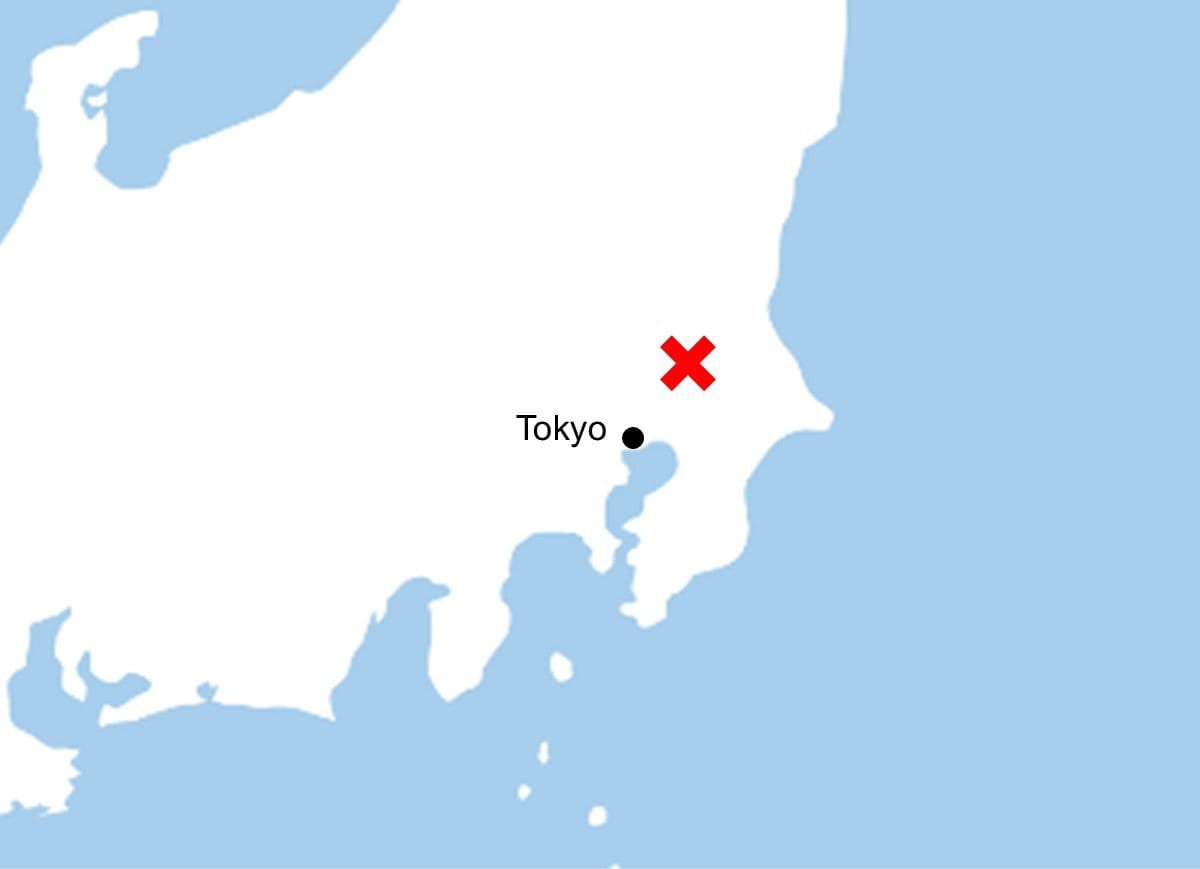
TOKYO, Japan — A magnitude 5.9 earthquake struck southern Ibaraki Prefecture early Sunday, shaking Tokyo and the wider eastern Kanto region and prompting authorities to assess possible damage and injuries. The earthquake, which occurred at 2 a.m. at an estimated depth of 70 kilometers, did not trigger a tsunami, according to the Japan Meteorological Agency.
- Key Highlights:
- The magnitude 5.9 earthquake struck at 2 a.m. Sunday beneath southern Ibaraki Prefecture.
- Strong shaking of lower 5 was recorded in Tokyo and parts of Ibaraki, Saitama and Chiba.
- Two injuries were reported in Kawasaki as authorities continued damage assessments.
- No tsunami threat was issued, while rail and nuclear facility checks were underway.
Strong shaking recorded across Tokyo and Kanto
The strongest reported shaking reached lower 5 on Japan’s seven-point shindo seismic intensity scale in Tokyo’s Adachi Ward and in some areas of Ibaraki, Saitama and Chiba prefectures. Other parts of Tokyo, along with Tochigi, Gunma and Kanagawa prefectures, recorded intensity level 4 shaking.
According to the Meteorological Agency, lower 5 shaking can cause objects to fall from shelves and may lead people to grab onto nearby objects because of the severity of the movement.
In some locations, the shaking continued for as long as a minute. Residents received earthquake early warning alarms on mobile phones shortly before the tremors were felt.
Long-period ground motion reported in several areas
NHK reported Level 2 long-period ground motion in Kawaguchi city in Saitama Prefecture and Urayasu city in Chiba Prefecture. Similar motion was also observed in Tokyo’s Koto and Edogawa wards.
Long-period ground motion refers to slower and more prolonged shaking that can cause high-rise buildings to sway significantly. At Level 2, people may have difficulty remaining standing, while furniture and other objects can move or fall.
Authorities check for injuries and earthquake damage
Authorities across affected areas began assessing the impact of the earthquake after the early-morning tremor. As of 3 a.m., Kawasaki city had reported two injuries, according to NHK.
A water pipe had also ruptured in the Kiyosumi area of Tokyo’s Koto Ward. However, reports said it had not yet been established whether the damage was directly caused by the earthquake.
Emergency and local authorities continued working to determine whether there had been further injuries or structural damage elsewhere in the affected region.
JR East examines rail infrastructure before morning services
JR East began checking whether the earthquake had caused any damage to railway infrastructure. NHK reported that the operator was expected to decide by 4:30 a.m. whether the first trains of the day could begin operating as usual.
The inspections were part of wider checks launched after the strong shaking affected several major population centres across the Kanto region.
Checks carried out at Tokai nuclear facilities
In Tokai village in Ibaraki Prefecture, where the Tokai and Tokai No. 2 nuclear power plants are located, the earthquake registered intensity level 3 on the shindo scale.
The Japan Atomic Power Company said no abnormalities had been found at the Tokai No. 2 nuclear plant following the earthquake. Checks were continuing at the Tokai nuclear plant, which is currently being decommissioned.
Tokai No. 2 has been offline for an extended period, according to the information provided.
Prime Minister orders impact assessment
Within an hour of the earthquake, Prime Minister Sanae Takaichi said on X that efforts were underway to determine the full extent of the quake’s impact. A liaison office was established at the Prime Minister’s Office Crisis Management Center following the tremor.
Takaichi said she had instructed officials to establish the extent of any damage and provide the public with timely and accurate information as assessments continued.
“To those in the areas where the shaking was strong, I ask that you continue to remain vigilant for the possibility of another earthquake of similar magnitude,” the prime minister said.
No tsunami warning issued after magnitude 5.9 quake
The Japan Meteorological Agency said the earthquake originated beneath southern Ibaraki Prefecture at a depth of 70 kilometers and confirmed that the event did not trigger a tsunami.
The early-morning earthquake affected Tokyo and several surrounding prefectures, with officials continuing checks on public infrastructure, possible injuries and other impacts as information emerged from across the Kanto region.

Praveen Yadav is the Founder and Editor at The Nation Bulletin. With over 3 years of experience in digital journalism and news reporting, he covers national affairs, governance, and breaking current events with a commitment to factual accuracy and verified reporting.