The NCLT’s approval of Dr Subhash Chandra’s personal insolvency repayment plan has triggered a major debate over creditor recoveries, personal guarantees and the functioning of India’s insolvency framework. The plan addresses admitted financial creditor claims of about ₹22,006.57 crore through a total payout of ₹6.50 crore.
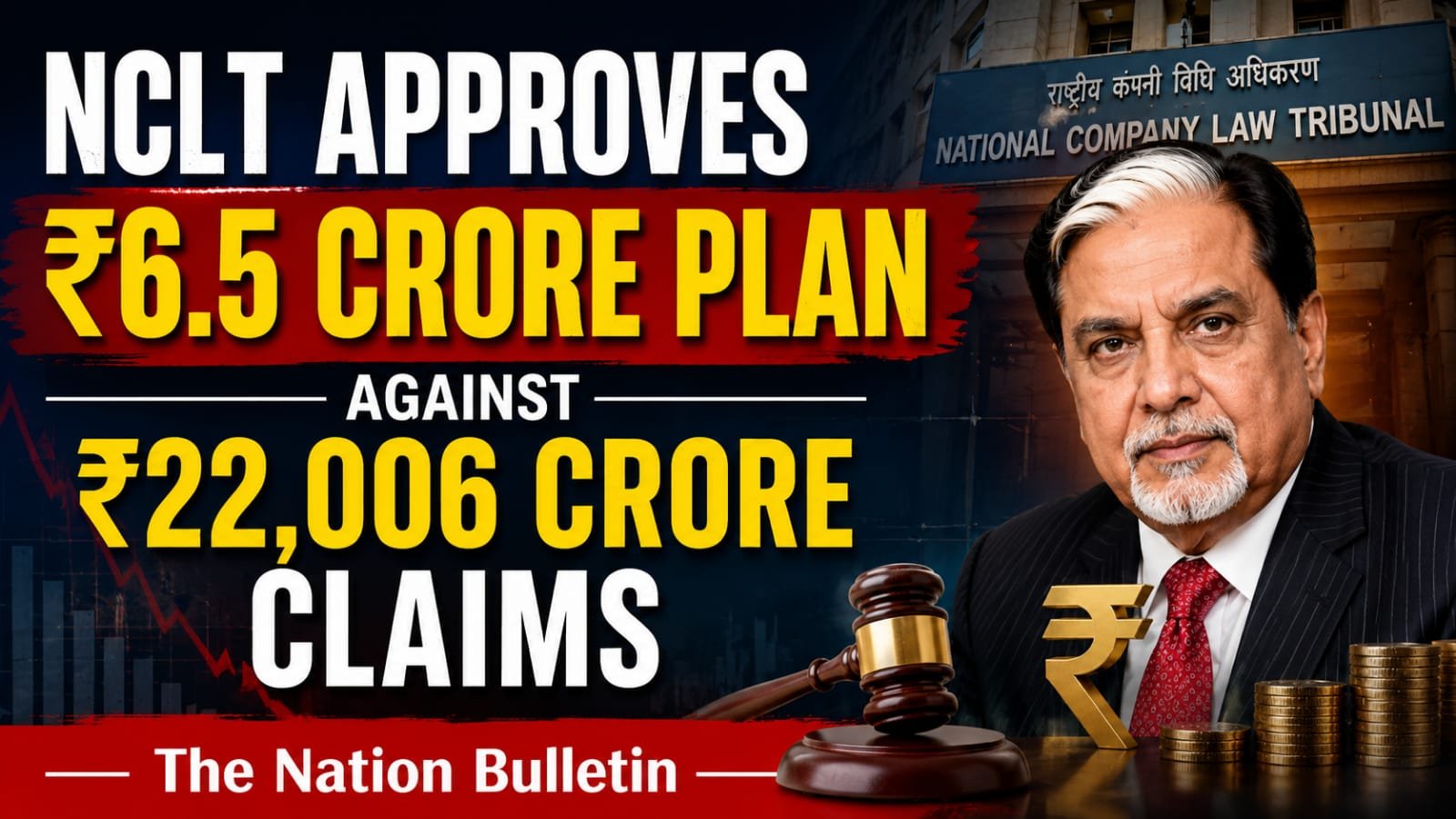
New Delhi, India — The National Company Law Tribunal’s New Delhi Bench has approved a repayment plan in the personal insolvency resolution process involving Essel Group founder Dr Subhash Chandra, providing for a ₹6.50 crore payout against admitted financial creditor claims of approximately ₹22,006.57 crore. Under the approved arrangement, ₹6.25 crore is earmarked for eligible financial creditors and ₹25 lakh for process costs, resulting in an estimated recovery of roughly 0.028% to 0.03% and a haircut of about 99.97%.
Key Highlights
- The approved repayment plan addresses financial creditor claims of approximately ₹22,006.57 crore.
- A total of ₹6.50 crore has been allocated under the plan, including ₹6.25 crore for eligible creditors and ₹25 lakh for process costs.
- The repayment proposal received 80.81% voting support, exceeding the 75% statutory threshold referred to under Section 114 of the IBC.
- Judicial Member Nilesh Sharma approved the plan on August 25, 2026, after the original two-member Bench delivered differing opinions.
- The tribunal held that once approved, the repayment plan becomes binding on all creditors, including those who voted against it.
Dr Subhash Chandra personal insolvency plan: Key financial details
The personal insolvency proceedings arose from personal guarantees provided by Dr Subhash Chandra in connection with institutional loans taken by various subsidiaries and associated entities of the Essel Group.
The repayment plan approved by the tribunal provides for a total payout of ₹6.50 crore. Of this amount, ₹6.25 crore has been designated for distribution among eligible financial creditors, while ₹25 lakh has been reserved for administrative and process-related expenses.
| Financial Parameter | Amount / Data | Details |
|---|---|---|
| Admitted financial creditor claims | ₹22,006.57 crore | Total admitted claims linked to the personal guarantor proceedings |
| Total repayment plan payout | ₹6.50 crore | ₹6.25 crore for creditors and ₹25 lakh for process costs |
| Amount for financial creditors | ₹6.25 crore | To be distributed among eligible creditors |
| Process costs | ₹25 lakh | Allocated towards administration of the insolvency process |
| Estimated recovery rate | Approximately 0.028%–0.03% | Recovery in comparison with admitted claims |
| Estimated haircut | Approximately 99.97% | Difference between admitted claims and recovery under the plan |
| Voting support | 80.81% (80.814%) | Above the 75% statutory threshold cited under Section 114 |
| Dissenting voting share | Approximately 19.19% | Creditors who opposed the repayment plan |
The size of the recovery gap has placed the case at the centre of a broader discussion on personal insolvency and the practical value of personal guarantees when a guarantor’s recoverable assets are limited.
How the insolvency proceedings began
The process formally began in 2022 when Indiabulls Housing Finance, now referred to as Sammaan Capital, approached the tribunal under Section 95 of the Insolvency and Bankruptcy Code after a default linked to a ₹170 crore loan extended to Vivek Infracon.
The proceedings were initiated against Dr Subhash Chandra based on his personal guarantee. After the petition was admitted in 2024, the resolution professional proceeded with the insolvency resolution process.
The case later reached an important judicial stage when the original two-member NCLT Bench differed over whether the repayment proposal should be approved.
NCLT split verdict and appointment of a third member
The two-member Bench was divided on the legal and procedural issues surrounding the repayment plan. Judicial Member Ashok Kumar Bhardwaj supported approval, relying on the 80.81% voting support and the stated limitations surrounding the debtor’s assets.
Technical Member Reena Sinha Puri took the opposite view, citing concerns relating to procedural speed, verification of claims and what she considered serious legal deficiencies in the process.
To resolve the difference of opinion, the NCLT President appointed Judicial Member Nilesh Sharma as a third member under Section 419(5) of the Companies Act, 2013.
In a detailed 144-page decision issued on August 25, 2026, Nilesh Sharma approved the repayment plan under Section 114 of the IBC.
Why the approved repayment plan is binding on dissenting creditors
The tribunal held that once a repayment plan is approved by the adjudicating authority, it becomes binding on all creditors under the framework referred to in Section 115 of the IBC, including creditors who voted against the proposal.
The dissenting creditors identified in the source include LIC Housing Finance, HDFC Bank, Axis Bank, Canara Bank and Union Bank. According to the tribunal’s reasoning described in the supplied material, these creditors cannot continue separate parallel recovery proceedings for their original claims outside the approved plan in a manner that would defeat the collective resolution process.
The decision therefore reinforced the collective nature of the personal insolvency framework, where the approved statutory process governs the treatment of claims against the personal guarantor.
LIC Housing Finance claim and the recovery gap
LIC Housing Finance had an admitted claim of ₹1,322.39 crore in the proceedings. Under the approved arrangement, its proportional recovery was stated to be approximately ₹38.09 lakh, representing around 0.028% of its admitted claim.
| Creditor Detail | Amount / Recovery | Position Under the Plan |
|---|---|---|
| LIC Housing Finance admitted claim | ₹1,322.39 crore | Part of the admitted creditor claims |
| LIC Housing Finance proportional recovery | Approximately ₹38.09 lakh | Estimated recovery of around 0.028% |
| Total admitted financial claims | ₹22,006.57 crore | Claims considered in the insolvency process |
| Total creditor distribution pool | ₹6.25 crore | Available for eligible financial creditors |
Dispute over voting rights and related entities
One of the most sensitive issues before the tribunal concerned the composition of the creditor voting group. Dissenting creditors argued that entities allegedly connected to the promoter had played a role in creating an artificial majority in favour of the repayment plan.
Five entities — Veena Investments, Direct Media Distribution, World Crest Advisors, Lemonade Capital and Corpcall Capital — together accounted for approximately 61.78% of the voting share referred to in the proceedings.
The tribunal concluded that family or business proximity alone was insufficient to establish that an entity was an “associate” under Section 79(2)(g) of the IBC. Their voting rights therefore remained valid.
| Disputed Party / Group | Claim or Voting Position | Tribunal’s Finding |
|---|---|---|
| Veena Investments | Part of the group with approximately 61.78% combined voting share | Voting remained valid |
| Direct Media Distribution | Part of the disputed group | Family or business proximity alone was held insufficient to establish associate status |
| World Crest Advisors | Part of the disputed group | Voting remained valid under the tribunal’s assessment |
| Lemonade Capital | Part of the disputed group | Voting remained valid |
| Corpcall Capital | Part of the disputed group | Voting remained valid |
| Anil Kumar representing 960 individuals | Individual claims questioned | Excluded from the final list due to lack of primary supporting documentation |
| Sunil Jain representing 300 individuals | Individual claims questioned | Excluded from the final list due to lack of primary supporting documentation |
The claims represented by Anil Kumar on behalf of 960 individuals and Sunil Jain on behalf of 300 individuals were excluded from the final list because of the absence of primary supporting documentation. The tribunal directed that the ₹6.25 crore creditor distribution amount be redistributed among the remaining eligible creditors.
Concerns over the speed of the insolvency process
The dissenting creditors also questioned the pace at which the repayment proposal moved through the process. According to their argument, the plan was presented on October 16, 2024, followed by the filing of the resolution professional’s report the next day.
A voting meeting was then held on October 24. The objecting creditors argued that the available time was inadequate for a detailed examination of claims running into approximately ₹21,697 crore.
The tribunal, however, held that the alleged procedural irregularities did not automatically invalidate the repayment plan. It noted, according to the supplied material, that creditors had access to relevant documents and exercised their voting rights.
Net worth dispute and allegations over asset depletion
A major dispute in the case concerned the sharp differences between the net worth figures cited by banks for earlier years and the asset position presented before the resolution professional in 2024.
| Period / Reference | Asset or Net Worth Figure | Context Provided in the Proceedings |
|---|---|---|
| 2016 parliamentary declaration | ₹39.08 crore | Public asset record disclosed in an affidavit at the time of Rajya Sabha election |
| 2017 figure cited by banks | ₹45,888 crore | Alleged net worth cited during loan assessment; described by the promoter as unrealistic and without basis |
| 2018 figure cited by banks | ₹40,562 crore | Net worth figure cited in relation to institutional loan approvals |
| 2024 declaration before resolution professional | ₹31.79 crore | Included a residential house valued at approximately ₹25 crore |
The banks argued that the dramatic decline in the promoter’s stated net worth warranted a wider forensic examination and raised concerns that assets may have been transferred or concealed.
The promoter’s office, however, stated that Dr Subhash Chandra had not personally taken direct loans and had acted only as a guarantor. It also said that the actual claims of creditors opposing the plan amounted to ₹3,992 crore rather than ₹22,000 crore.
The explanation provided on behalf of the promoter for the lower asset position included the use of personal accounts to pay employee salaries and liabilities during the crisis affecting group companies.
Why the tribunal supported the commercial approach to the plan
The tribunal’s reasoning rested on the practical comparison between the approved repayment proposal and the alternative of moving the personal guarantor into bankruptcy.
According to the assessment described in the source material, the actual recoverable value of Dr Subhash Chandra’s personal assets was lower than the ₹6.50 crore offered under the repayment arrangement. The tribunal concluded that pushing the guarantor into full bankruptcy would not necessarily result in creditors receiving even the amount available under the approved plan.
The tribunal also distinguished between the personal liability of the guarantor and the liabilities of the original corporate borrowers. The personal insolvency repayment plan was described as addressing the guarantor’s personal legal liability and not preventing financial creditors from pursuing recoveries from the principal corporate debtors that had originally received the loans.
Another important aspect of the decision concerned the limits of judicial review. The tribunal stated that the adjudicating authority’s role was supervisory, corrective and judicial rather than that of an investigative agency. With more than 80% of the voting share supporting the plan, the tribunal held that it could not simply substitute its own commercial assessment for the collective commercial judgment of the creditors.
Political reactions and public criticism
The decision drew strong reactions from political and public figures. Congress MP Jairam Ramesh criticised the outcome, describing a recovery of ₹6.5 crore against dues of ₹22,006 crore as more than a conventional “haircut,” using the term “mundan” to express his criticism of the scale of the loss.
Former industrialist Vijay Mallya, who is living abroad, also commented on the matter through the social media platform X. He contrasted the recovery figures mentioned in connection with his own case — ₹14,100 crore recovered against a debt figure of ₹6,203 crore — with what he described as nominal settlements in other large cases.
The contrasting reactions added a political dimension to a case that is fundamentally centred on the operation of India’s personal insolvency and debt resolution framework.
What the case means for personal guarantees and creditor recovery
The case raises broader questions about the financial value of personal guarantees in large corporate lending arrangements. As reflected in the proceedings, the practical value of enforcing a personal guarantee may depend heavily on the guarantor’s directly recoverable and unencumbered personal assets.
The supplied material also highlights concerns about cases in which assets are connected with complex corporate structures or foreign trusts, potentially limiting the value that can be realised through a personal insolvency process.
Another policy issue concerns the determination of voting rights and the treatment of entities alleged to be connected to promoters. The dispute in this case showed how the classification of creditors and related entities can have a major impact on the voting outcome of a repayment plan.
The NCLT’s approval of the Dr Subhash Chandra repayment plan therefore stands as a major test of how India’s personal insolvency system balances collective creditor decision-making, limited recoverable assets, dissenting institutional creditors and the legal finality of an approved repayment arrangement.
Frequently Asked Questions
What is the total amount approved under Dr Subhash Chandra’s repayment plan?
The total approved payout is ₹6.50 crore, including ₹6.25 crore for eligible financial creditors and ₹25 lakh for process costs.
How much were the admitted financial creditor claims?
The admitted financial creditor claims were approximately ₹22,006.57 crore.
What percentage of creditors supported the repayment plan?
The repayment plan received 80.81% voting support, or 80.814%, which was above the 75% statutory threshold referred to under Section 114 of the IBC.
Can dissenting creditors continue separate recovery action against the personal guarantor?
According to the tribunal’s decision described in the supplied material, once the repayment plan is approved under the relevant IBC provisions, it becomes binding on all creditors, including those who voted against it, and parallel action outside the collective resolution framework cannot be pursued in a manner that defeats the approved process.
The decision leaves the case as an important reference point in the continuing debate over creditor recoveries, the effectiveness of personal guarantees and the commercial discretion exercised by creditors under India’s insolvency framework.

Praveen Yadav is the Founder and Editor at The Nation Bulletin. With over 3 years of experience in digital journalism and news reporting, he covers national affairs, governance, and breaking current events with a commitment to factual accuracy and verified reporting.