Indian Stock Market Today: Indian equities came under renewed selling pressure on September 2 as escalating West Asian tensions pushed crude oil prices higher and intensified concerns over inflation, the rupee and corporate margins.
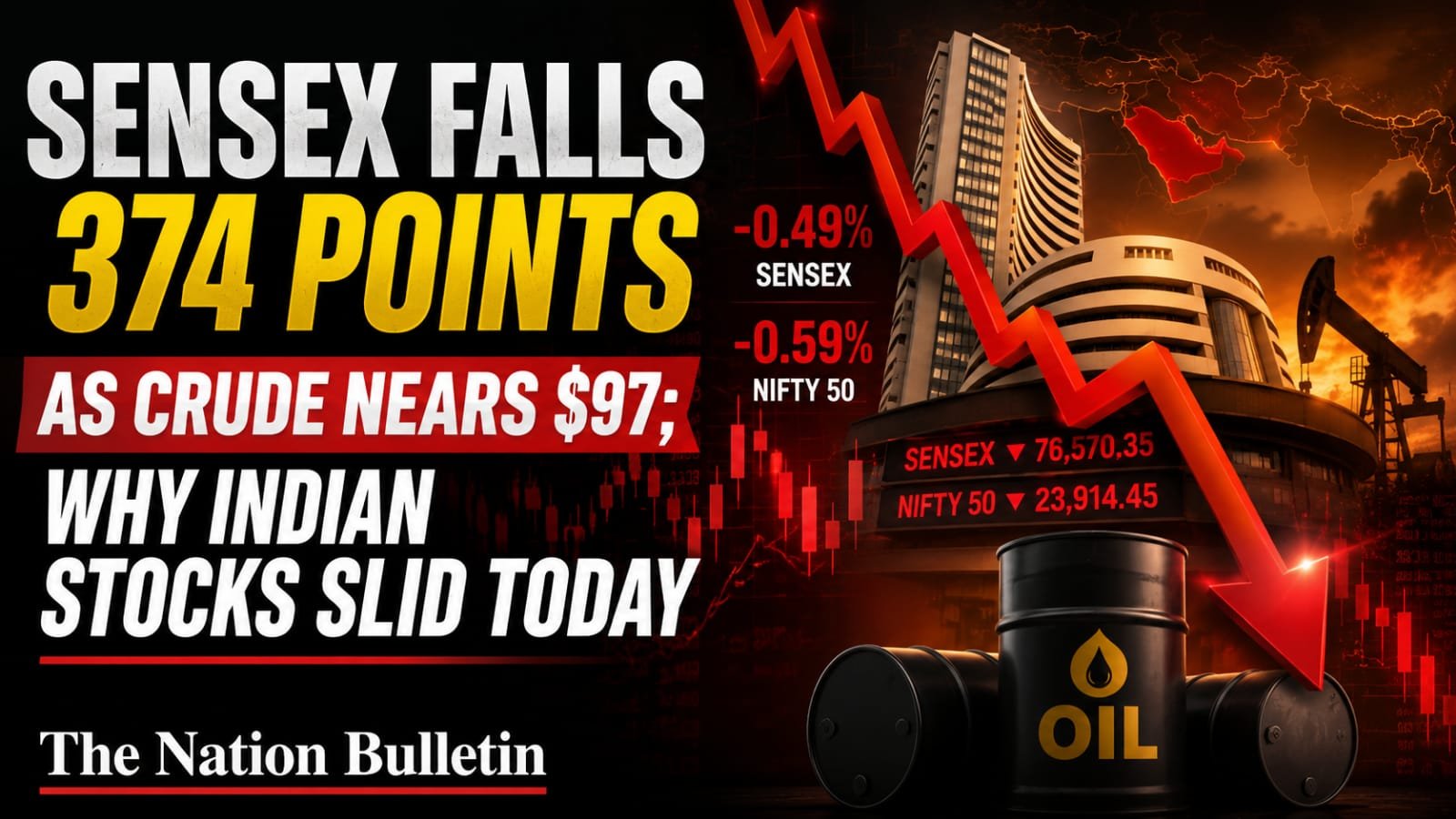
NEW DELHI — Indian benchmark indices ended lower on September 2, 2026, as escalating geopolitical tensions in West Asia and a sharp rise in international crude oil prices weighed on investor sentiment. The BSE Sensex fell 373.93 points, or 0.49%, to close at 76,570.35, while the NSE Nifty 50 declined 141.35 points, or 0.59%, to settle at 23,914.45.
The losses were steeper during the session. The Sensex touched an intraday low of 76,399.27 after falling more than 700 points from its earlier levels, while the Nifty 50 slipped to 23,858.85. A late recovery during the Closing Auction Session helped both benchmarks finish above their session lows.
Why Indian Stocks Fell on September 2
The immediate trigger for the sell-off was renewed military escalation between the United States and Iran, raising concerns about disruptions around the Strait of Hormuz, a key route for global energy shipments.
Brent crude rose 2.17% to around $96.71 a barrel, while West Texas Intermediate crude gained 1.80% to $91.84. WTI has now advanced more than 8% across the previous two sessions, increasing concerns about the impact of higher energy costs on oil-importing economies such as India.
India imports more than 85% of its crude oil requirements, making a prolonged rise in international oil prices particularly important for inflation, the current account and corporate profitability. Higher energy costs can also raise input expenses for industries ranging from transportation and chemicals to tyres and paints.
Rupee, Foreign Investors and Volatility Add to Pressure
The equity sell-off coincided with weakness in the Indian rupee, which traded between 94.95 and 95.17 against the US dollar during the session. Higher crude prices increase India’s dollar demand for energy imports, while elevated global bond yields can make emerging-market assets less attractive to foreign investors.
Foreign institutional investors also maintained a defensive stance in derivatives. Their aggregate index futures long-to-short ratio fell to 15.13%, while net short index futures positions held by foreign accounts crossed 264,000 contracts.
The India VIX, a measure of expected market volatility, climbed more than 5% to 11.76, reflecting increased demand for downside protection as geopolitical uncertainty intensified.
IT, Auto and Oil Stocks Bear the Brunt
Technology stocks were among the notable losers, with the Nifty IT index falling more than 2%. TCS, Infosys, Wipro, Tech Mahindra and Persistent Systems were among the stocks under pressure.
Automobile stocks also declined. Maruti Suzuki fell more than 4%, while Mahindra & Mahindra and Eicher Motors also ended lower. Investors weighed weaker monthly sales signals alongside concerns that higher fuel and input costs could put pressure on demand and margins.
Oil marketing companies including BPCL, HPCL and Indian Oil Corporation faced selling pressure as crude prices moved higher. The concern for refiners and fuel retailers is that rising international procurement costs may not always be passed through immediately to domestic consumers.
Paint and tyre manufacturers were similarly affected by concerns over higher crude-linked input costs. Asian Paints, MRF, Apollo Tyres, CEAT and JK Tyre were among the stocks facing pressure, while aviation stocks such as InterGlobe Aviation were affected by expectations of higher aviation fuel costs.
Coal India and Pharma Stocks Buck the Trend
Not all sectors moved lower. Coal India gained 3.6%, supported by a reported 5.5% year-on-year increase in August coal dispatches and developments related to the proposed divestment of a stake in Mahanadi Coalfields.
Pharmaceutical stocks also showed relative resilience, with investors moving toward defensive areas amid broader market uncertainty. Sun Pharma and Dr. Reddy’s Laboratories were among the stocks that attracted comparatively stronger interest.
Nifty 50 Support Levels in Focus
The late-session recovery helped the Nifty 50 remain above the 23,900 level. The 23,850–23,900 area is now being closely watched as an important near-term support zone.
A sustained close below 23,850 could increase downside pressure, while the 24,100–24,200 range is being watched as immediate resistance. The broader market remains vulnerable to sharp moves as investors assess developments around the Strait of Hormuz, crude prices, currency movements and global interest rates.
What Investors Will Watch Next
The direction of global crude prices and developments in West Asia are likely to remain key drivers for Indian equities in the near term. Investors will also monitor the rupee, foreign institutional positioning and movements in global bond yields.
For India, the biggest concern is whether the oil-price shock remains temporary or develops into a prolonged period of elevated energy costs. A sustained rise in crude could put pressure on inflation, external balances and corporate margins, while any easing of geopolitical tensions could support a recovery in risk appetite.
Disclaimer: This article is based on market information and verified sources and is intended for informational purposes only. It is not investment advice. Market conditions can change rapidly, and investors should conduct their own research or consult a qualified financial professional before making investment decisions.

Praveen Yadav is the Founder and Editor at The Nation Bulletin. With over 3 years of experience in digital journalism and news reporting, he covers national affairs, governance, and breaking current events with a commitment to factual accuracy and verified reporting.