CTET 2026 Exam Postponed: The Central Board of Secondary Education has deferred the September 6 examination after a supplementary registration drive triggered by the Supreme Court’s extended August 2028 certification deadline for in-service educators.
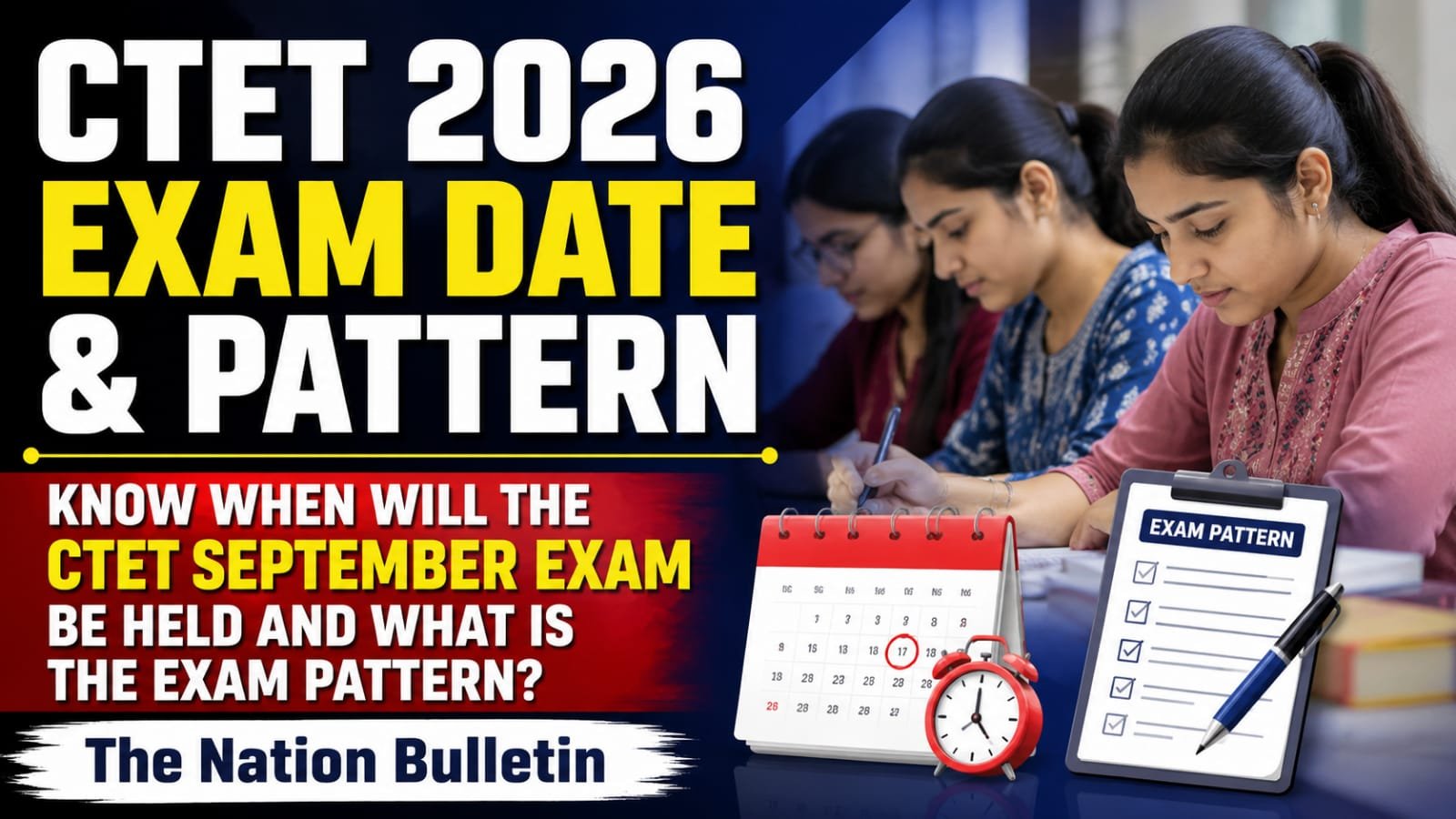
NEW DELHI — The Central Board of Secondary Education (CBSE) has formally deferred the nationwide administration of the 22nd Central Teacher Eligibility Test (CTET), originally scheduled for September 6, 2026. The postponement follows an extraordinary reopening of the registration window that concluded on September 1, 2026, aimed at accommodating thousands of in-service teachers seeking statutory compliance under updated judicial guidelines. CBSE confirmed that a rationalized test schedule and revised examination date will be released shortly on its official portal, ctet.nic.in.
Key Highlights
- Exam Rescheduled: The offline OMR-based test slated for September 6 (with September 5 as reserve) is postponed; revised dates are pending administrative center allocation.
- Judicial Catalyst: The rescheduling follows a May 29, 2026 Supreme Court ruling establishing TET as an unavoidable qualification under the RTE Act while granting an Article 142 extension to August 31, 2028.
- Application Intake Concluded: A special supplementary registration window open from August 25 to September 1, 2026, has officially closed. Candidates registered in the May–June phase do not need to reapply.
- Algorithmic City Allotment: Venue selection by candidates remains removed; test centers across 132 designated cities are assigned automatically to manage logistics and security across 27 test languages.
Quick Overview
| Operational Parameter | Original Status | Current Revised Status |
|---|---|---|
| Examination Session | 22nd Edition (September 2026) | Maintained (Cycle active) |
| Scheduled Test Date | September 6, 2026 | Postponed (New date awaited) |
| Supplementary Registration | Not Applicable | Concluded on September 1, 2026 |
| Admit Card Release | 2 days prior to exam | Will release 48 hours before new test date |
| Examination Mode | Pen-and-paper OMR | Pen-and-paper OMR (150 MCQs per paper) |
Judicial Directive Sparks Administrative Realignment
The administrative shift stems from proceedings before the Supreme Court of India in State of U.P. v. Anjuman Ishaat-e-Taleem Trust & Ors. (Review Petition (Civil) Diary No. 53434/2025 in Civil Appeal No. 1385/2025). On May 29, 2026, a Division Bench comprising Justice Dipankar Datta and Justice Manmohan held that qualifying the Teacher Eligibility Test constitutes an indispensable statutory mandate under Section 23 of the Right of Children to Free and Compulsory Education (RTE) Act, 2009. The apex court affirmed that the fundamental right to education under Article 21A guarantees students qualified, professional pedagogy.
While the bench refused blanket exemptions for in-service teachers recruited prior to statutory benchmarks, it recognized the severe systemic displacement immediate enforcement would cause. Exercising its equitable powers under Article 142 of the Constitution, the Court extended the mandatory qualification deadline for in-service teachers from August 31, 2027, to August 31, 2028. The court also instructed examining bodies to conduct regular assessments to give educators adequate opportunities to qualify.
To align with this judgment and safeguard teacher continuity, the CBSE issued public notice F. No. CBSE/CTET/Sept./2026/e-73233, reopening online applications from August 25 through September 1, 2026. The influx of applicants prompted the postponement of the September 6 test date to allow district-level center rationalization across the country.
Examination Architecture and Structural Blueprint
The operational framework of the test remains unchanged. The 22nd CTET will be conducted offline via optical mark recognition (OMR) sheets across two separate tiers. Paper II will take place during the morning session (09:30 to 12:00 IST), followed by Paper I during the afternoon session (14:30 to 17:00 IST).
Both papers comprise 150 objective Multiple Choice Questions (MCQs) carrying 150 aggregate marks for a testing duration of 150 minutes. The evaluation utilizes a single-mark addition (+1) for every correct answer, with no negative marking applied for incorrect or unattempted responses.
Paper I Structural Pattern (Primary Tier: Classes I to V)
- Child Development and Pedagogy: 30 MCQs (30 marks) covering child growth, inclusive education, and learning concepts.
- Mathematics: 30 MCQs (30 marks) split evenly between foundational numeracy and pedagogical approaches.
- Environmental Studies: 30 MCQs (30 marks) assessing core science/social topics and instructional strategies.
- Language I (Compulsory): 30 MCQs (30 marks) evaluating advanced language proficiency and teaching methodologies.
- Language II (Compulsory): 30 MCQs (30 marks) testing comprehension, syntax, and language fundamentals.
Paper II Structural Pattern (Upper Primary: Classes VI to VIII)
Paper II evaluates advanced subject-specific competencies. While Child Development and Pedagogy (30 MCQs) and both compulsory language modules (30 MCQs each) mirror the structure of Paper I, the academic discipline component offers 60-mark specialization streams:
- Mathematics and Science: 60 MCQs (60 marks) dividing mathematics content (30 marks) and science content (30 marks), inclusive of pedagogical applications.
- Social Studies / Social Sciences: 60 MCQs (60 marks) examining history, geography, social and political life (40 marks), alongside curricular and project pedagogy (20 marks).
Candidates select two different languages from 27 authorized options; identical language selection across both modules is impermissible under CBSE examination regulations.
Statutory Eligibility and Benchmark Scores
Qualifications adhere to National Council for Teacher Education (NCTE) norms. Paper I requires a Senior Secondary certificate (minimum 50% marks) with a two-year Diploma in Elementary Education (D.El.Ed) or a four-year B.El.Ed. In line with prevailing apex court directives, general Bachelor of Education (B.Ed) degrees remain valid only for Paper II. Paper II applicants must hold a recognized undergraduate degree accompanied by a D.El.Ed, B.Ed, or equivalent NCTE-recognized four-year integrated qualification.
The qualifying threshold for candidates in the Unreserved category is set at 60% (90 out of 150 marks). Candidates from SC, ST, OBC (Non-Creamy Layer), and PwD classifications receive a 5% statutory concession, setting their qualifying benchmark at 55% (82 marks). The CTET certificate carries lifetime validity, providing qualification credentials for appointments across central bodies (KVS, NVS, Central Tibetan Schools), Union Territory administrations, and participating state boards.
Next Administrative Steps for Candidates
With the supplementary application portal officially shuttered, CBSE technical teams are processing regional candidate densities across 132 designated test cities. Automated center allocations will produce advance city intimation slips approximately 10 to 14 days before the rescheduled date, with final e-admit cards made downloadable 48 hours prior to the test. Candidates are advised to rely strictly on announcements published at ctet.nic.in.
Frequently Asked Questions
Why was the CTET September 2026 exam postponed?
The exam scheduled for September 6, 2026, was postponed after CBSE reopened registration from August 25 to September 1, 2026. This reopening accommodated in-service teachers granted an extended compliance window by the Supreme Court, requiring reconfigured testing center capacity.
Do candidates who applied in May–June need to register again?
No. The CBSE has confirmed that candidates who successfully completed their registration and fee payment during the initial May 11 to June 10, 2026 window are fully validated and do not need to resubmit applications.
Can applicants request a change in their examination city?
No. Testing venues across 132 cities are assigned through an automated centralized algorithm to balance examinee density and preserve logistical integrity. The board does not accept transfer or modification requests under any circumstances.

Praveen Yadav is the Founder and Editor at The Nation Bulletin. With over 3 years of experience in digital journalism and news reporting, he covers national affairs, governance, and breaking current events with a commitment to factual accuracy and verified reporting.