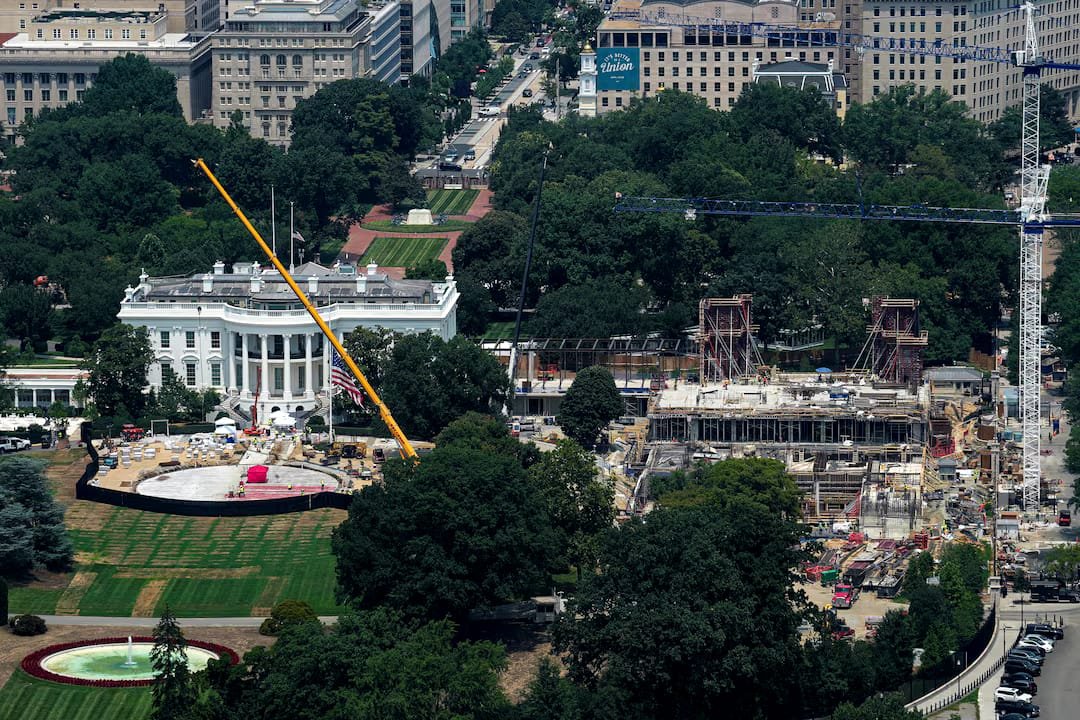
WASHINGTON, United States — A US federal appeals court has ordered the Donald Trump administration to stop above-ground construction of a planned $400 million ballroom at the White House, ruling that the president cannot fundamentally reshape the historic complex without approval from Congress.
The 2-1 decision by the US Court of Appeals for the District of Columbia Circuit on Friday marks a major setback for Trump’s effort to build a 90,000-square-foot ballroom on the site of the demolished East Wing. The court upheld a preliminary injunction obtained by the National Trust for Historic Preservation, which challenged the project after construction began without congressional authorization.
Key Highlights
- The US appeals court has blocked above-ground construction of Trump’s planned $400 million White House ballroom.
- The court said major changes to the White House require congressional approval.
- The ruling has been paused for 14 days, allowing the Trump administration to seek review from the US Supreme Court.
- Trump has described the ballroom as a national security necessity and vowed to appeal the decision.
Appeals Court Says Congress Must Approve Major Changes
The appeals court majority said the president does not have unrestricted authority to fundamentally alter the White House. In its opinion, the judges stressed that each president occupies the White House temporarily rather than owning the property.
The court concluded that deciding whether a large ballroom should be constructed is a matter for Congress rather than an action the executive branch can undertake on its own.
The decision does not permanently prevent a ballroom from being built. Instead, it stops above-ground construction while the legal dispute continues and until the administration obtains congressional approval.
The court also rejected the argument that national security concerns automatically allow the executive branch to bypass legal requirements.
“National security arguments are not an automatic get-out-of-law-free card,” the majority opinion said.
Trump Plans Supreme Court Appeal
The appeals court has placed its order on hold for 14 days, giving the Trump administration an opportunity to ask the US Supreme Court to review the case.
Trump has already indicated that his administration will pursue that route. In a post on Truth Social on Friday, he called the appeals court decision “horrendous” and politically motivated and said it exposed the president, White House officials and visitors to potential attacks.
Trump also referred to the proposed ballroom as a “military center”, arguing that the structure is connected to a broader security plan for the White House.
According to Trump, the proposed facility would include bomb shelters, medical facilities and protection against drones and missiles. He described these elements as part of one large and complex security structure.
Trump said the appeals court ruling should be overturned by the Supreme Court in its entirety.
National Trust Welcomes the Ruling
The National Trust for Historic Preservation brought the lawsuit challenging the project after the administration demolished the East Wing and began work on the planned ballroom.
National Trust President Brent Leggs welcomed the appeals court decision, describing it as an important moment for public participation in decisions involving historic places.
He said the ruling represented a significant victory for the public’s ability to express its views about places of historical importance, including the White House.
Lower Court Had Already Halted Above-Ground Work
The appeals court ruling followed two decisions by US District Judge Richard Leon, who had previously blocked above-ground construction at the site while allowing underground work to continue.
Leon, who was appointed by Republican former President George W. Bush, had issued injunctions preventing the administration from proceeding with the above-ground portion of the project.
The Trump administration appealed those decisions, bringing the dispute before the DC Circuit Court of Appeals.
Administration Argues Project Is Linked to Security
During arguments before the appeals court on June 5, Justice Department attorney Yaakov Roth argued that federal courts should not intervene in a privately funded project of this nature.
Roth said the National Trust’s concerns amounted to an “architectural preference” that should not outweigh national security considerations.
The administration has argued that the former East Wing left the president and others inside the White House vulnerable to potential attacks. The ballroom project, according to the administration’s position, is therefore connected not only to the needs of large formal events but also to the security of the White House.
The appeals court majority, however, said the executive branch cannot use those security arguments to avoid the legal limits governing major changes to the White House.
Trump-Appointed Judge Dissents
Circuit Judge Neomi Rao, who was appointed by Trump during his first term, disagreed with the majority decision.
Rao argued that the lower court’s injunction went beyond the appropriate role of federal courts and that construction should be permitted to continue.
In her dissent, she described the district court’s involvement in supervising construction at the White House as judicial overreach and said the appeals court majority had affirmed that approach.
The split decision reflects the disagreement within the appeals court over how far federal courts can go in intervening in the administration’s plans for the White House property.
Ballroom Project Has Become a Major White House Renovation Effort
The planned ballroom is part of a broader effort by Trump to reshape the landscape around central Washington’s government buildings and national monuments.
The administration has presented the ballroom as necessary for large formal functions and for improving the safety of the White House.
The project involves the former East Wing site, where the administration began construction after demolishing the existing structure.
The planned ballroom covers approximately 90,000 square feet, or about 8,360 square meters. The project has also attracted attention because its projected cost has increased substantially from the initial estimate.
Trump Defends Rising Project Cost
Trump has defended the ballroom’s price tag after its estimated cost rose to approximately $400 million, roughly double the initial projection.
In a Truth Social post in May, Trump attributed the increase to changes in the scale and quality of the proposed facility. He said the ballroom was approximately twice the size of the original proposal and would be built to a higher standard.
Trump has promised that the completed project will be “magnificent, safe, and secure.”
Separate Kennedy Center Dispute
The ballroom dispute comes amid another legal controversy involving Trump’s efforts to reshape a prominent Washington institution.
In a separate lawsuit, a judge recently ruled that Trump’s name had been illegally added to the exterior of the Kennedy Center performing arts venue and ordered that the name be removed.
The two disputes are separate legal matters, but the ballroom case is part of a wider pattern of litigation surrounding changes associated with Trump’s efforts to alter prominent sites in Washington.
What Happens Next in the Ballroom Case?
The appeals court’s ruling is currently on hold for 14 days, giving the Trump administration time to seek Supreme Court review.
Until the legal process moves forward, the appeals court’s decision prevents above-ground construction from proceeding under the terms of the ruling.
The court made clear that its decision does not permanently rule out construction of a ballroom. The central issue is whether the executive branch can proceed with such a major alteration to the White House without congressional approval.
Frequently Asked Questions
Why did the US appeals court block Trump’s ballroom project?
The appeals court ruled that the Trump administration cannot fundamentally reshape the White House without congressional approval. The decision upheld a preliminary injunction obtained by the National Trust for Historic Preservation.
Will Trump appeal the White House ballroom ruling?
Yes. Trump has said his administration will appeal the decision to the US Supreme Court. The appeals court has paused its order for 14 days to allow the administration to seek Supreme Court review.
Conclusion
The appeals court ruling has temporarily halted above-ground work on Trump’s planned $400 million White House ballroom and placed congressional authority at the center of the dispute. While the administration argues that the project serves both practical and national security purposes, the appeals court majority has held that those concerns do not allow the executive branch to bypass the requirement for congressional approval.
The next major step will depend on whether the Trump administration asks the US Supreme Court to intervene during the 14-day window provided by the appeals court.

Praveen Yadav is the Founder and Editor at The Nation Bulletin. With over 3 years of experience in digital journalism and news reporting, he covers national affairs, governance, and breaking current events with a commitment to factual accuracy and verified reporting.