Former Union Human Resource Development Minister Dr. Murli Manohar Joshi has raised a broad policy debate over India’s education system, arguing that examination integrity, public spending, higher education, school consolidation and the meaning of a developed India need deeper reconsideration.
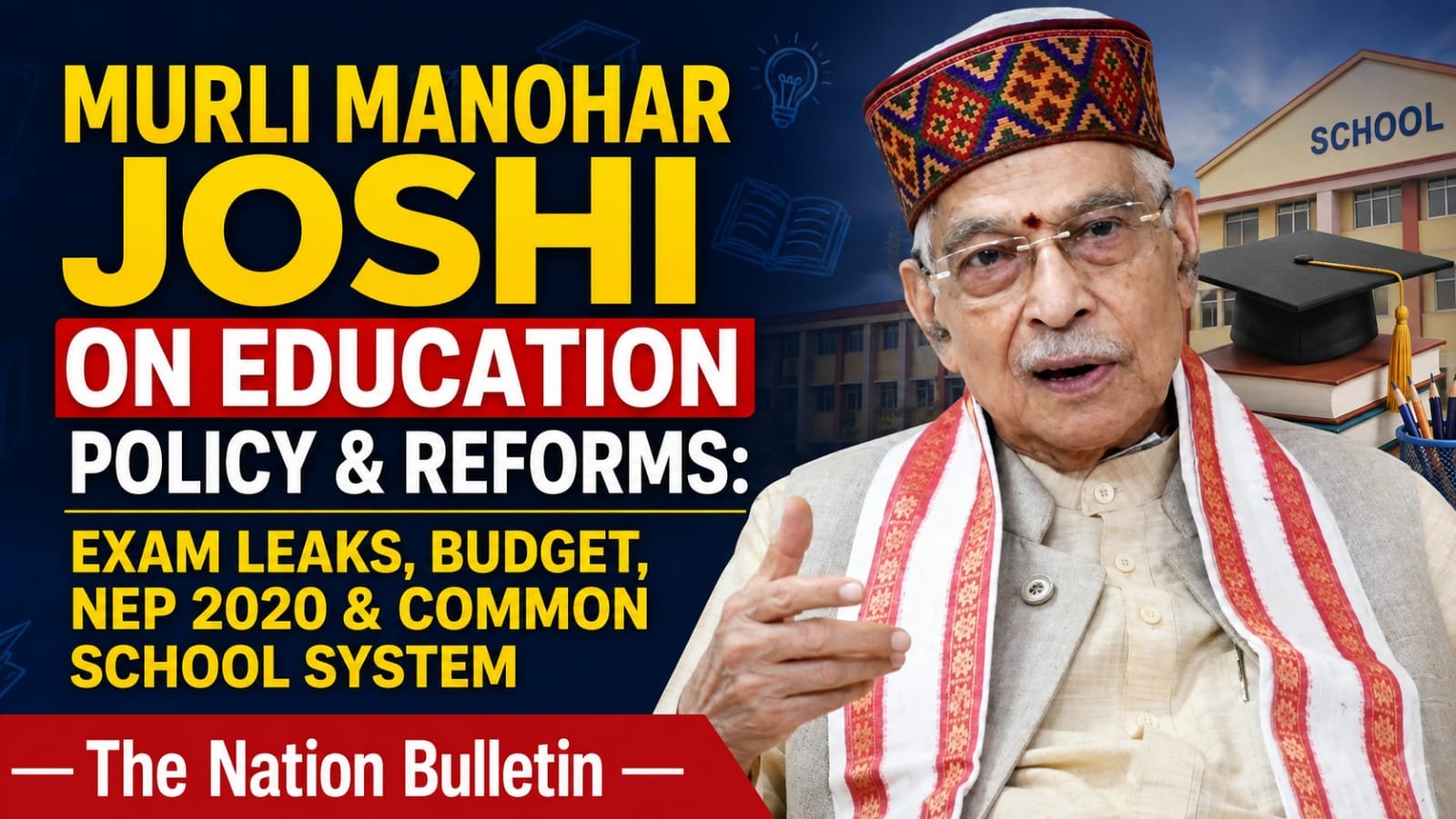
NEW DELHI — Dr. Murli Manohar Joshi’s views on Murli Manohar Joshi education policy present education as a central part of India’s long-term development rather than merely a support system for economic growth. His assessment covers recurring paper leaks, changing budget priorities, the commercialisation of education, the role of policy institutions in shaping the National Education Policy (NEP) 2020, and the need to strengthen public education.
Key Highlights
- Dr. Joshi has linked recurring examination paper leaks to wider institutional corruption rather than treating them only as logistical or technical failures.
- He has questioned the growing emphasis on roads, expressways and physical infrastructure while arguing for greater attention to primary education, public health and research.
- He has raised concerns about highly educated young people facing underemployment because higher education expansion has not been sufficiently aligned with employment opportunities.
- He has criticised the excessive commercialisation of education and raised concerns over very high fees in higher and professional education.
- He has questioned the role of the NITI Aayog in the formulation of NEP 2020 and argued for greater autonomy for educators and teachers.
- He has opposed school closure and consolidation when low enrolment is linked to inadequate infrastructure and staffing.
- He has advocated the Common or Neighbourhood School System associated with the Kothari Commission as a means of promoting social equality.
- He has argued that the idea of a developed India should include human values, social equality and coexistence with nature, rather than being measured only through GDP and physical assets.
Murli Manohar Joshi Education Policy: Examination System and Paper Leak Crisis
Dr. Joshi’s assessment treats repeated paper leaks in competitive and academic examinations as a symptom of a wider institutional problem. In his view, the issue cannot be resolved simply by improving examination logistics, question-paper transportation or security arrangements.
He has connected examination malpractice with corruption across the broader administrative and social system. His argument is that when people see appointments, contracts and promotions being influenced by bribery or financial power, it can weaken ethical standards across society. Students who observe financial irregularities around recruitment or wider governance scandals may also begin to see unfair practices as socially acceptable.
From this perspective, students should not be treated as the sole source of examination malpractice. The administrative environment that permits corruption also needs to be held accountable.
Dr. Joshi has also questioned what he considers an excessive security response to examination leaks. He referred to the use of specialised security forces, confidential printing arrangements and even aircraft for transporting question papers as an approach resembling a situation in which a war has broken out instead of an examination being conducted.
He contrasted the present situation with his experience during the Atal Bihari Vajpayee administration and questioned why a similar nationwide paper-leak crisis was not seen during that period. His broader argument is that examination integrity cannot be isolated from transparency in banking, business, recruitment and governance.
Budget Priorities: Physical Infrastructure Versus Human Capital
A major part of Dr. Joshi’s criticism concerns the balance between spending on physical infrastructure and investment in human capital. He has questioned the declining share of primary education and health in public spending alongside increased emphasis on road transport and physical infrastructure.
His argument is not that expressways, bridges or other infrastructure are unnecessary. Instead, he has questioned treating their construction as the ultimate measure of development. Such infrastructure requires engineers, scientists, technicians and researchers for its design, construction, operation and continued improvement.
Without strong schools, universities and research institutions, India could remain dependent on external sources for sophisticated machinery and technical knowledge. From this perspective, investment in education is directly connected with the country’s ability to build and maintain its physical infrastructure independently.
| Policy Dimension | Earlier Human Capital Framework | Contemporary Physical Infrastructure Framework |
|---|---|---|
| Primary Investment Area | Primary education, public health and basic research | Highways, expressways and logistics infrastructure |
| Core Development Measure | Human development, life values and social equality | GDP growth and asset creation |
| Institutional Role of Education | Non-commercial public service and citizen development | Market-oriented skill development and private investment centre |
| Administrative Unit | Local school and the student at the last mile | Cost efficiency and school consolidation |
Higher Education, Underemployment and Commercialisation
Dr. Joshi has argued that the success of higher education should not be measured only by the number of degrees awarded. In his assessment, education must also connect with productive employment and the actual requirements of the labour market.
He cited the situation of highly qualified young people in metropolitan areas as an example of this mismatch. According to the analysis, young people holding qualifications such as an M.A., Ph.D. and B.Ed. in cities including Delhi may be working on contracts as sanitation workers or junior clerks for salaries of around Rs 25,000 to Rs 30,000. He presents this as evidence of structural underemployment and a lack of strategic coordination between educational expansion and economic planning.
He has also raised concerns about the rapid commercialisation of education and healthcare. His position does not reject private participation altogether, but argues that a defined share of private-sector profits should be reinvested in educational quality and infrastructure.
He has particularly questioned situations in which higher and professional education can demand fees of up to Rs 50 lakh. In his assessment, such costs can push talented students from poorer and middle-class families outside competitive educational opportunities.
The source also links intense social and economic pressures in expensive elite institutions with serious student distress, highlighting the broader institutional pressures associated with the commercialisation of education.
NEP 2020 and the Role of Policy Institutions
Dr. Joshi has argued that education policy should be guided by long-term philosophical and social objectives rather than short-term political or economic priorities. He has also stressed the importance of policy continuity between governments.
Referring to the Atal Bihari Vajpayee period, he said that the government did not completely discard the National Education Policy 1986 prepared during the Rajiv Gandhi administration when changes to textbooks and education policy were discussed. Instead, modifications were made within the existing framework.
His argument is that education is a generational process. Completely replacing a policy merely because it was formulated under a government led by another political party can create instability across the education system.
Questions Over NITI Aayog’s Role in NEP 2020
Dr. Joshi has also questioned the policy-making mechanism behind NEP 2020, particularly the role of the NITI Aayog. He contrasted it with the earlier Planning Commission, saying that during his time, the Planning Commission’s role included estimating national employment and labour requirements but did not involve direct intervention in education policy and curriculum matters.
In discussing the NEP 2020 drafting process, he referred to Dr. K. Kasturirangan, who chaired the draft committee, and indicated that several structural elements of the policy were determined through the NITI Aayog. His concern is that such intervention could reduce the autonomous role of educationists and teachers in policy development.
School Consolidation Versus Basic Facilities
Dr. Joshi has raised serious objections to closing or merging primary and secondary schools on the basis of low enrolment, including approaches associated with initiatives such as SATH-E.
His argument is that declining enrolment in government schools does not necessarily mean that demand for education has disappeared. Instead, inadequate school buildings, roofs, drinking water and availability of teachers for compulsory subjects can influence whether families choose government schools.
From this perspective, closing schools because of low enrolment can amount to the state withdrawing from its responsibility and making access to formal education more difficult for poorer families. He has therefore called for basic infrastructure and staffing to be strengthened rather than relying on school consolidation as the primary response.
Neighbourhood School System and Social Equality
Dr. Joshi has strongly supported the Common or Neighbourhood School System recommended by the Kothari Commission. The proposed approach would bring children from different economic and social backgrounds into the same local school system during their foundational and secondary education.
Under the model described in the source, children from wealthy and poor families, as well as children of senior administrative officials, should study together and receive free education in local neighbourhood schools through the relevant stages.
Dr. Joshi has argued that if constitutional amendment is required to establish such an egalitarian system, that option should also be considered. His underlying argument is that meaningful social equality and improvements in public education are difficult to achieve unless children from different sections of society share the same classrooms.
Rethinking the Meaning of a Developed India
Dr. Joshi has also questioned a definition of ‘developed India’ based primarily on GDP, high-rise buildings and expressways. He has argued that development should also be judged through human values and coexistence with nature.
In this context, he has pointed to tribal communities that may be considered economically backward under conventional measures but, in his assessment, demonstrate strong values through their relationship with nature, environmental sensitivity and emphasis on honesty.
He has also highlighted what he sees as a contradiction between celebrating India’s ancient Vedic knowledge tradition and the idea of India as a ‘Vishwaguru’ on one hand, while allowing education to become an expensive and exclusionary market on the other.
Policy Implications for Education and Governance
The overall argument presented by Dr. Murli Manohar Joshi is that education should not be treated merely as an instrument for supplying labour to the economy. He places education within a wider framework of human development, character formation and social justice.
On examination reform, his position favours institutional transparency, cleaner administration and transparent recruitment processes over increasingly heavy security arrangements alone. On budgeting, he has called for a rebalancing of priorities towards primary education, advanced research and public health alongside physical infrastructure.
On education governance, he has argued for greater autonomy for educational institutions and teachers, stronger basic facilities instead of school closures, and movement towards a Common or Neighbourhood School System. Taken together, these proposals frame education as a long-term public responsibility connected to social equality, institutional integrity and the broader definition of national development.
Frequently Asked Questions
What are Dr. Murli Manohar Joshi’s main concerns about India’s education policy?
Dr. Joshi has raised concerns about examination paper leaks, budget priorities, education commercialisation, school consolidation, NEP 2020 and the role of policy institutions.
What has Dr. Joshi said about examination paper leaks?
He has linked recurring paper leaks to wider institutional corruption and argued that stronger transparency and cleaner administration are needed instead of relying only on security measures.
What is Dr. Joshi’s view on the Common or Neighbourhood School System?
He supports the Common or Neighbourhood School System associated with the Kothari Commission, under which children from different social and economic backgrounds would study together in local schools.
What concerns has Dr. Joshi raised about school consolidation?
He has questioned closing or merging schools because of low enrolment when problems may instead involve inadequate buildings, water facilities and teachers for compulsory subjects.

Sonu Yaduvanshi is a Senior Content Specialist and Digital News Editor at The Nation Bulletin with over 5 years of editorial experience. He specializes in government recruitments, competitive exams, public policy, and national affairs, focusing on source-verified reporting and factual clarity for readers.