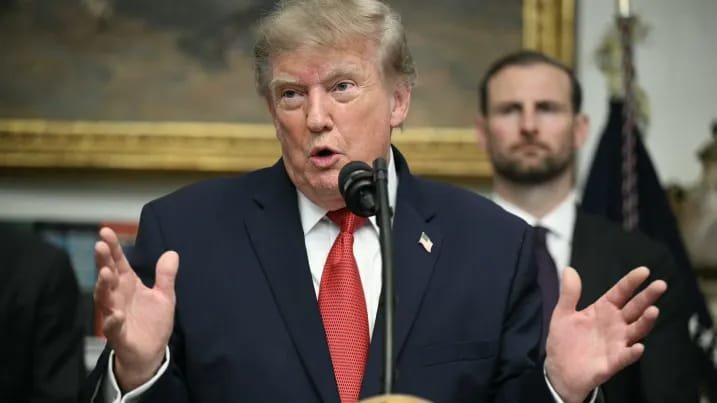
WASHINGTON, United States — President Donald Trump has renewed his criticism of the Federal Reserve’s interest-rate policy, arguing that the United States should be paying substantially lower borrowing costs despite solid economic data. Trump said Federal Reserve Chair Kevin Warsh was doing a “great job” but questioned the policy positions of other members of the central bank’s board.
- Trump urged the Federal Reserve to adopt a more accommodative interest-rate policy.
- He praised Fed Chair Kevin Warsh while accusing other board members of political motivations.
- Minutes from the Fed’s July meeting showed many officials believed higher rates could remain necessary if inflation fails to make further progress.
- Trump compared US borrowing costs with Switzerland’s benchmark rate of about 0.5% and linked lower rates to economic growth and government debt financing.
Trump Says US Interest Rates Should Be Much Lower
Speaking to reporters on Wednesday, Trump argued that stronger economic figures should normally create conditions for lower interest rates. He said the current relationship between economic data and monetary policy was moving in the opposite direction.
“Now, when we announce good numbers, the better they are, the worse it is for interest rates,” Trump said.
Trump said lower rates would support economic growth while also reducing the financing burden associated with the US government’s nearly $40 trillion debt.
Trump Praises Kevin Warsh but Criticizes Fed Board
Trump distinguished Federal Reserve Chair Kevin Warsh from his broader criticism of the central bank. Warsh, whom Trump nominated to lead the institution earlier this year, began serving as chair in May after succeeding Jerome Powell.
Powell remains on the Federal Reserve Board as a governor. Trump has repeatedly criticized Powell in the past over the pace of interest-rate reductions, but on Wednesday he said Warsh was doing a “great job.”
Trump nevertheless questioned the motivations of other board members, saying several were appointed by former presidents Barack Obama and Joe Biden, as well as by Trump himself.
“The problem is he has a board, and it’s a political board,” Trump told reporters.
Trump suggested that some members could favor maintaining higher rates for political reasons, although the Federal Reserve has not voted to increase its benchmark rate in more than three years.
Fed Has Already Cut Rates, but Trump Wants More
The Federal Reserve’s recent policy record differs from Trump’s characterization of the current direction. The central bank has not raised its benchmark interest rate since 2023. The Federal Open Market Committee cut rates three times during the latter part of 2025, following three reductions in 2024.
Those cuts have nevertheless fallen short of what Trump wants. His latest comments came as markets and policymakers continue to assess whether additional reductions will be appropriate in the months ahead.
July Fed Minutes Signal Concern Over Inflation
The timing of Trump’s remarks coincided with the release of minutes from the Federal Open Market Committee’s July meeting. The minutes indicated that many officials expected higher interest rates could still be required unless inflation makes further progress toward the central bank’s 2% target.
Inflation data since the July meeting has generally been positive, according to the supplied report, but the annual inflation rate remains above the Federal Reserve’s 2% objective. That leaves policymakers balancing price pressures against concerns about economic growth.
US Economy Grew 1.5% in Second Quarter
The US economy expanded at an annualized rate of 1.5% in the second quarter, according to the figures cited in the report. The result was below expectations and slower than the 2.1% annualized growth recorded during the first three months of the year.
Trump has argued that lower borrowing costs would help sustain economic activity. His comments reflect his broader preference for monetary conditions that he believes can support growth while lowering the government’s debt-servicing burden.
Trump Compares US Rates With Switzerland
Trump also pointed to the gap between US interest rates and borrowing costs in some other economies. He specifically cited Switzerland, where the benchmark rate is around 0.5%, as an example of a country operating with much lower rates.
Switzerland faces a different economic environment, including very low inflation and a particularly strong safe-haven currency. Trump nevertheless questioned why the United States should be paying around 3.5% when Switzerland’s rate is substantially lower.
“I see countries like Switzerland where they’re the number one lowest interest rates, a half a percent, and we pay three and a half percent,” Trump said.
Trump went as far as saying he had the “absolute right” to cut off all business with a country such as Switzerland, while also saying he did not believe the United States had a bond-market problem despite what he considers excessively high rates.
Treasury Expands Long-Term Bond Market Operations
Trump’s comments came on the same day the US Treasury Department announced an expansion of its bond-market operations. The move followed a rise in longer-maturity debt and is aimed specifically at the longer end of the Treasury market.
The programme will target debt with maturities of at least 10 years. The supplied material also said the Treasury was increasing the minimum size of operations involving 10- to 30-year Treasury securities from $2 billion per transaction to $4 billion, with the objective of improving liquidity in the long-term bond market.
Rate-Cut Debate Keeps Fed Independence in Focus
Trump’s latest remarks add to the continuing debate over the Federal Reserve’s independence and the appropriate pace of monetary easing. While the president wants significantly lower borrowing costs, Fed officials remain focused on bringing inflation closer to their 2% objective before committing to further policy changes.
The July meeting minutes underscore the central challenge facing policymakers: economic growth has slowed, but inflation has not yet returned fully to the Federal Reserve’s target. That tension will remain central to the next stages of the US interest-rate debate.
Markets Await the Fed’s Next Policy Signal
With Trump continuing to demand lower rates and Fed officials weighing inflation risks against slower economic growth, expectations for future policy decisions are likely to remain closely watched. The central bank’s assessment of inflation and economic activity will determine whether further easing becomes appropriate.
For the White House, the issue also carries a significant fiscal dimension because lower borrowing costs could reduce the expense of financing the country’s massive federal debt. For the Federal Reserve, however, the pace of any rate reductions remains tied to its assessment of inflation and broader economic conditions.

Praveen Yadav is the Founder and Editor at The Nation Bulletin. With over 3 years of experience in digital journalism and news reporting, he covers national affairs, governance, and breaking current events with a commitment to factual accuracy and verified reporting.


