An expired paracetamol injection used at Lalganj Community Health Centre in Pratapgarh has triggered disciplinary action against two pharmacists and the sealing of the facility’s medicine store for investigation.
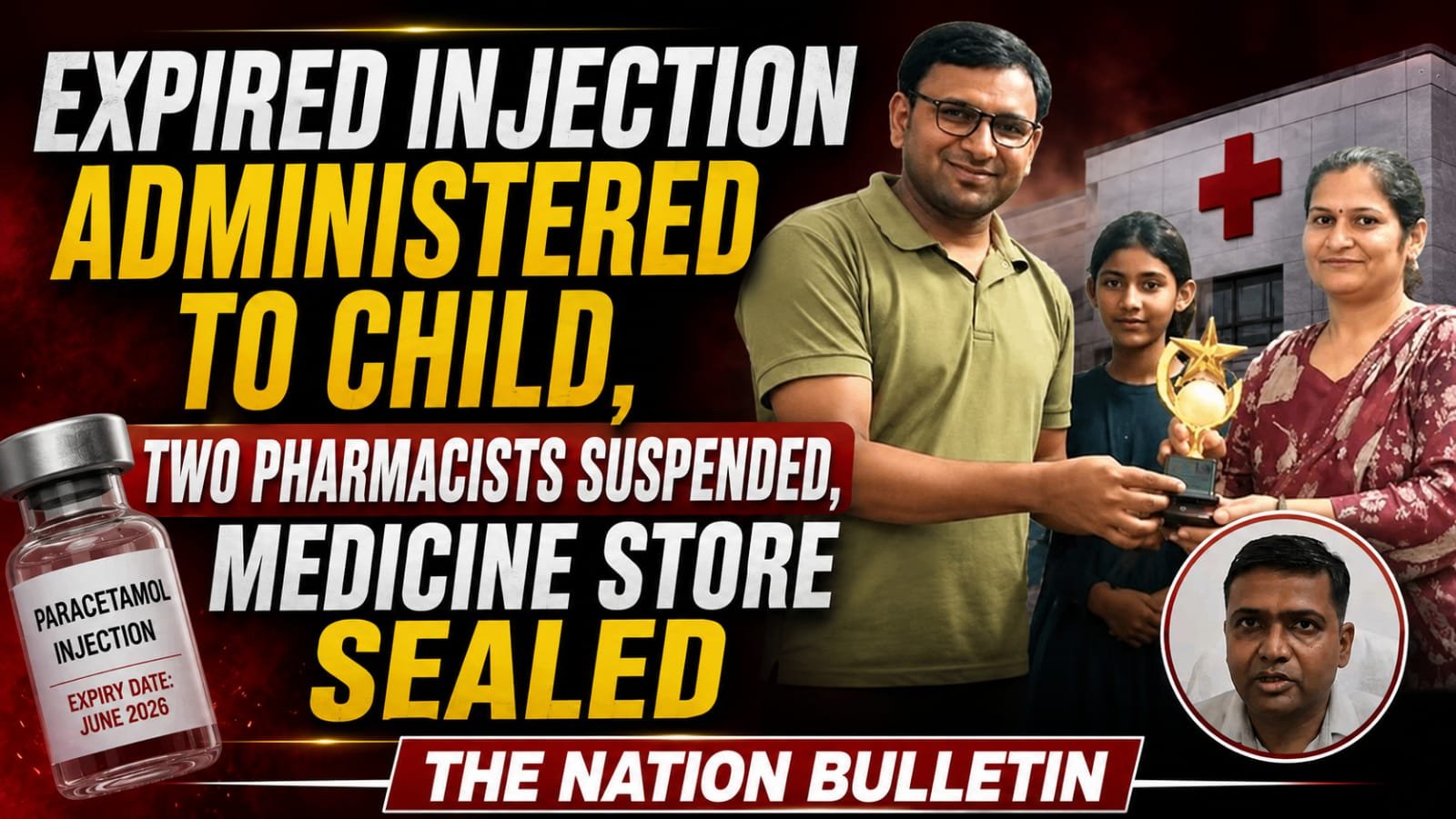
PRATAPGARH, Uttar Pradesh — The expired injection case Pratapgarh has raised questions over medicine storage, expiry-date verification, clinical safety and accountability at government health facilities after an expired paracetamol injection was administered to eight-year-old Shreyasi Singh at Lalganj Community Health Centre (CHC) and Trauma Centre. The incident came to light when the accompanying attendant checked the empty ampoule and found that its stated expiry period was June 2026.
Key Highlights
- Eight-year-old Shreyasi Singh was brought to Lalganj CHC and Trauma Centre with high fever at around 3 pm on Friday.
- Health workers administered intravenous paracetamol through a glucose drip in the emergency room.
- The empty ampoule was subsequently checked and found to carry an expiry period of June 2026.
- Chief Medical Officer Dr. A.N. Prasad ordered disciplinary action, with two pharmacists suspended by Friday evening.
- Duty pharmacist Dev Kumar Dubey was suspended for administering the medicine without checking its expiry date.
- Store in-charge pharmacist Arvind Kumar Shukla was suspended over the release and storage of the expired batch.
- The Lalganj CHC medicine store was sealed on Saturday morning to preserve evidence and facilitate a physical audit and investigation.
- The child showed no apparent toxic or adverse effects from the medicine while under medical observation, according to the supplied account.
Expired Injection Case Pratapgarh: How the Incident Came to Light
The incident occurred at Lalganj CHC and Trauma Centre, located around 35 kilometres from the Pratapgarh district headquarters. Shreyasi Singh, the eight-year-old daughter of Lalganj Sub-Divisional Magistrate (SDM) Vachaspati Singh, was brought to the health centre with a high fever.
During treatment in the emergency room, health workers administered paracetamol intravenously through a glucose drip. After the injection had been used, the accompanying attendant examined the empty ampoule and found that the printed expiry period was June 2026.
Once the issue was identified, the SDM reprimanded the doctors and paramedical staff on duty and immediately informed the Chief Medical Officer and District Magistrate. The child remained under medical observation, with no toxic or adverse effect from the medicine reported in the supplied material.
Two Pharmacists Suspended After Preliminary Inquiry
The health department initiated disciplinary action after Chief Medical Officer Dr. A.N. Prasad took cognisance of alleged gross negligence, indifference towards official duties and violation of safety procedures.
| Administrative or Clinical Component | Details | Action or Responsibility |
|---|---|---|
| Patient | Shreyasi Singh, 8 years old | Daughter of Lalganj SDM Vachaspati Singh |
| Health facility | Lalganj Community Health Centre and Trauma Centre | Located around 35 km from Pratapgarh district headquarters |
| Medicine involved | Intravenous paracetamol injection | Expired medicine was administered |
| Duty pharmacist | Dev Kumar Dubey | Suspended for administering the medicine without verifying its expiry date |
| Store in-charge pharmacist | Arvind Kumar Shukla | Suspended over release of the expired batch and storage failure |
| Administrative attachment | Both suspended pharmacists | Attached to the Office of the Deputy Chief Medical Officer during suspension |
| Evidence preservation | Medicine store at Lalganj CHC | Sealed for physical audit and investigation on the CMO’s orders |
The disciplinary order stated that Arvind Kumar Shukla, the store in-charge, had released the expired medicine from the store, while Dev Kumar Dubey administered it without carrying out the required pre-administration verification. Both pharmacists were attached to the Deputy Chief Medical Officer’s office pending further disciplinary proceedings.
Drug Supply Chain Gaps Behind the Expired Medicine Incident
The case also raises questions beyond the conduct of the two suspended employees. The supplied analysis identifies weaknesses in drug supply chain management, including stock verification, inventory audits, segregation of expired medicines and their regulated disposal.
Medicine-management systems commonly described in the source include First Expiry, First Out (FEFO) and First In, First Out (FIFO). Under the proposed process described in the material, medicines approaching expiry should be removed from active stock and placed in a separate quarantine area before safe condemnation and disposal.
| Control Point | Expected Process Described in the Source | Issue Highlighted by the Case |
|---|---|---|
| Stock rotation | FEFO and FIFO systems | Expired medicine reached the point of administration |
| Expiry management | Near-expiry medicines moved to a quarantine area | Need for stronger segregation and monitoring |
| Inventory verification | Physical stock checks and periodic audits | Absence of an effective routine verification mechanism was highlighted |
| Disposal | Safe condemnation and disposal of expired medicines | No automated system was identified in the supplied analysis |
| Clinical verification | Medicine, patient, dose, route, time and documentation checks | Expiry verification before administration was not followed |
Patient Safety and the Six Rights of Medication Administration
The supplied analysis also points to the Six Rights of Medication Administration: the right patient, right medicine, right dose, right route, right time and right documentation. Verification of medicine validity before administration is presented as an essential part of clinical safety.
The source further discusses risks associated with expired medicines, including reduced effectiveness, possible molecular degradation and contamination concerns. These points form part of the supplied analytical assessment of the risks involved in inadequate medicine-quality controls.
Does Administrative Status Affect Accountability?
The incident has also prompted a broader question about whether government health systems respond equally quickly when ordinary citizens are affected. In this case, disciplinary action and sealing of the medicine store followed within a short period after the issue was reported.
The supplied analysis argues that many patients visiting government hospitals in rural and semi-urban areas may not have the knowledge or opportunity to examine medicine labels, batch numbers and expiry dates themselves. It therefore frames automated quality assurance and transparent stock controls as necessary safeguards for all patients rather than mechanisms that depend on administrative intervention.
Proposed Digital Drug Inventory Reforms
The supplied policy recommendations call for a centralised digital drug inventory management system across primary and community health centres, including e-Aushadhi or a Digital LMS. Under the proposed framework, medicine batch numbers and expiry dates would be linked through barcode technology and entered into the inventory system.
The proposed system would technically freeze a batch 90 days before its expiry, preventing its routine use and allowing sufficient time for segregation and disposal. This would shift expiry management from manual identification towards automated stock control.
Double Verification and Independent Medicine Audits
The source also proposes a double-sign clinical checklist at every health centre. Under this arrangement, both the ward nurse and pharmacist would verify the medicine batch and expiry date before administration and certify the details on the patient’s treatment sheet.
Another proposed measure is an independent medicine inspection cell under the Chief Medical Officer’s office. It would conduct monthly surprise audits of medicine stores at CHCs and PHCs and certify the safe disposal of expired medicines.
The Lalganj incident has already resulted in the suspension of two pharmacists and the sealing of the medicine store for investigation. The wider policy question raised by the case is whether government health facilities can strengthen digital inventory tracking, clinical verification and routine auditing so that expired medicines are identified before they reach patients.
Frequently Asked Questions
What happened in the expired injection case in Pratapgarh?
An expired paracetamol injection was administered to eight-year-old Shreyasi Singh at Lalganj Community Health Centre and Trauma Centre. The issue was discovered after the accompanying attendant checked the empty ampoule.
Which pharmacists were suspended in the Pratapgarh medicine case?
Duty pharmacist Dev Kumar Dubey and store in-charge pharmacist Arvind Kumar Shukla were suspended. Dubey was held responsible for administering the medicine without expiry verification, while Shukla was held responsible for releasing the expired batch and the related storage failure.
What action was taken at Lalganj CHC after the expired injection was found?
The two pharmacists were suspended and attached to the Deputy Chief Medical Officer’s office during the suspension period. The Lalganj CHC medicine store was also sealed on Saturday morning for evidence preservation, physical audit and investigation.
What reforms have been proposed after the Lalganj CHC medicine incident?
The supplied analysis proposes digital drug inventory tracking, barcode-linked batch and expiry records, a 90-day pre-expiry technical freeze, double-sign clinical verification, monthly surprise medicine-store audits and certified disposal of expired medicines.

Praveen Yadav is the Founder and Editor at The Nation Bulletin. With over 3 years of experience in digital journalism and news reporting, he covers national affairs, governance, and breaking current events with a commitment to factual accuracy and verified reporting.