The Lucknow-Kanpur Expressway has come under scrutiny after serious pavement damage, sinkholes and repeated repair failures were reported soon after its opening. The episode has triggered regulatory action, an independent technical inquiry and questions over construction quality and institutional accountability.
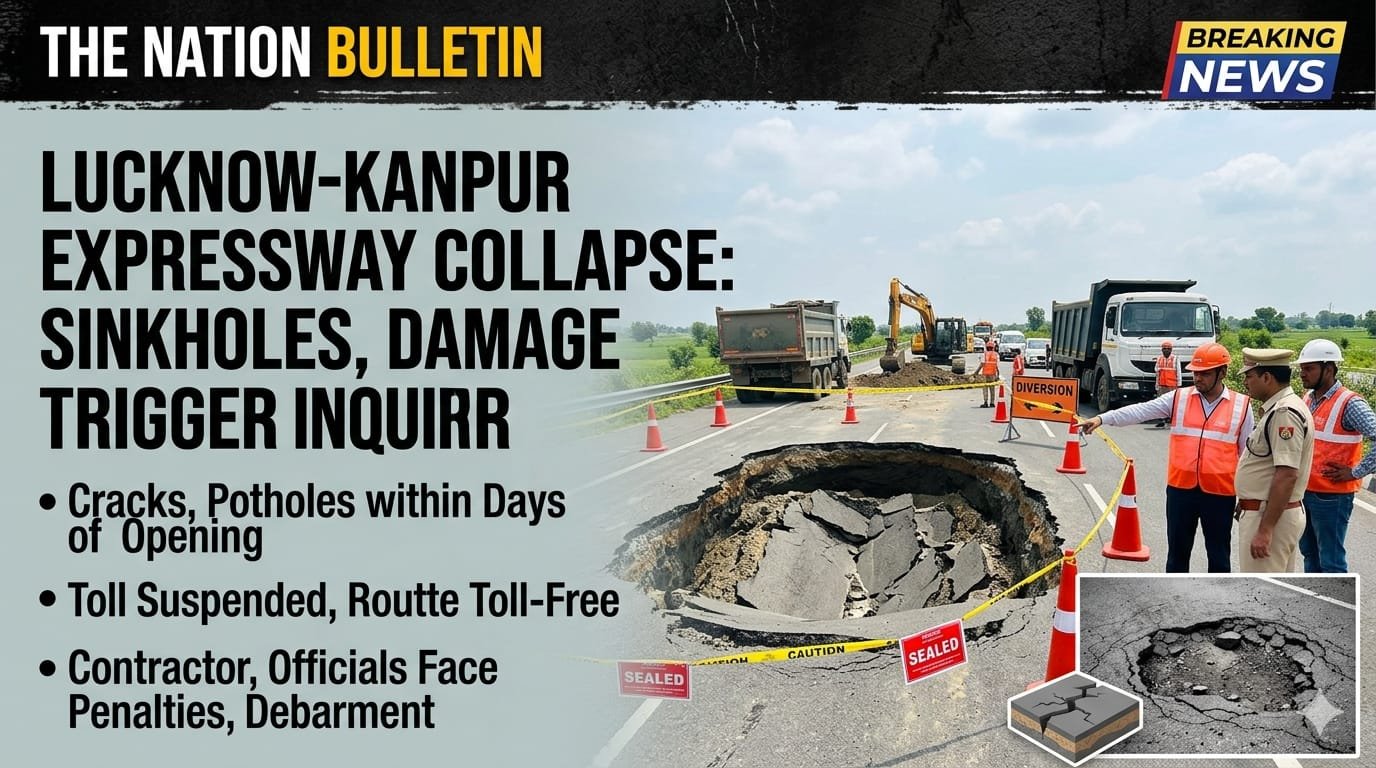
Lucknow, India — The Lucknow-Kanpur Expressway, a 63-kilometre six-lane corridor developed at an estimated cost of about ₹4,200 crore to ₹4,700 crore, has faced major structural and operational problems shortly after its formal inauguration on July 13 by Defence Minister Rajnath Singh. According to the supplied material, cracks, asphalt failures and pavement settlement appeared within 13 days of operations, while more than 80 major potholes and over 2,500 patchwork locations were recorded within the following 24 to 32 days.
Key Highlights
- The 63-kilometre expressway developed widespread pavement distress shortly after opening.
- More than 80 major potholes and over 2,500 patchwork points were reportedly recorded.
- Sinkholes measuring up to 5 metres in length and 1.5 to 3 metres in depth were reported at several locations.
- Toll collection was suspended indefinitely for safety reasons and the route was declared toll-free.
- PNC Infratech faced proposed non-performer action, while several project and engineering officials faced disciplinary measures.
- An independent expert committee headed by IIT Kharagpur civil engineering professor K. S. Reddy was formed to investigate the technical failures.
Lucknow-Kanpur Expressway Faces Widespread Pavement Damage
The most significant deterioration was reported across the approximately 45-kilometre greenfield section between Unnao and Lucknow, affecting both carriageways. The supplied material states that several areas showed deterioration at the sub-base and wearing-course levels.
At kilometre 64.0 near Korari, a 100-metre patch was reportedly applied over an initial 20-metre defect. Within four days, asphalt reportedly swelled and potholes appeared across an area extending around 200 metres. A five-kilometre route diversion was subsequently used for resurfacing, while openings were made in the concrete saucer drain to improve water discharge.
At kilometre 63.3 near Israel Khera, a 100-metre section reportedly settled twice, with repaired asphalt breaking apart and accumulating as debris. Other locations, including Rawal, Neverna, Sikandarpur, Katesar, Kantha, Taura and Badarka, also recorded surface failures, shoulder settlement, slope movement, micro-cracks or damage to the central divider.
Sinkholes and Emergency Repairs Add to Safety Concerns
Among the more severe failures was a crater in the main carriageway at the Behta village section, measuring approximately five metres in length and 1.5 metres in depth. Three dumpers of a DLC mixture were reportedly used for emergency filling.
Another major cavity developed near the Azad Marg toll plaza at the Aata Banthar underpass after rainfall. The cavity was reported to be about five feet wide and 10 feet deep, prompting embankment reconstruction and two days of emergency filling work.
Repeated repairs reportedly failed within 48 to 96 hours in some locations. The continuing deterioration prompted the National Highways Authority of India to suspend toll collection indefinitely on safety grounds and keep the route toll-free.
Drainage and Pavement Performance Under Technical Scrutiny
The supplied technical assessment attributes the deterioration to multiple possible systemic deficiencies rather than rainfall alone. It identifies drainage performance as a major factor, stating that concrete saucer drains running parallel to the carriageway were inadequate for rapidly removing rainwater.
According to the analysis, water entered the shoulder and lower pavement layers, including Wet Mix Macadam and Dense Bituminous Macadam. Excess moisture in the subgrade reportedly reduced soil cohesion and load-bearing capacity, contributing to permanent deformation when heavy commercial vehicles travelled over saturated sections.
The analysis also identifies possible premature oxidation of bitumen as another contributing factor. According to authority officials cited in the source, the civil structure had been completed in June 2025 but did not carry regular traffic for approximately a year. The supplied assessment states that prolonged exposure to weather without traffic-induced compaction may have contributed to deterioration of the bituminous binder.
Repair Methods Also Questioned
The source material raises concerns about the methods used for emergency repairs. It states that industrial fans were used to dry saturated areas during rainfall and that hot-mix asphalt was placed on wet surfaces.
According to the technical assessment, moisture and ineffective prime or tack coats could prevent proper bonding between the new and existing layers. This was cited as a possible reason why some patchwork reportedly broke apart only a few days after application.
Regulatory Action Against Contractor and Officials
The reported failures triggered administrative and contractual action involving the contractor, project officials and independent engineering personnel.
PNC Infratech Limited faced a proposal to be classified as a “non-performer”, along with a two per cent performance-security penalty and an order requiring the contractor to bear the full cost of repairs.
Then-project director Nakul Prakash Verma was reportedly removed from the position and sent back to his parent department, with a formal departmental charge sheet issued. Former project director Saurabh Chaurasia also faced charge-sheet proceedings over alleged supervisory shortcomings.
Project manager Vivek Kumar Gupta was reportedly dismissed and debarred from NHAI and MoRTH projects for two years. Independent engineer team leader Surendra Kumar and resident engineer Yatendra Kumar were also reportedly debarred for two years. Theme Engineering Services, identified as the independent consultant firm, received a show-cause notice for alleged contractual violations.
IIT Kharagpur Committee to Examine Structural Failures
An independent expert committee headed by IIT Kharagpur civil engineering professor K. S. Reddy has been constituted to examine the reasons behind the reported failures. Its scope includes pavement design, material composition and construction standards.
The source also states that laser profilometer technology is being used across the entire 63-kilometre corridor to map micro-cracks, uneven surfaces and structural settlement more precisely.
Questions Over PNC Infratech’s Contractual Record
The supplied material also examines the corporate and political connections associated with PNC Infratech. It identifies Pradeep Kumar Jain, Naveen Kumar Jain and Chakresh Jain among the promoter group. Naveen Kumar Jain is described in the source as a senior BJP leader, former Agra mayor and Uttar Pradesh Rajya Sabha member for the 2024–2030 term.
The source further cites earlier concerns involving the company’s construction record. It states that PNC Infratech received a ₹58 crore government financial bonus in 2018 for completing a 56-kilometre section of the Agra-Lucknow Expressway ahead of schedule, but that a major road cavity subsequently developed on that section within six months.
The supplied material also states that the Central Bureau of Investigation began an investigation in 2024 naming four PNC Infratech officials in a case involving an alleged bribe to an NHAI general manager-cum-project director.
New Highway Contracts Amid Regulatory Proceedings
Another issue highlighted in the source is the allocation of new highway projects while regulatory action concerning the Lucknow-Kanpur Expressway was underway. According to the supplied material, NHAI awarded PNC Infratech two new Hybrid Annuity Model projects in July 2026 with a combined value of ₹3,483 crore.
The projects identified in the source are the four-laning of the Barabanki-Mustafabad section of NH-927, valued at ₹1,728 crore, and the Mustafabad-Biswan section, valued at ₹1,755 crore. The simultaneous regulatory proceedings and new contract awards have prompted questions in the supplied analysis about contractor qualification, technical track records and accountability in public highway contracts.
Potential Scale of Reconstruction
The source estimates the immediate cost of primary corrective work at around ₹3 crore. However, it states that if the IIT Kharagpur investigation confirms serious defects in the sub-base layers and embankment soil, reconstruction of the entire 125 to 126 lane-kilometre, 525-millimetre-thick pavement package could become necessary.
Such extensive reconstruction could raise the final cost to hundreds of crores of rupees, according to the supplied assessment. Under the reported contract terms, the construction agency is responsible for operation and maintenance for 15 years, meaning the source states that the resulting financial burden would fall on the contractor.
The technical investigation and detailed mapping of the corridor will determine the extent of the structural problems and the scale of corrective work required. The project remains under scrutiny over construction quality, drainage performance, engineering supervision and institutional accountability.
Quick Answers for Candidates
What problems were reported on the Lucknow-Kanpur Expressway?
The expressway reportedly developed pavement cracks, asphalt failures, settlement, more than 80 major potholes, over 2,500 patchwork locations and several sinkholes.
Why was toll collection suspended on the Lucknow-Kanpur Expressway?
The supplied material states that NHAI suspended toll collection indefinitely on safety grounds and kept the route toll-free amid continuing deterioration.
Who is investigating the structural failures of the Lucknow-Kanpur Expressway?
An independent expert committee headed by IIT Kharagpur civil engineering professor K. S. Reddy was constituted to examine the reported failures.
What could happen if serious pavement defects are confirmed?
The supplied assessment states that if serious defects in the sub-base layers and embankment soil are confirmed, reconstruction of the entire pavement package could become necessary.

Praveen Yadav is the Founder and Editor at The Nation Bulletin. With over 3 years of experience in digital journalism and news reporting, he covers national affairs, governance, and breaking current events with a commitment to factual accuracy and verified reporting.