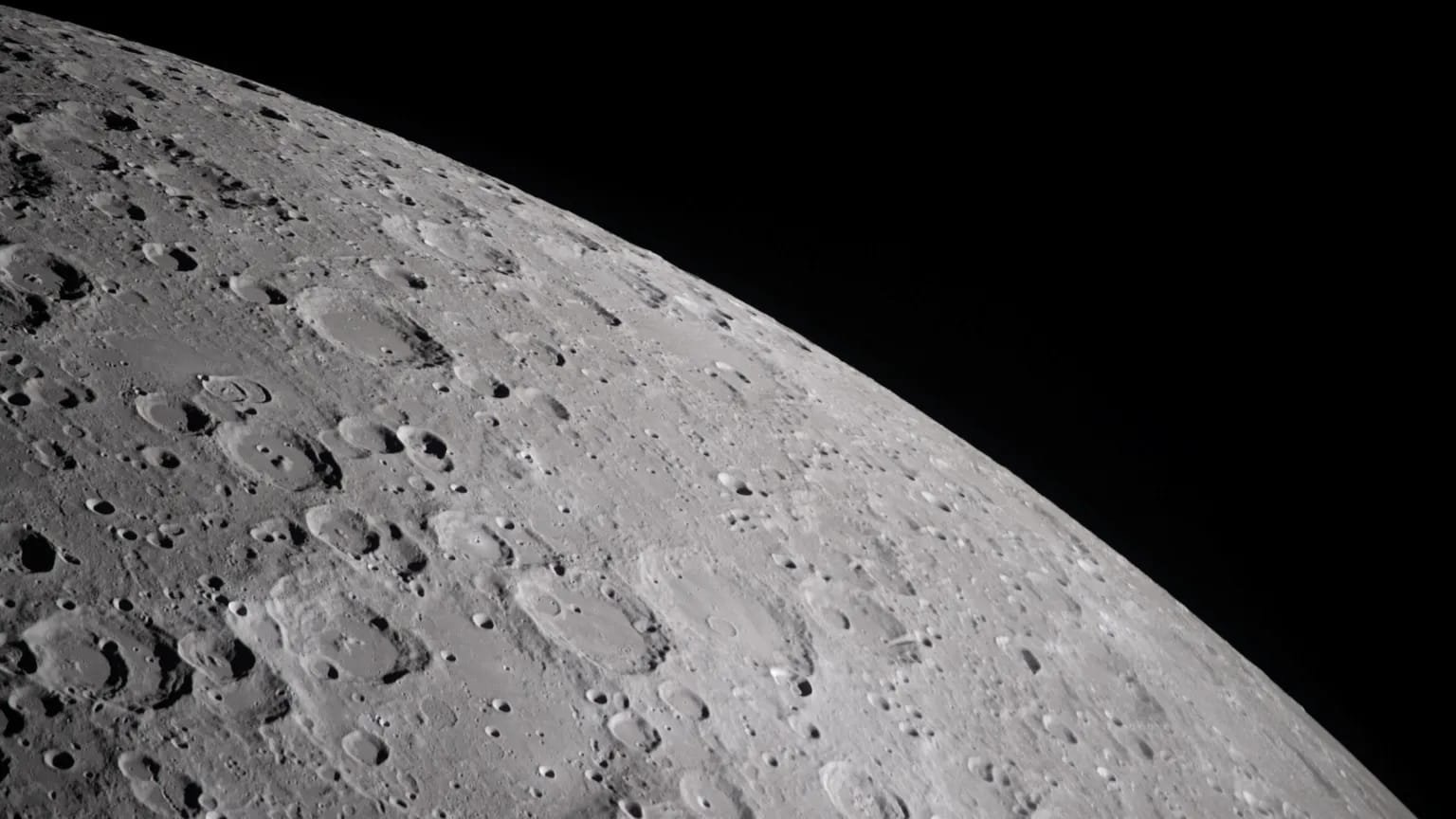
Washington, August 5: A spent upper stage of a SpaceX Falcon 9 rocket is believed to have crashed into the Moon, creating what scientists expect to be a fresh impact crater near the well-known Einstein crater. While the collision was unplanned, researchers say it presents a valuable scientific opportunity to better understand how high-speed impacts shape the lunar surface and influence future Moon exploration missions.
The rocket stage, which had been drifting through space since completing its mission in January last year, was expected to strike the lunar surface at a speed of around 5,400 mph (8,700 km/h). Scientists believe the impact occurred near the Einstein crater, a large lunar formation located on the Moon’s far side.
Spent Falcon 9 Stage Drifted Toward the Moon
The Falcon 9 mission successfully delivered two lunar landers into space after launching from Florida. Once the payloads were sent toward the Moon, the rocket’s upper stage completed its job and remained in a long, looping orbit around Earth and the Moon.
Over the following 18 months, the combined gravitational influence of the Earth, Moon and Sun, together with the subtle pressure created by sunlight, gradually altered the rocket stage’s trajectory. Astronomers monitoring the object later determined that these small forces had placed it on a direct course toward the lunar surface.
The upper stage, estimated to weigh more than 4,000 kilograms and measuring roughly the height of a five-storey building, accelerated continuously before the expected impact.
Impact Difficult to Observe Directly
Scientists believe the collision generated a brief flash of light that lasted only a fraction of a second, making it extremely difficult to observe from Earth. Even advanced amateur telescopes were unlikely to capture the moment because of the short duration and the great distance separating Earth and the Moon.
Researchers say observers may instead detect a cloud of dust thrown high above the lunar surface following the impact. According to scientific estimates, the dust plume could extend up to 100 kilometres before gradually settling back onto the Moon.
Several major observatories across the Americas are now analysing observational data collected around the expected time of impact. Scientists caution that processing the information and confirming the exact results could take several days or even weeks.
NASA and Lunar Orbiters Expected to Study the Crash Site
Although no spacecraft was ideally positioned to witness the collision live, lunar orbiters are expected to play a crucial role in examining its aftermath. NASA’s Lunar Reconnaissance Orbiter is anticipated to capture detailed images of the impact region, allowing researchers to compare photographs taken before and after the event.
South Korea’s Danuri lunar orbiter also reportedly passed near the impact area shortly before the expected collision. Researchers associated with the mission are expected to analyse the collected observations before releasing any findings.
Accidental Impact Creates Valuable Research Opportunity
For planetary scientists, the unexpected collision represents far more than an isolated space event. Because researchers already know the approximate size, weight, speed and expected impact location of the Falcon 9 upper stage, the incident effectively becomes a real-world scientific experiment that can be used to test existing models of lunar impacts.
Scientists will analyse how the collision excavated the lunar surface, the dimensions of the newly formed crater, the amount of debris ejected into space and the way shockwaves travelled through the Moon’s crust. The findings are expected to improve scientific understanding of impact physics and the behaviour of the lunar surface under high-speed collisions.
Why the Findings Matter for Future Moon Missions
The data collected from the impact could help engineers design safer lunar missions in the years ahead. Understanding how far rock fragments and dust travel after a collision is considered important for protecting spacecraft, robotic missions and future human habitats planned near the Moon’s surface.
Researchers also hope the freshly exposed material beneath the lunar surface will provide additional insights into the Moon’s geological history. Studying subsurface rocks may improve understanding of how the Earth-Moon system formed approximately 4.5 billion years ago and how the lunar landscape has evolved over billions of years.
One of Several Human-Made Objects to Reach the Moon
Human-made spacecraft have impacted the Moon on numerous occasions since the early years of space exploration. Some missions intentionally targeted the lunar surface for scientific research, while others reached the Moon unintentionally after completing their primary objectives.
The first recorded human-made impact occurred in 1959 when the Soviet Union’s Luna 2 probe became the first spacecraft to reach the Moon. Over subsequent decades, several NASA Ranger spacecraft, Apollo mission hardware and dedicated research missions also intentionally collided with the lunar surface to gather scientific information.
More recently, NASA’s LCROSS mission deliberately struck the Moon in 2009 to investigate the presence of water ice within permanently shadowed craters. The last confirmed accidental impact occurred in 2022, when a discarded rocket booster was believed to have collided with the lunar surface after spending years in space.
Scientists Await Detailed Analysis
Although the collision is believed to have occurred as predicted, researchers emphasise that confirmation of the exact impact site and crater size will depend on detailed analysis of telescope observations and high-resolution images from lunar orbiters.
As scientists continue processing the collected data, the Falcon 9 upper-stage impact is expected to contribute valuable information to planetary science while helping improve planning for future robotic and human exploration of the Moon.

Praveen Yadav is the Founder and Editor at The Nation Bulletin. With over 3 years of experience in digital journalism and news reporting, he covers national affairs, governance, and breaking current events with a commitment to factual accuracy and verified reporting.