UPSC Mains GS Paper 3 2026 was assessed as moderate and manageable, with the paper continuing the recent emphasis on analytical questions, contemporary issues, current affairs and data-backed answers.
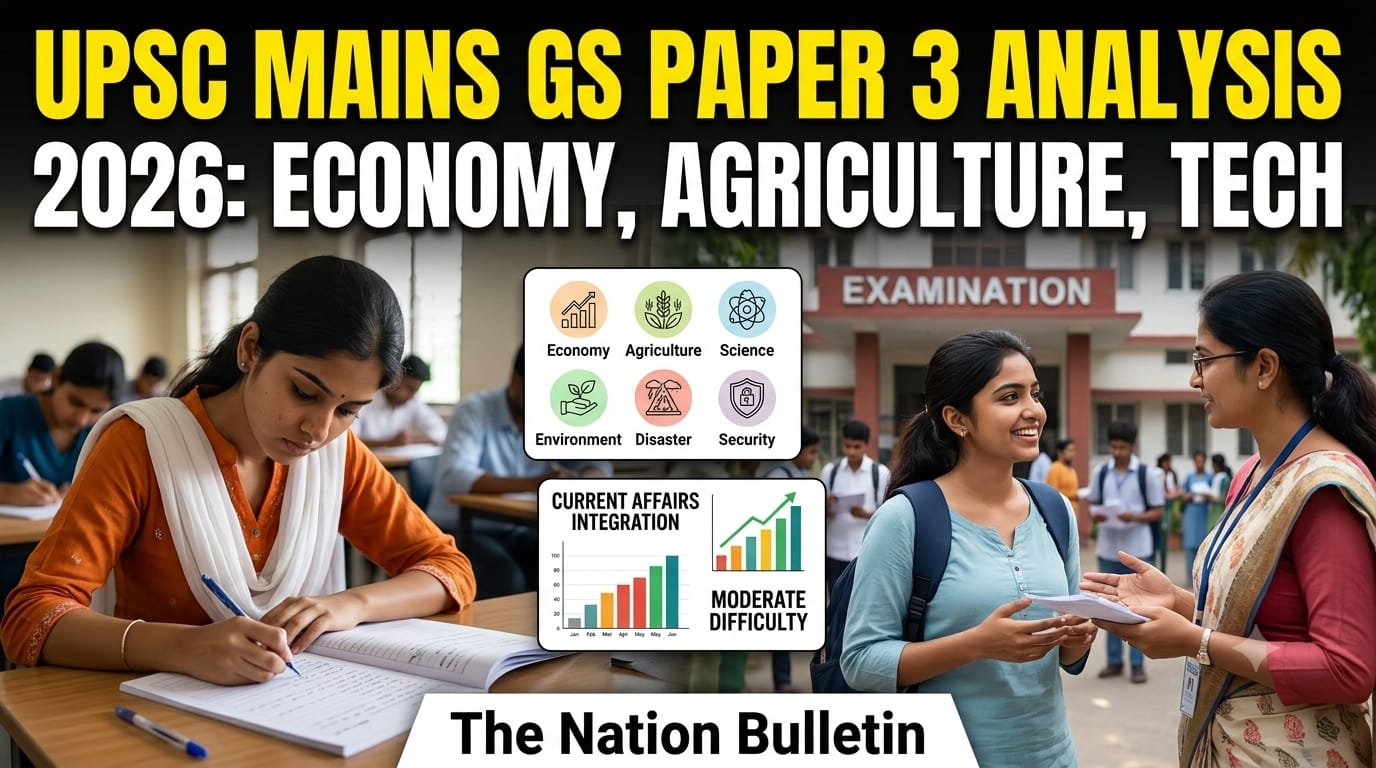
NEW DELHI, India — The Union Public Service Commission conducted the UPSC Civil Services Mains 2026 General Studies Paper 3 examination on August 23, 2026, in the forenoon session. The 250-mark descriptive paper covered Indian Economy, Agriculture, Science and Technology, Environment and Biodiversity, Disaster Management, and Internal Security.
The initial UPSC Mains GS Paper 3 Analysis 2026 indicates that the overall difficulty was moderate. Candidates who had maintained regular current-affairs preparation and practised answer writing were better placed to handle questions requiring links between static concepts and contemporary developments.
Key Highlights
- UPSC GS Paper 3 was conducted on August 23, 2026, during the forenoon session.
- The paper carried 250 marks and had a three-hour duration.
- The overall difficulty level was assessed as moderate and manageable.
- The paper covered Economy, Agriculture, Science and Technology, Environment and Biodiversity, Disaster Management, and Internal Security.
- Current affairs were closely integrated with static concepts across the paper.
- Data, rankings, statistics and specific examples were highlighted as important value additions for high-quality answers.
UPSC Mains GS Paper 3 Difficulty Level 2026
The UPSC Mains GS Paper 3 difficulty level 2026 was described as moderate, with individual questions varying from relatively accessible to those requiring deeper analytical understanding. The paper was considered manageable for candidates who had consistently followed contemporary developments alongside their static preparation.
The nature of the questions meant that simply recalling information was not enough in several areas. Candidates needed to understand the relevance of current developments and present their arguments in a structured manner within the limited examination time.
UPSC Mains GS Paper 3 Paper Pattern
| Particular | Details |
|---|---|
| Exam | UPSC Civil Services (Main) Examination 2026 |
| Paper | General Studies Paper 3 |
| Paper Number | Paper III |
| Exam Date | August 23, 2026 |
| Session | Forenoon |
| Duration | 3 Hours |
| Maximum Marks | 250 |
| Nature | Descriptive |
| Major Areas | Economy, Agriculture, Science & Technology, Environment & Biodiversity, Disaster Management and Internal Security |
UPSC Mains GS Paper 3 Question Paper Analysis 2026
The paper maintained representation across the six broad areas covered by the GS Paper 3 syllabus. The supplied analysis indicates approximately four questions each from Economy, Agriculture, Science and Technology, and Internal Security, while Environment and Disaster Management were also represented in the paper.
This distribution required candidates to maintain broad preparation rather than relying heavily on a single GS Paper 3 subject. The range of areas also reinforced the need for candidates to switch between economic, technological, environmental and security-related themes during the examination.
Current Affairs Remained Central to GS Paper 3
A major feature identified in the UPSC Mains GS Paper 3 Analysis 2026 was the integration of current affairs with foundational concepts. Questions connected with developments such as the Digital Rupee and the Financial Inclusion Index required candidates to bring together contemporary information and their understanding of the underlying subject.
Mission Drishti was another current-development reference highlighted in the analysis. Such questions demonstrate the importance of following recent developments while simultaneously understanding the static concepts needed to explain their broader significance.
Importance of Data-Backed Answers
The analysis also highlighted the strategic value of using reliable data and specific examples in GS Paper 3 answers. Generic statements may provide a basic explanation, but relevant figures, rankings and concrete examples can give greater substance to an analytical response.
Examples mentioned in the source include the Global Innovation Index and startup statistics. Candidates preparing for future examinations can therefore maintain compact collections of important data points that can be deployed across Economy, Science and Technology and other relevant areas.
What the 2026 GS Paper 3 Analysis Means for Aspirants
The paper reinforces the need to combine static preparation with current affairs. Candidates should avoid treating these two components as separate areas because contemporary questions can require the application of concepts learned from standard study material.
Answer-writing practice is equally important. Regular timed writing can help aspirants improve the speed at which they organise arguments, select relevant examples and present information within the three-hour examination window.
Recommended Preparation Approach for Future UPSC Candidates
Future aspirants should use standard static resources as the foundation while continuously updating their preparation through reliable current-affairs sources. The analysis specifically points toward resources such as the Economic Survey, PIB, The Hindu and The Indian Express for strengthening current-affairs preparation.
Specific examples and data should be collected alongside topics rather than separately at the end of preparation. This makes it easier to support arguments when answering questions on economic reforms, internal security, technology and other analytical areas.
Previous-year questions should also be incorporated into regular practice. Writing answers to actual Mains questions helps candidates understand the difference between knowing a topic and presenting a focused, structured response under examination conditions.
UPSC Mains GS Paper 3: Key Takeaways
- Maintain strong foundations across all six major GS Paper 3 areas.
- Connect static concepts with recent developments and current affairs.
- Use specific examples, facts and data to substantiate important arguments.
- Track reliable government and current-affairs sources regularly.
- Practise answer writing under timed conditions to improve speed and structure.
- Build concise revision material containing useful statistics, rankings and examples.
Frequently Asked Questions
When was UPSC Mains GS Paper 3 2026 conducted?
UPSC Mains GS Paper 3 2026 was conducted on August 23, 2026, during the forenoon session.
What was the UPSC Mains GS Paper 3 difficulty level in 2026?
The overall difficulty was assessed as moderate and manageable, although some questions required deeper analytical understanding.
How many marks does UPSC GS Paper 3 carry?
UPSC Mains GS Paper 3 carries 250 marks and is conducted as a descriptive written examination.
Which subjects are covered in UPSC GS Paper 3?
GS Paper 3 covers Indian Economy, Agriculture, Science and Technology, Environment and Biodiversity, Disaster Management, and Internal Security.
What was the major trend in UPSC GS Paper 3 2026?
The major trend identified in the analysis was the integration of current affairs with static concepts, along with an emphasis on analytical and data-supported answers.
The 2026 GS Paper 3 paper therefore reinforces a preparation model built around breadth, current awareness and analytical answer writing. For future aspirants, the key lesson is to combine static knowledge with reliable data, contemporary examples and consistent timed practice.

Praveen Yadav is the Founder and Editor at The Nation Bulletin. With over 3 years of experience in digital journalism and news reporting, he covers national affairs, governance, and breaking current events with a commitment to factual accuracy and verified reporting.