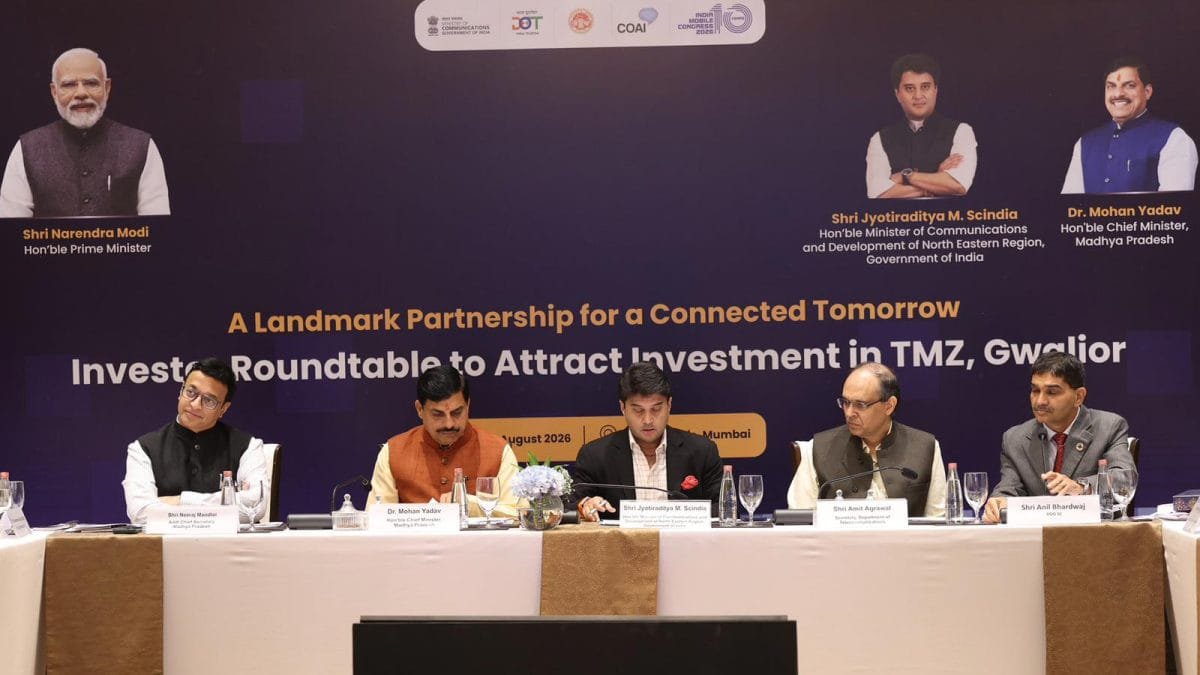
India’s first dedicated Telecom Manufacturing Zone (TMZ) in Gwalior has received cumulative investment commitments worth ₹5,500 crore, marking a significant step in the country’s efforts to strengthen domestic telecom manufacturing. The latest round of proposals, valued at ₹2,000 crore, was announced during the second Investors’ Meet held in Mumbai on Tuesday and is expected to create nearly 4,000 new jobs.
With these fresh commitments, the project’s total estimated employment generation has crossed 18,000 jobs. The new investments build on the ₹3,500 crore worth of proposals secured during the inaugural Investors’ Roundtable in New Delhi last week, where companies also indicated the potential to create around 14,000 employment opportunities.
Scindia and MP Chief Minister Lead Investor Outreach
The Investors’ Meet was jointly chaired by Union Minister for Communications and Development of North Eastern Region Jyotiraditya M. Scindia and Madhya Pradesh Chief Minister Dr. Mohan Yadav. Around 18 leading companies representing different segments of the telecom ecosystem participated in the discussions, reflecting growing industry interest in the proposed manufacturing hub.
The government has set an ambitious target of attracting investments exceeding ₹10,000 crore into the Telecom Manufacturing Zone over the coming years. Officials believe the project will play an important role in expanding India’s manufacturing capabilities while strengthening the country’s position in the global telecommunications supply chain.
Government Highlights India’s Telecom Transformation
Addressing industry leaders, Scindia said India’s telecommunications and digital sectors have witnessed a major transformation over the past 12 years under the leadership of Prime Minister Narendra Modi. He said the country’s rapid digital expansion has created favourable conditions for establishing India as a global manufacturing destination for telecom products.
The Union Minister stressed that the next phase of growth should focus on increasing domestic manufacturing capacity alongside innovation. Referring to the vision of “Make in India, Make for the World” and “Local for Global”, he said India should transition from being primarily a services-driven economy to one that also leads in the design and production of globally competitive telecom products.
Scindia said this transformation would require greater domestic value addition, stronger intellectual property creation within India and increased participation by Indian companies in the global telecom equipment market.
Integrated Telecom Manufacturing Ecosystem Planned
According to the Union Minister, the proposed Telecom Manufacturing Zone has been designed as a first-of-its-kind initiative dedicated exclusively to the telecommunications sector. Unlike conventional industrial parks, the project aims to bring together the complete telecom value chain within a single integrated ecosystem.
The proposed cluster will support activities ranging from research and development to manufacturing, semiconductor-related activities, testing facilities, optical fibre production, telecom equipment manufacturing and other allied industries. Officials believe such an integrated approach will improve collaboration among companies while strengthening India’s manufacturing capabilities in advanced telecom technologies.
Gwalior Chosen for Strategic Advantages
Scindia highlighted several factors that influenced the selection of Gwalior as the location for India’s first Telecom Manufacturing Zone. He said the city’s central geographical position, improving transport connectivity, existing industrial infrastructure, availability of skilled manpower and competitive operating costs make it an attractive destination for domestic and international investors.
He also referred to major infrastructure projects currently under development, including the proposed Agra-Gwalior Greenfield Expressway. Once completed, the expressway is expected to reduce travel time between Delhi-NCR and Gwalior to less than three hours, further improving logistics and industrial connectivity for businesses operating in the region.
Special Purpose Vehicle to Oversee Project Implementation
Scindia said the Telecom Manufacturing Zone will be implemented through a Special Purpose Vehicle (SPV) comprising representatives from the Department of Telecommunications (DoT) and the Government of Madhya Pradesh. He described the arrangement as a unique Centre-State partnership aimed at ensuring faster decision-making, smoother project execution and better coordination with investors.
The SPV is expected to facilitate investment approvals, infrastructure development and industry engagement while creating an enabling environment for companies looking to establish manufacturing and research facilities in the proposed cluster.
Madhya Pradesh Invites Global Investors
Chief Minister Dr. Mohan Yadav invited domestic and international companies to invest in Madhya Pradesh, highlighting the state’s investor-friendly policies, manufacturing ecosystem and industrial incentives. He said the Telecom Manufacturing Zone represents an important collaborative initiative between the Union Government and the state government to strengthen India’s telecom manufacturing capabilities.
The investor outreach programme was organised by the Department of Telecommunications in collaboration with the Cellular Operators Association of India (COAI). Alongside the Investors’ Roundtable, a Strategic Roundtable on “Capitalizing India’s Telecom Decade and Promoting Telecom Manufacturing Zone” brought together industry leaders to discuss long-term opportunities in the sector.
Leading Technology Companies Show Interest
According to the Department of Telecommunications, several global technology companies—including Qualcomm, Ericsson, Nokia, NTT DATA, TCS and Tech Mahindra—expressed interest in exploring investment opportunities within the proposed Telecom Manufacturing Zone. The discussions also included the possibility of establishing global service support and development centres in Gwalior.
India’s three private telecom service providers—Bharti Airtel, Reliance Jio and Vodafone Idea—also welcomed the initiative. The companies said they would encourage their vendor ecosystems to evaluate manufacturing and supply chain opportunities inside the upcoming industrial cluster.
170-Acre Plug-and-Play Industrial Cluster Planned
The Telecom Manufacturing Zone is being developed across approximately 170 acres in Gwalior as a plug-and-play industrial cluster dedicated to telecom manufacturing, research and development, innovation, mobile devices, optical fibre, telecom equipment and next-generation 5G and 6G technologies.
Under the Memorandum of Understanding signed between the Union Government and the Government of Madhya Pradesh, the Centre will provide 100% funding of ₹493 crore for Phase I of the project. The state government has allotted nearly 170 acres of land free of cost and announced a range of incentives to encourage investment in the zone.
India Eyes Global Leadership in Telecom Manufacturing
During the strategic discussions, Scindia also invited global investors to participate in the India Mobile Congress 2026, scheduled to be held from October 7 to 10 at Yashobhoomi in New Delhi. The event is expected to provide another platform for showcasing India’s growing telecom ecosystem and attracting international investment.
With investment commitments now reaching ₹5,500 crore and the government targeting more than ₹10,000 crore in the coming years, the Telecom Manufacturing Zone is expected to play a significant role in strengthening domestic production, expanding exports, encouraging technological innovation and generating large-scale employment. Officials believe the initiative will support India’s broader vision of Aatmanirbhar Bharat while positioning the country as a global hub for telecom manufacturing and next-generation communications technology.

Praveen Yadav is the Founder and Editor at The Nation Bulletin. With over 3 years of experience in digital journalism and news reporting, he covers national affairs, governance, and breaking current events with a commitment to factual accuracy and verified reporting.