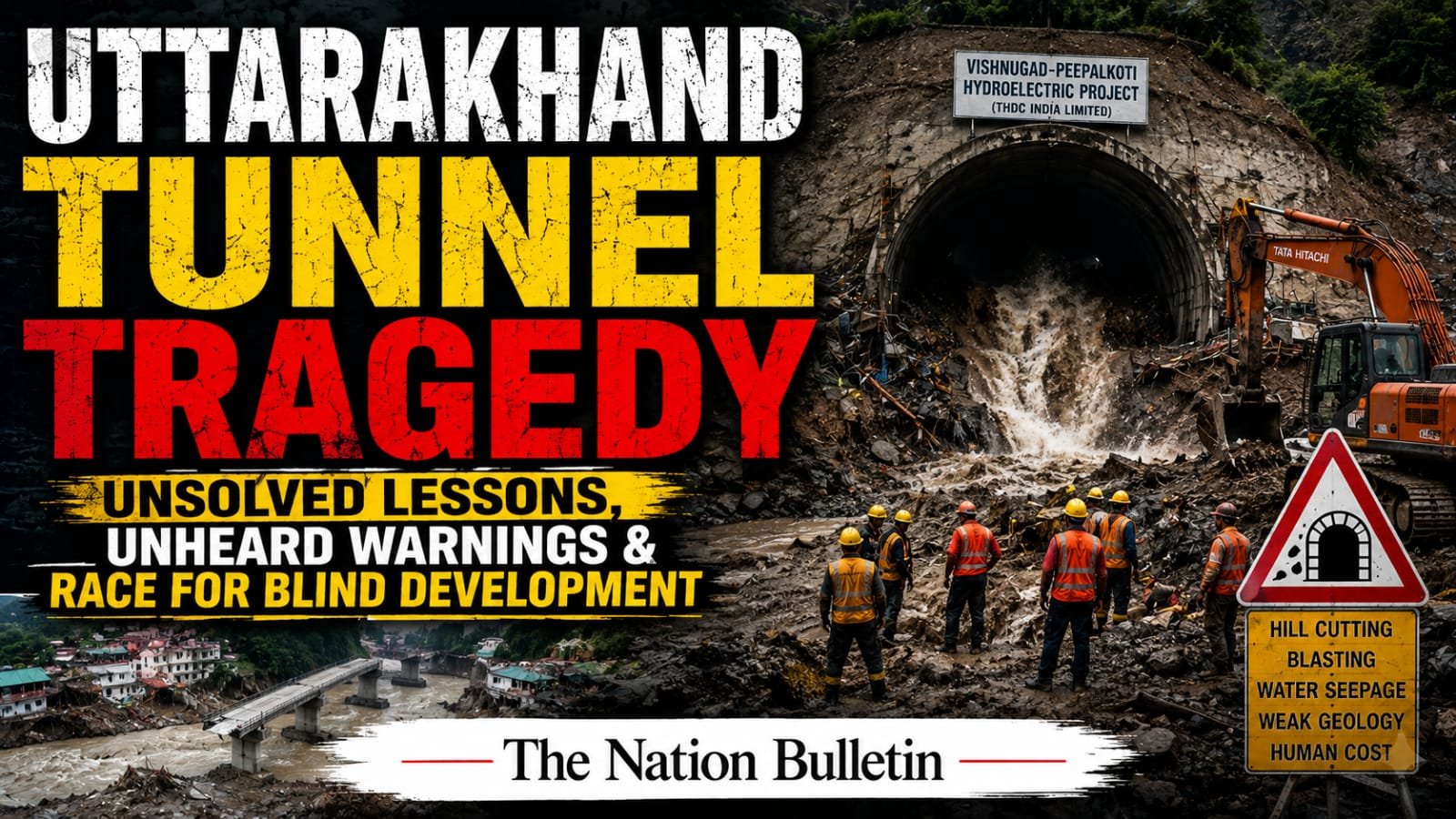
CHAMOLI, India — Uttarakhand Tunnel Accidents: The tunnel accident at the under-construction Vishnugad-Pipalkoti Hydroelectric Project in Uttarakhand’s Chamoli district on August 13 has once again raised questions over safety standards, geological assessments and the pace of infrastructure development in the Himalayan region. A sudden surge of water and debris inside the project’s tunnel killed eight workers and injured more than 14 others, according to the supplied report.
The accident has renewed scrutiny of a pattern that has repeatedly emerged in Uttarakhand. From the 2021 Rishiganga disaster and the 2023 Silkyara tunnel crisis to the latest Pipalkoti incident, questions remain over whether investigations and compensation are being followed by meaningful changes in tunnel-construction practices and worker-safety systems.
What happened at the Vishnugad-Pipalkoti tunnel?
The accident occurred inside the Mayapur tunnel of the Vishnugad-Pipalkoti hydropower project, being developed by THDC. Water and debris suddenly entered the construction area, creating a deadly emergency for workers inside the tunnel.
The supplied material points to several geological and hydrological risks that had reportedly been identified in scientific assessments associated with the project. These included weak rock formations, shear zones, natural fractures and significant water seepage from above the tunnel.
The location also has natural drainage channels above the construction area. The report identifies Mona Nala and two other seasonal streams running above the tunnel, raising concerns about the additional pressure created by water during the peak monsoon period.
Were geological warnings already known?
According to the supplied material, internal scientific reports associated with the project had already identified geological vulnerabilities in the area. Weak rock, shear zones and natural fractures can complicate underground excavation because the stability of the surrounding rock mass can change rapidly once construction begins.
Water seepage was another identified concern. In a Himalayan tunnel, underground water movement can interact with fractured rock and excavation activity, increasing the difficulty of maintaining stable working conditions.
The report argues that these warning signs required construction and safety measures to be adapted to the conditions on the ground, particularly during the monsoon season.
Why construction methods are under scrutiny
The supplied material raises questions about the use of the drill-and-blast method, or D&BM, in a sensitive Himalayan geological environment. Unlike highly controlled mechanical excavation, blasting introduces repeated explosive disturbance into the surrounding rock mass.
The central concern is not that drill-and-blast excavation is inherently unsuitable for every Himalayan tunnel, but whether the method, blasting pattern, ground-support system and monitoring regime are appropriate for the specific geological conditions encountered during construction.
The material argues that greater use of controlled excavation methods, including tunnel boring technology where technically suitable, could reduce some forms of disturbance. The choice of excavation method, however, has to be determined by geology, tunnel dimensions, ground conditions and project design.
Uttarakhand’s recurring tunnel and hydropower accidents
The Pipalkoti accident has been placed in a wider history of tunnel, hydropower and landslide-related incidents in Uttarakhand. The supplied data identifies several major events over the past decade and a half.
| Year | Project / Location | Nature of Incident | Reported Impact |
|---|---|---|---|
| 2010 | Rishiganga Hydroelectric Project, Chamoli | Major landslide and debris | 3 workers died and several others were injured. |
| 2021 | Tapovan-Vishnugad and Rishiganga, Raini | Glacier-related disaster and tunnel flooding | Projects were devastated; 206 people were reported missing or declared dead, while more than 100 people were never found. |
| 2023 | Silkyara Bend-Barkot Tunnel, Uttarkashi | Collapse of part of the tunnel | 41 workers remained trapped about 200 feet underground for 17 days, triggering a major rescue operation involving teams and expertise from across the world. |
| 2025 | Pipalkoti and Tapovan areas | Locomotive trolley collision and internal landslide incidents | More than 23 workers were reported injured. |
| August 2026 | Vishnugad-Pipalkoti Tunnel, Chamoli | Heavy water and debris ingress followed by tunnel collapse | 8 workers died and more than 14 were injured. |
Why the Himalayan geology demands a different approach
The Himalayas are a relatively young and geologically active mountain system. Their complex rock formations, faults, fractures and changing groundwater conditions make underground construction substantially different from tunnelling in more stable geological environments.
This means tunnel design cannot rely solely on broad geological assumptions made before excavation. Conditions encountered during construction must be continuously assessed, with support systems and excavation practices adjusted when the rock mass behaves differently from initial expectations.
Emergency escape routes remain a critical concern
One of the major concerns raised in the supplied material is the absence of dedicated emergency escape passages in large tunnel projects. The report links this concern to the Austrian Tunnelling Method and argues that workers need an alternative route to escape if the primary tunnel becomes blocked.
The 2023 Silkyara crisis demonstrated how quickly a tunnel emergency can become a prolonged rescue operation when the principal passage is obstructed. The Pipalkoti accident has therefore renewed questions about whether emergency evacuation infrastructure should be treated as a core component of tunnel design rather than an optional addition.
Real-time monitoring could provide an earlier warning
Another issue identified in the supplied material is the need for continuous geological and hydrological monitoring. Sudden changes in groundwater pressure, seepage, rock movement or ground deformation can indicate that conditions inside or around a tunnel are changing.
The report argues that such changes should trigger immediate warnings and, where necessary, suspension of construction until the risk has been reassessed. The broader principle is that construction schedules should never override a credible warning from monitoring systems.
Questions over environmental assessments
The supplied material also raises concerns about the quality and independence of environmental impact assessments and feasibility studies for Himalayan infrastructure projects.
It argues that geological fractures, tectonic faults and other vulnerabilities can be underestimated during the approval process. If geological risks are inadequately assessed at the planning stage, later construction decisions may be based on an incomplete understanding of the site.
This makes independent geological review particularly important for projects involving tunnels, hydropower plants and large-scale excavation in fragile mountain terrain.
Worker safety cannot become a compensation calculation
The human cost of tunnel construction is another central issue. The supplied material notes that many workers employed on such projects come from economically weaker regions, including Uttar Pradesh, Bihar, Jharkhand and Chhattisgarh.
The concern is that workers can become the most vulnerable part of an infrastructure system in which deadlines, contracts and project costs receive greater institutional attention than occupational safety.
Compensation after an accident cannot substitute for prevention. A robust safety system has to reduce the probability of an accident and provide workers with realistic options for escape when something goes wrong.
Carrying-capacity assessments need greater attention
The report proposes a scientific carrying-capacity assessment for individual Himalayan river valleys. Such an exercise would examine how many dams, tunnels and other major infrastructure projects a particular valley can sustain without creating unacceptable cumulative environmental and geological risks.
The argument is that projects should not always be evaluated individually when several large interventions are being developed within the same mountain system. The combined effect of excavation, blasting, road construction, hydropower development and altered drainage patterns also needs to be considered.
Independent geological audits could strengthen accountability
The supplied material calls for continuous third-party geological audits involving independent institutions and specialists, including organisations such as the Wadia Institute and IIT Roorkee.
Under such a system, project safety would not depend exclusively on assessments commissioned or controlled within the project’s own administrative structure. Independent teams could periodically examine tunnel stability, water ingress, rock behaviour and support systems as excavation progresses.
The objective would be to identify changing risks before they develop into a full-scale emergency.
Technology can strengthen tunnel-worker safety
The proposed safety roadmap also includes digital monitoring and emergency life-line systems. The supplied material recommends RFID or GPS-based worker tracking systems so that the location of workers can be identified during an emergency.
It also proposes emergency oxygen chambers inside tunnels and safe shelter points at intervals of about 500 metres. Such infrastructure could provide workers with additional protection when immediate evacuation becomes impossible.
These systems would be particularly important in long tunnels, where a blocked entrance or rapidly changing geological conditions can leave workers far from the surface.
Who should be held accountable after a tunnel accident?
The supplied material argues that serious safety failures should not end with departmental inquiries or compensation packages. It calls for stronger legal accountability for contractors and responsible officials where negligence is established.
Construction agencies, including companies such as HCC mentioned in the supplied material, should be subject to investigation where evidence indicates that legally required safety measures were ignored or inadequately implemented.
Any criminal liability, however, would have to be determined through evidence and due legal process rather than imposed solely because an accident occurred.
The development versus ecology debate
Uttarakhand’s geography makes the debate particularly difficult. The state is strategically important, has significant hydropower potential and requires roads, tunnels and other infrastructure to connect remote areas.
That does not mean infrastructure development has to stop. The central question is whether development can proceed within the geological and ecological limits of the Himalayan environment.
A safer approach would require project design, construction techniques, environmental assessments and emergency systems to reflect the specific risks of the mountain terrain rather than treating Himalayan projects as conventional infrastructure works.
What the Pipalkoti accident should change
The latest accident has once again brought together several issues that have appeared in previous Uttarakhand disasters: difficult geology, water ingress, construction pressure, worker vulnerability, emergency evacuation and questions about the adequacy of monitoring.
The immediate response to the accident must focus on the injured workers, the families of those who died and a transparent determination of what happened inside the tunnel. Beyond that, the larger test will be whether the findings result in measurable changes to tunnel-safety practices.
Investigations have value only when their recommendations alter future decisions. For Uttarakhand, that means stronger geological monitoring, credible emergency escape arrangements, independent audits, transparent environmental assessments and clear responsibility for safety failures.
Frequently Asked Questions
Why are tunnel projects particularly challenging in Uttarakhand?
Uttarakhand lies in the young and geologically complex Himalayan mountain system, where fractured rock, shear zones, groundwater movement and unstable slopes can create rapidly changing conditions during excavation.
What safety measures are being proposed after the Pipalkoti tunnel accident?
The supplied proposals include carrying-capacity assessments for river valleys, independent geological audits, real-time monitoring, worker RFID/GPS tracking, emergency oxygen chambers, shelter points and stronger legal accountability where negligence is established.
What happens next?
The Pipalkoti tragedy should prompt a review of how Himalayan tunnels are planned, excavated and monitored. Hydropower and connectivity projects may remain necessary, but their safety systems must be designed around the realities of Himalayan geology.
The broader lesson is that geological warnings, water movement and worker-safety signals cannot be treated as obstacles to project deadlines. If the findings from the latest accident are converted into enforceable safety standards and independent monitoring, the tragedy can at least contribute to preventing another one.

Praveen Yadav is the Founder and Editor at The Nation Bulletin. With over 3 years of experience in digital journalism and news reporting, he covers national affairs, governance, and breaking current events with a commitment to factual accuracy and verified reporting.