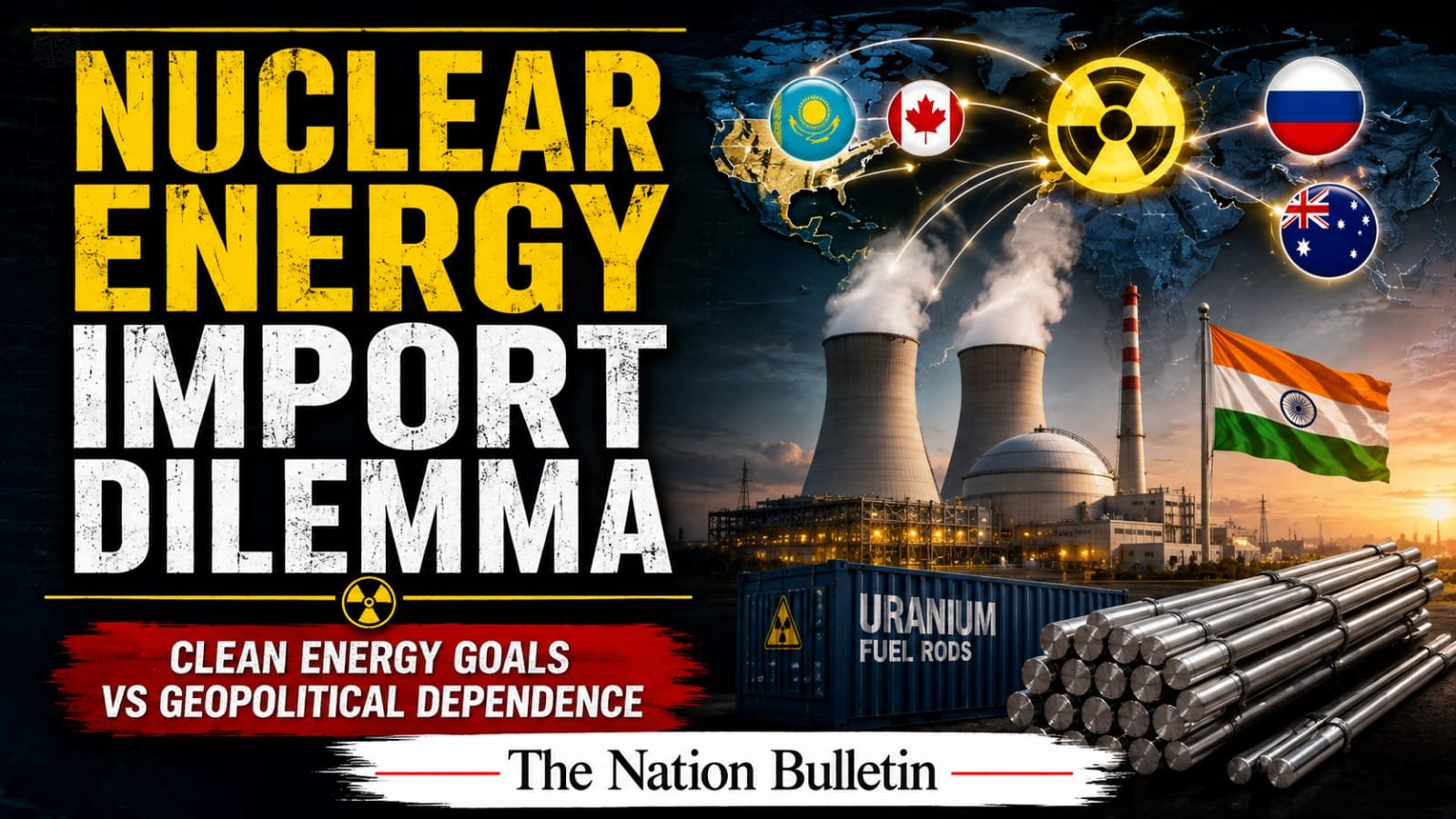
NEW DELHI, India — The global push to expand nuclear power is being driven by two powerful demands: cutting carbon emissions while maintaining a reliable supply of electricity around the clock. But behind the promise of nuclear energy as a low-carbon alternative to coal lies a less visible challenge: countries that expand nuclear generation can remain dependent on foreign uranium, enrichment services, reactor technology and specialised components.
- Uranium production is highly concentrated, with Kazakhstan alone accounting for about 39% of global mine output in 2024.
- India already imports nuclear fuel for reactors operating under International Atomic Energy Agency safeguards, while simultaneously expanding domestic fuel-cycle capabilities.
- India is pursuing an indigenous nuclear expansion based heavily on 700 MW Pressurised Heavy Water Reactors and its long-term three-stage nuclear programme.
- The country’s nuclear strategy is also shifting towards faster deployment, domestic manufacturing and newer reactor concepts, including small modular reactor designs.
The nuclear energy import dilemma
Nuclear power is often described as an energy-security asset because reactors can operate continuously and require relatively infrequent refuelling compared with fossil-fuel power stations. That gives nuclear generation an important advantage during sudden oil or gas supply disruptions.
Yet nuclear power does not eliminate international supply chains. A nuclear plant depends on a chain that can include uranium mining, conversion, enrichment, fuel fabrication, reactor technology, specialist equipment and replacement components.
That distinction is becoming increasingly important as governments plan a new wave of nuclear construction. The strategic question is no longer simply how much electricity a country can generate from nuclear plants, but how much of the underlying fuel and technology ecosystem it can control domestically.
Uranium production is concentrated in a few countries
The first vulnerability exists at the mining stage. According to the World Nuclear Association’s latest production data, Kazakhstan produced 23,270 tonnes of uranium in 2024, accounting for about 39% of global mine production. Canada supplied about 24% and Namibia about 12%. Together, the three countries represented roughly three-quarters of global uranium production.
That concentration does not mean nuclear power is immediately vulnerable to the disruption of a single supplier. Uranium can be sourced from multiple countries and utilities generally maintain inventories and long-term contracts. Nevertheless, concentration creates a strategic exposure as global reactor demand rises.
The International Energy Agency has also highlighted the importance of diversification across the nuclear fuel supply chain as governments seek to reduce geopolitical risks associated with concentrated suppliers.
Mining is only the beginning of the fuel cycle
Raw uranium cannot simply be placed inside most commercial power reactors. After mining and milling, uranium goes through several stages including conversion and, for many reactor designs, enrichment before it becomes suitable reactor fuel.
This creates another layer of geopolitical dependence. Enrichment is a highly specialised industrial capability and is concentrated among a small number of suppliers. Russia’s Rosatom has historically held a significant share of global commercial enrichment capacity, making diversification particularly important for countries seeking to reduce exposure to geopolitical disruptions.
The challenge became more visible after Russia’s invasion of Ukraine, when governments in the United States and Europe began examining ways to reduce dependence on Russian nuclear-fuel services without disrupting the operation of existing reactors.
Why reactor technology matters as much as uranium
Fuel is only one component of nuclear dependence. Large commercial reactors involve sophisticated engineering, specialised manufacturing, licensing systems and long-term technical support.
Major reactor designs have historically been associated with a relatively small group of suppliers, including Russian VVER technology, French EPR technology, US-origin designs such as the AP1000, South Korean reactor technology and Chinese designs.
For a country building a reactor supplied by an overseas company, dependence can therefore continue long after construction. Replacement parts, specialised equipment, software, maintenance expertise and technical services can remain connected to the original technology ecosystem.
India’s nuclear strategy is different
India has spent decades attempting to reduce this vulnerability by developing an indigenous nuclear programme. Its strategy is built around a three-stage programme designed to make greater use of domestic resources and eventually exploit India’s substantial thorium potential.
The first stage is based primarily on Pressurised Heavy Water Reactors, or PHWRs, using natural uranium. The second stage involves fast breeder technology, while the long-term objective is to use thorium-based fuel cycles in advanced reactors.
India’s Department of Atomic Energy says the first stage has reached a relatively mature position. Two indigenous 700 MW PHWR units at Kakrapar have entered commercial operation, while additional reactors are being constructed and more have received approval.
The 500 MW Prototype Fast Breeder Reactor at Kalpakkam is also moving through commissioning, with fuel loading underway as India attempts to advance the second stage of its programme.
India still needs imported nuclear fuel
Despite progress in domestic mining and fuel production, imports remain an important part of India’s nuclear fuel strategy. The 2008 India-US civil nuclear agreement and subsequent international arrangements opened the way for imported fuel for reactors under IAEA safeguards.
According to the Department of Atomic Energy, 16 reactors with a combined capacity of 6,380 MW, excluding RAPS-1, are currently being fuelled with imported material under safeguards. The government has also said that a total of 18,842.60 tonnes of uranium in various forms was imported between 2008-09 and 2024-25 for safeguarded reactors.
India has agreements and cooperation arrangements involving several nuclear-fuel suppliers and countries, including Russia, Kazakhstan, Canada and Uzbekistan. The diversification reduces exposure to any single supplier, but it does not eliminate dependence on international markets.
Domestic uranium resources provide only part of the answer
India is not without uranium resources. The Department of Atomic Energy has reported uranium resources in states including Andhra Pradesh, Jharkhand and Rajasthan, with exploration continuing to identify additional deposits.
However, the size of a geological resource and the amount that can be economically mined and processed are not the same thing. Ore grade, mining conditions, processing capacity, environmental approvals and infrastructure all influence how much uranium can ultimately enter the domestic fuel cycle.
India’s uranium production remains much smaller than that of the world’s leading producers. World Nuclear Association data estimates India’s 2024 uranium mine output at about 500 tonnes, compared with more than 23,000 tonnes from Kazakhstan.
Thorium is India’s long-term strategic bet
Thorium occupies a special position in India’s nuclear policy because the country has significant thorium resources but relatively limited high-grade uranium resources. The three-stage programme was designed partly around this resource imbalance.
However, thorium should not be treated as a near-term replacement for imported uranium. A commercially mature thorium fuel cycle requires advanced reactor systems, fuel fabrication and reprocessing capabilities. India’s fast breeder programme is therefore an important bridge towards the longer-term objective.
The Prototype Fast Breeder Reactor at Kalpakkam represents a major step in this direction. The Department of Atomic Energy said in 2026 that integrated commissioning was progressing and fuel loading was continuing towards first criticality.
Foreign reactor projects create another strategic calculation
India’s nuclear expansion is not limited to indigenous PHWRs. Foreign technology has also played an important role, most prominently at Kudankulam, where Russian-designed VVER reactors are operating and additional units are planned.
The experience demonstrates both the benefits and vulnerabilities of international cooperation. Foreign reactor technology can provide access to proven large-scale designs, engineering expertise and established supply chains, but projects can also be affected by international conflicts, logistics and supplier-specific disruptions.
The Indian government acknowledged in 2025 that construction of Kudankulam Units 3 and 4 had been affected by factors including the Russia-Ukraine conflict, alongside other project-specific difficulties.
Nuclear construction can take years to deliver power
Another dimension of the import dilemma is time. Nuclear plants are capital-intensive projects requiring extensive design reviews, regulatory approvals, site preparation, construction, testing and commissioning.
Delays can increase financing and construction costs while postponing the point at which a project begins generating electricity. India’s own project pipeline illustrates that even domestically backed reactor programmes can face schedule challenges.
The government has attributed delays at different projects to factors ranging from design reviews following the Fukushima accident to supply disruptions, contractor financial difficulties and the complexities of first-of-a-kind technology.
Nuclear liability rules have also shaped India’s expansion
India’s nuclear liability framework has historically been an important consideration for foreign reactor suppliers and investors. The Civil Liability for Nuclear Damage Act, 2010 created a liability structure that differed in some respects from conventional international arrangements.
India subsequently enacted the SHANTI Act in 2025, establishing a new legal framework for nuclear energy and providing for private-sector participation subject to licensing and regulatory requirements. The new framework also provides a graded liability structure for nuclear installations.
The change is significant because attracting greater domestic and foreign investment will require clarity not only on technology and fuel supply but also on legal responsibility, insurance and compensation in the event of a nuclear incident.
Could supply chains become geopolitical weapons?
The possibility of supply-chain pressure is one of the strongest arguments for diversification. Energy history has repeatedly shown that strategic commodities can become instruments of geopolitical influence when supply is concentrated.
Nuclear fuel is different from oil and gas because a reactor does not need continuous daily fuel deliveries. Utilities can plan purchases years in advance and maintain inventories, giving nuclear operators greater protection from short-term supply shocks.
But long-term dependence can still matter. If enrichment, fuel fabrication or critical reactor components are controlled by a small group of suppliers, a geopolitical dispute could affect future fuel contracts, maintenance schedules or expansion plans.
Strategic fuel stocks can reduce short-term vulnerability
One way to reduce exposure is to maintain diversified inventories. India has already recognised the strategic importance of uranium reserves. The government announced a uranium reserve programme more than a decade ago to ensure that safeguarded reactors did not face fuel shortages.
A broader strategy could combine long-term contracts with multiple suppliers, domestic mining, fuel fabrication capacity and adequate strategic inventories. Such a model would not eliminate imports but could make the system more resilient if one supplier suddenly becomes unavailable.
SMRs could change the technology equation
Small Modular Reactors, or SMRs, are increasingly being promoted as another possible route towards reducing the scale and complexity of nuclear construction. Instead of building very large reactors at individual sites, SMR concepts aim to use smaller standardised units that could potentially be manufactured more extensively in factories.
For India, the appeal is partly industrial. A standardised domestic reactor programme could create opportunities for Indian manufacturers to produce more components locally and reduce dependence on imported large-reactor systems.
India’s Department of Atomic Energy says it is pursuing designs including the 200 MW Bharat Small Modular Reactor and other advanced reactor concepts as part of its nuclear expansion strategy.
India’s nuclear expansion is moving towards 100 GW
The scale of India’s ambition has increased sharply. The government has outlined a roadmap towards 100 GW of nuclear power capacity, while earlier targets focused on a much smaller fleet.
The Department of Atomic Energy has also stated that India wants nuclear power to play a significant role in its electricity mix by 2047, when the country marks 100 years of independence.
Meeting such an ambition will require more than constructing reactors. It will require a resilient fuel cycle, domestic manufacturing, skilled manpower, regulatory capacity, financing and reliable supply chains.
The real issue is not imports, but strategic dependence
Importing uranium or nuclear technology is not inherently a weakness. Almost every major nuclear power uses international supply chains at some stage of the fuel or equipment cycle.
The vulnerability emerges when a country becomes dependent on a single supplier or a narrow group of suppliers for a critical component that cannot be quickly replaced.
For India, the most practical strategy is therefore likely to be a combination of domestic PHWR manufacturing, diversified uranium imports, stronger fuel-cycle capabilities, progress on fast breeders and thorium systems, and carefully selected international technology partnerships.
Can nuclear energy deliver both clean power and energy security?
Nuclear energy can contribute to both objectives, but the two are not automatically identical. A reactor may generate low-carbon electricity domestically while depending on foreign uranium, enrichment services or specialised technology.
India’s experience shows that energy security is better understood as control over the entire chain rather than ownership of the generating station alone.
The country’s indigenous PHWR programme, expanding uranium exploration, domestic fuel manufacturing, fast breeder programme and emerging SMR designs all represent attempts to strengthen that control. At the same time, imported fuel and international partnerships will remain important during the expansion phase.
The nuclear renaissance therefore presents India with a strategic balancing act. The objective is not to eliminate every international dependency, which would be unrealistic, but to ensure that no single geopolitical shock can undermine the country’s ability to keep its reactors fuelled, maintained and producing electricity.
Frequently Asked Questions
Does nuclear power make a country completely energy independent?
No. Nuclear power can reduce dependence on fossil-fuel imports and provide stable electricity, but uranium mining, conversion, enrichment, fuel fabrication and reactor technology can involve international suppliers. Energy security depends on how diversified and resilient those supply chains are.
Can India’s thorium reserves eliminate uranium imports?
Not in the near term. India’s three-stage programme is designed to eventually make greater use of thorium, but the required reactor and fuel-cycle technologies are still being developed and deployed. Uranium remains important for India’s current and expanding PHWR fleet.
What happens next?
India’s nuclear strategy is entering a new phase in which capacity expansion and supply-chain resilience will have to advance together. The country is simultaneously increasing domestic reactor construction, developing advanced systems, expanding fuel-cycle infrastructure and maintaining international fuel partnerships.
The strongest defence against a nuclear import crisis will not be complete isolation from global markets. It will be diversification, domestic manufacturing, strategic inventories and technological capability strong enough to prevent any single supplier or geopolitical dispute from becoming a national energy vulnerability.
Sources: Department of Atomic Energy, Government of India; Press Information Bureau, Government of India; World Nuclear Association; OECD Nuclear Energy Agency.

Praveen Yadav is the Founder and Editor at The Nation Bulletin. With over 3 years of experience in digital journalism and news reporting, he covers national affairs, governance, and breaking current events with a commitment to factual accuracy and verified reporting.