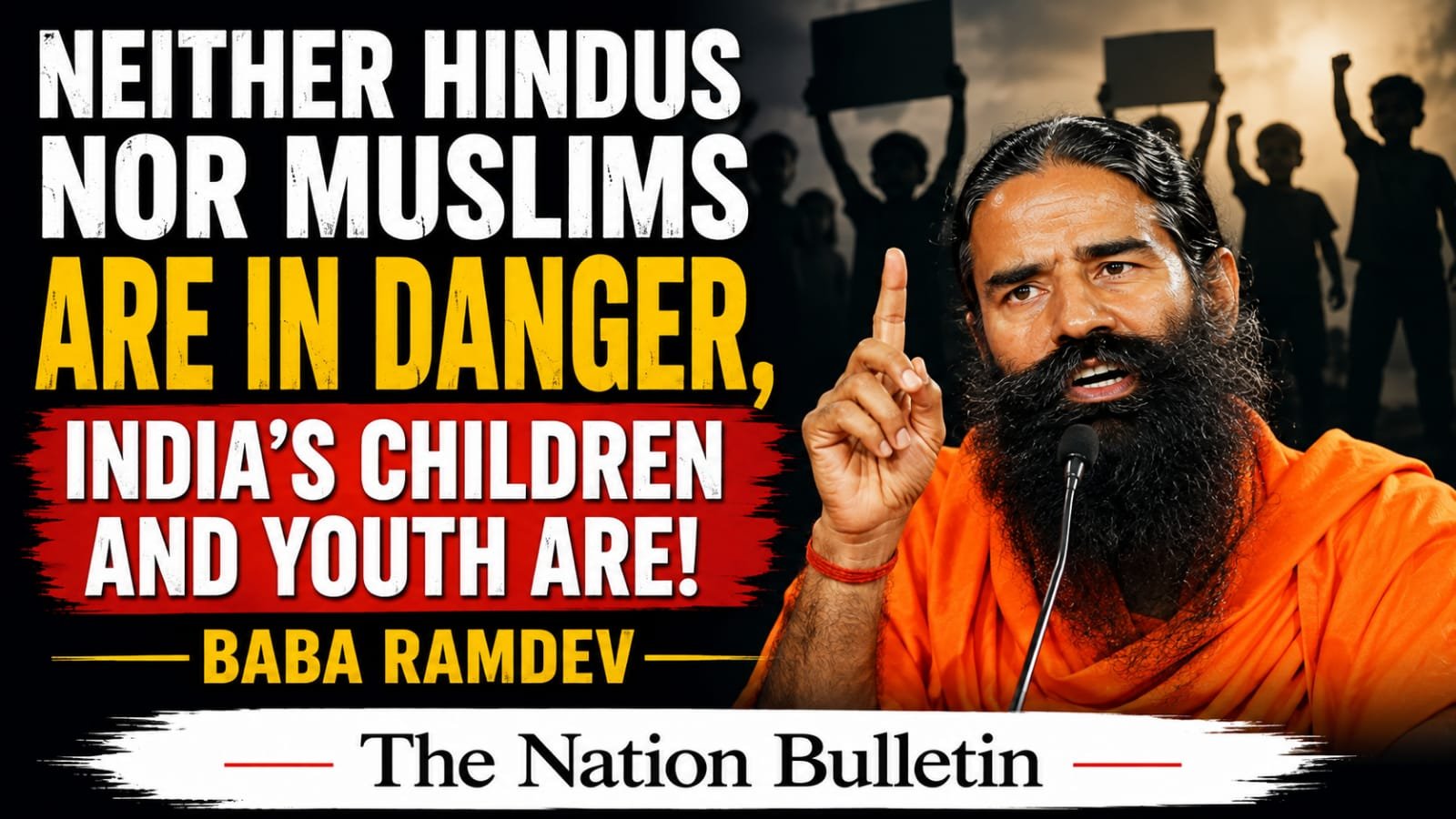
Yoga guru Baba Ramdev has expressed concern over the growing use of children in protests and public movements, arguing that India’s biggest challenge is not the safety of any particular religion or caste, but the future of its children and young people.
Speaking about the broader political and social discourse around claims that particular communities are under threat, Ramdev said the focus should instead be on protecting the country’s younger generation, its democratic institutions and its future.
‘No Religion or Caste Is in Danger’
Baba Ramdev rejected the idea that any particular religious or social community is facing an existential threat in India. He referred to Hindus, Muslims, Jains, Sikhs and Buddhists, as well as different caste and tribal communities, while stressing that the real concern should be the condition of the country’s younger generation.
According to Ramdev, the country’s childhood and youth are facing a more serious threat than the identity-based concerns that often dominate public debates.
He also linked the issue to concerns surrounding India’s future, culture, environment, sovereignty and social unity, arguing that growing disorder within the system can eventually fuel public anger.
Concern Over Children Being Brought Into Protests
One of the central points in Ramdev’s remarks was the participation of young children in protests and demonstrations.
He questioned whether children studying in primary schools should be brought onto streets for political or social movements when their primary responsibility at that age should be education.
Ramdev argued that very young children may not fully understand what a protest, demonstration or confrontation with authorities means. According to him, involving children in such activities can expose them to situations they are not mature enough to understand.
Impact on Education and Childhood
Ramdev particularly raised concerns about children who are still at the beginning of their education. He questioned how a child can concentrate on learning when they are repeatedly taken away from classrooms and brought into protests.
He appealed to social and political organisations to ensure that children are not pushed into demonstrations for purposes they cannot independently understand or evaluate.
The remarks put the focus on a broader question: where should the line be drawn between a family’s or community’s participation in a movement and the involvement of minors who may have little understanding of the issues involved?
Ramdev Supports Peaceful Democratic Protest
Ramdev also clarified that his criticism was not directed at democratic protest itself. He said peaceful movements conducted within the framework of the Constitution and the rule of law have a legitimate place in a democracy.
At the same time, he criticised protests that turn violent, involve destruction of property or attempt to disrupt public order.
His position, therefore, distinguishes between constitutional and peaceful dissent on one side and violence or disorder in the name of protest on the other.
Why the Statement Matters
The comments come amid continuing debates in India over protests, political mobilisation and the participation of young people in public movements.
The involvement of minors in demonstrations raises questions not only about their safety but also about their education, emotional well-being and ability to understand the political or social issues involved.
Ramdev’s remarks have consequently added another dimension to the discussion by shifting attention away from religious and caste identities and towards the future of India’s younger generation.
A Debate Over the Future of India’s Youth
At the heart of Ramdev’s statement is the argument that public and political movements should not come at the cost of childhood and education.
India’s democratic system provides space for disagreement, peaceful protest and public mobilisation. However, the participation of children in such activities remains a sensitive issue because minors may not have the maturity to make fully informed decisions about political or confrontational situations.
Ramdev’s appeal is therefore centred on keeping children away from situations that could interfere with their education or expose them to conflict, while preserving the constitutional space for peaceful democratic expression.
The statement has sparked renewed discussion about the responsibilities of political and social organisations, parents and community leaders when children become part of public demonstrations.
Praveen Yadav is the Founder and Editor at The Nation Bulletin. With over 3 years of experience in digital journalism and news reporting, he covers national affairs, governance, and breaking current events with a commitment to factual accuracy and verified reporting.