Deadly floods and mudslides across Nepal and Tibet have left hundreds dead, thousands missing and communities struggling to recover. In the aftermath, overflowing morgues, mass burials and destroyed homes have become a grim reality for survivors.
The Nepal floods have devastated communities along Himalayan valleys, with bodies continuing to emerge from thick mud and riverbanks after the floodwaters receded. By Sunday, the reported death toll in Nepal and Tibet had reached 804, while more than 3,000 people were still reported missing.
Key Highlights
- The reported death toll in Nepal and Tibet reached 804 by Sunday.
- More than 3,000 people remained missing, according to the supplied report.
- Morgues across Nepal were overwhelmed, prompting authorities to begin mass burials.
- More than 250 bodies had washed up along riverbanks in Chitwan, but only nine had been identified.
- DNA samples were collected from bodies before temporary burial to support future identification.
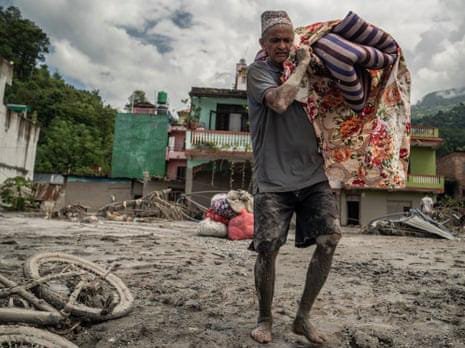
- Residents in Devighat returned to destroyed homes to recover whatever belongings remained.
Overflowing Morgues Force Temporary Mass Burials
The scale of the disaster has created a severe challenge for authorities trying to recover and identify victims. Bodies have been found hundreds of miles from where people lived, while many are too badly disfigured for relatives to identify them visually.
With morgues running out of space, authorities have started temporary mass burials in Bharatpur. Police said DNA samples were taken from each body before it was tagged, assigned a location number and placed in a shallow grave. The aim is to allow families to identify victims later and recover them for proper funeral rites.
The foreign secretary, Amrit Bahadur Rai, said on Sunday that the Nepal government had requested “more than 1,000 freezer units” to provide additional storage capacity for the dead.
Hundreds of Bodies Recovered in Chitwan
In Chitwan, around 100 miles downstream from the areas worst affected by the flash floods and mudslides, more than 250 bodies had been recovered along riverbanks. Only nine had been successfully identified because of the condition of the remains.
Authorities have also used photographs to help families search for identifying features such as jewellery, wedding rings, tattoos and scars. Images of recovered victims were displayed for relatives and uploaded to the Nepal police website, while photographs were also placed outside the morgue in Kathmandu.
Rescuers Continue Searching Through Thick Mud
Thousands remain missing, while some of the worst-hit locations are still inaccessible except by army helicopter. Entire villages were swept away by the combination of water, mud and debris, complicating the search for survivors and victims.
In accessible areas, rescue teams have continued digging through homes buried under mud. In Devighat, a sacred town on the Trishuli River, police teams were searching the remains of a house where only the feet of another victim were visible through the mud.
Police superintendent Amabadutta Bhatta said teams had already recovered 10 bodies from the location and warned that further victims could remain buried beneath the mud.
Devighat Residents Return to Destroyed Homes
Survivors in Devighat have returned to what remains of their houses, searching through mud and debris for possessions they can salvage. Many homes were destroyed, leaving behind concrete blocks, twisted metal and heavily damaged rooms.
Usha Nepali, 49, returned to the remains of the house where she had raised four children and three grandchildren. She said she had invested everything in the property and was now unsure where her family could go.
“I invested everything to build this house, so now I don’t know where to go and what to do.”
Nepali said the land no longer felt safe, but it remained the only land her family had.
Another Flood Warning Raises Fresh Fears
The danger had not disappeared even after the initial floodwaters receded. On Sunday, the Trishuli River rose rapidly again, prompting rescuers to urge people in Devighat to move to higher ground.
Residents began gathering the few belongings they could recover as they prepared to leave the area. Jamuna Magar, 36, said her husband’s family had lived in Devighat for generations, but the destruction had made returning to life there difficult to imagine.
Magar said she had managed to take her gold after receiving the flood warning but had lost almost everything else. She feared for her children and said she could no longer see Devighat as a safe place for her family.
With homes destroyed and the river posing a continuing threat, survivors face the prospect of abandoning a community that had been their home for generations. The scale of destruction has left families searching not only for missing relatives and possessions, but also for somewhere safe to rebuild their lives.

Praveen Yadav is the Founder and Editor at The Nation Bulletin. With over 3 years of experience in digital journalism and news reporting, he covers national affairs, governance, and breaking current events with a commitment to factual accuracy and verified reporting.