BOSTON, United States — President Donald Trump-backed World Liberty Financial is collaborating with Hong Kong-based AI venture WorldClaw, which provides access to artificial-intelligence models developed by several Chinese technology companies facing U.S. government national-security or intellectual-property concerns.
- 43 of 90 AI models reviewed by Reuters on WorldClaw’s website were developed by Chinese companies including Alibaba, Baidu and Z.ai.
- WorldClaw accepts World Liberty’s USD1 stablecoin as a payment option for access to AI models.
- The Trump family owns 38% of World Liberty and earns revenue linked to the use of its crypto tokens.
- A World Liberty executive has served as an external adviser to WorldClaw, while Trump’s sons have promoted the venture.
Trump-backed World Liberty works with AI platform offering Chinese models
WorldClaw was founded earlier this year and provides customers with access to a large collection of AI models from both Chinese and U.S. technology companies. Its offerings include models from OpenAI and Anthropic alongside systems developed by Chinese firms.
A Reuters review found that 43 of the 90 models listed on WorldClaw’s website came from Alibaba, Baidu, Z.ai and other Chinese technology companies. The collaboration itself is not illegal, and Chinese AI models have gained wider international use partly because they can be cheaper than competing alternatives.
However, the arrangement has drawn scrutiny because several of the Chinese companies whose models are available through the platform have faced restrictions or criticism from the U.S. government.
Why the WorldClaw partnership is attracting scrutiny
Alibaba and Baidu are among the companies whose AI models are available through WorldClaw. The U.S. Department of Defense has designated both companies as Chinese military-aligned firms, a classification that prevents the Pentagon from doing business with them.
Z.ai, formerly known as Zhipu AI, appears on the U.S. Department of Commerce’s entity list. The designation places significant restrictions on the company’s access to U.S. technology and can require export licenses for certain transactions involving U.S. companies.
WorldClaw also offers models from DeepSeek and Moonshot. U.S. administration officials have recently accused those Chinese companies of intellectual-property theft involving American AI competitors. The companies did not respond to Reuters’ requests for comment, while the Chinese government has disputed allegations of technology theft.
Alibaba, Baidu and Z.ai have also disputed U.S. government claims concerning their alleged links to China’s military. Alibaba said it was not a Chinese military company and described its inclusion on the Pentagon’s list as arbitrary, adding that it intended to seek removal from the designation.
World Liberty’s crypto connection to WorldClaw
WorldClaw describes itself as an independently owned and operated AI company and says it is not managed or controlled by World Liberty or its affiliates.
Despite that separation, the companies have a commercial relationship. WorldClaw accepts USD1, the dollar-backed stablecoin issued by World Liberty, as one of its payment methods for AI services.
The Trump family owns 38% of World Liberty. Revenue connected to World Liberty’s crypto tokens therefore creates a potential financial interest for the family when customers use those tokens through platforms such as WorldClaw.
USD1 is backed by traditional assets including U.S. Treasury securities and is designed to maintain a constant value against the U.S. dollar. The Trump family is entitled to a percentage of the interest generated by those assets.
World Liberty and White House reject conflict-of-interest concerns
White House spokesperson Anna Kelly said there were no conflicts of interest in the relationship between World Liberty and WorldClaw and said President Trump acts in the interests of the American public.
World Liberty spokesman David Wachsman described WorldClaw as an independent company. He also argued that major U.S. technology companies similarly provide access to AI models developed by both American and Chinese companies.
WorldClaw said its platform helps American AI companies reach international users and stressed that making a model available does not amount to endorsing its developer.
World Liberty executive advising WorldClaw
The relationship extends beyond the payment system. WorldClaw said Ryan Fang, World Liberty’s head of growth, has acted as an external adviser and supporter, particularly on USD1 adoption, partnerships and international expansion.
According to WorldClaw, Fang’s role is strictly advisory. The company’s website separately states that WorldClaw is not offered, managed or controlled by World Liberty.
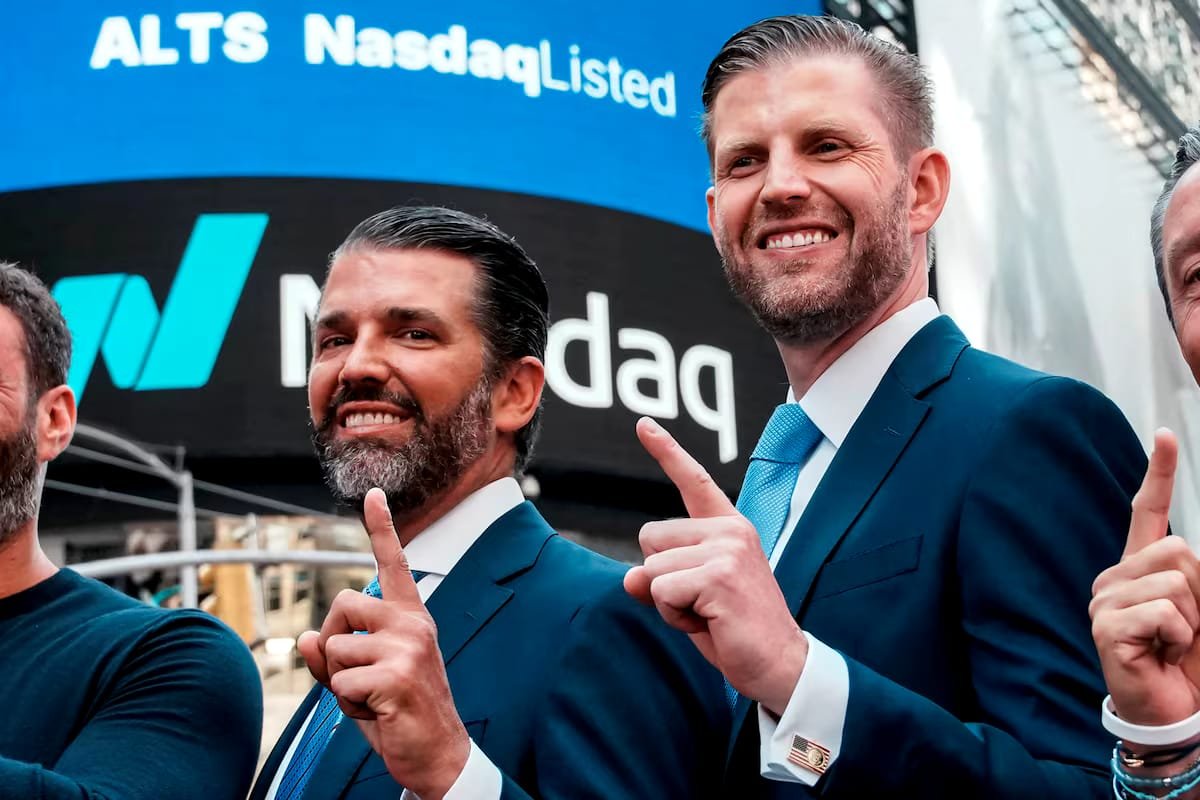
Trump’s sons have also publicly promoted WorldClaw. Donald Trump Jr. said in May that he would meet winners of a WorldClaw contest at Mar-a-Lago, while Eric Trump described the collaboration on X as the “future of finance.”
Concerns over Chinese AI security risks
The debate is not limited to the commercial relationship. Experts have also raised questions about potential security and privacy risks associated with routing users through AI models developed by Chinese companies.
WorldClaw’s WorldRouter tool aggregates access to different AI models. The company says the service has more than 10,000 users and receives more than 50 million requested tasks each day.
Daniel Remler, a senior fellow at the Center for a New American Security and a former policy adviser at the U.S. State Department, said Chinese AI models could create risks involving government monitoring, censorship of outputs and malicious code affecting AI agents.
WorldClaw’s website says the company may share user inputs with the companies that provide its AI models. The company said it takes security seriously and applies privacy and security safeguards to its platform.
Trump administration’s China AI policy remains under debate
The WorldClaw relationship comes as Washington continues to debate how aggressively the United States should respond to China’s rapid progress in artificial intelligence.
Trump has previously stressed the importance of ensuring that the United States stays ahead of China in technology and AI. At the same time, U.S.-China tensions over artificial intelligence have been accompanied by efforts to reduce friction ahead of a planned Trump-Xi Jinping summit next month.
Peter Jeydel, an attorney who leads the sanctions and trade controls team at Troutman Pepper Locke, said the arrangement could be viewed differently depending on whether the administration’s China policy is interpreted as security-focused or increasingly business-oriented.
The U.S. Departments of Commerce and Defense did not respond to Reuters’ questions about WorldClaw.
Trump family’s wider crypto earnings
Reuters reported in June that the Trump family’s earnings from World Liberty token sales had exceeded $1.4 billion. That represented the largest component of the more than $2.3 billion the family had made from cryptocurrency, according to that report.
Donald Trump Jr. and Eric Trump run the Trump Organization’s family business, while President Trump retains ownership through a trust.
Frequently Asked Questions
What is WorldClaw?
WorldClaw is a Hong Kong-based AI venture that provides users with access to a range of artificial-intelligence models from companies in the United States and China.
Why are Chinese AI models on WorldClaw controversial?
Some of the Chinese companies behind the models have been placed under U.S. government restrictions or accused by U.S. officials of posing national-security or intellectual-property risks, although the models themselves are generally legal for individuals and businesses to use in the United States.
What happens next
The WorldClaw arrangement is likely to remain under scrutiny as U.S. policymakers balance national-security concerns surrounding Chinese AI with the growing international use of Chinese-developed models.
The Reuters review found no indication that the collaboration itself violates U.S. law. The central issue raised by experts is whether the commercial relationship creates a tension between the Trump administration’s approach to Chinese technology and the financial interests associated with World Liberty.

Praveen Yadav is the Founder and Editor at The Nation Bulletin. With over 3 years of experience in digital journalism and news reporting, he covers national affairs, governance, and breaking current events with a commitment to factual accuracy and verified reporting.