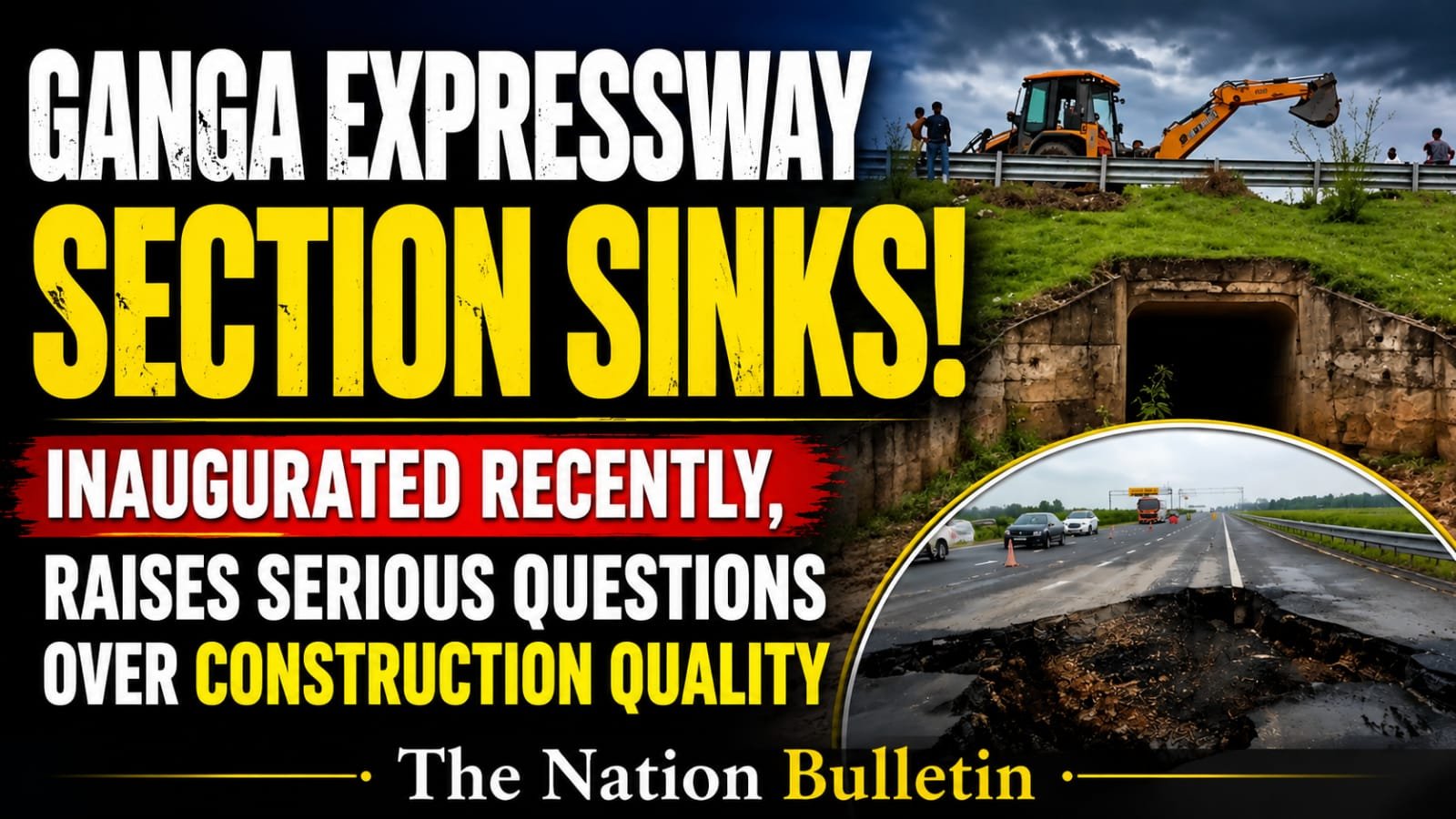
AMROHA, India — A portion of the newly inaugurated Meerut-Prayagraj Ganga Expressway reportedly sank after heavy rain in the Hasanpur tehsil area of Uttar Pradesh, raising questions over construction quality, drainage arrangements, embankment stability and maintenance protocols on the 594-km expressway.
The affected stretch lies between Faiyaznagar and Sahadra Milak villages, where a section of the main carriageway reportedly developed a depression on Friday afternoon following heavy rainfall. The sudden damage created a potential risk for high-speed traffic, prompting expressway personnel to immediately restrict movement and begin repair work.
- A section of the Ganga Expressway reportedly sank between Faiyaznagar and Sahadra Milak after heavy rain.
- Workers used barricades, loudspeakers, a JCB and technical teams to secure and repair the affected stretch.
- The damaged portion was reportedly repaired in an operation lasting around three hours, while a 100-200 metre area was placed under controlled traffic conditions.
- The incident has raised questions about earthwork compaction, drainage, slope protection, independent quality checks and the project’s defect liability obligations.
Ganga Expressway Road Subsidence Reported After Heavy Rain
According to the information provided, the road surface suddenly sank during heavy rainfall in the Hasanpur area. A hole developed on the carriageway, creating a danger that vehicles could lose control or overturn if they entered the affected section at speed.
Expressway personnel reached the location after the problem was detected. Loudspeakers were reportedly used to warn motorists to slow down, while barricading was installed around the damaged area to prevent vehicles from directly entering the affected portion.
A JCB and technical teams were deployed for repair work. The initial operation reportedly continued for about three hours, after which the depression was filled and the immediate situation was brought under control.
No speeding vehicle was reportedly caught directly in the affected section when the road gave way, helping avert what could have developed into a major accident.
Traffic Safety Measures Introduced After the Damage
The incident has particular significance because the expressway is designed for high-speed travel, with a design speed of up to 120 kmph. A sudden depression on such a corridor can create a serious hazard, particularly at night when visibility is reduced and drivers have less time to react.
Following the incident, the affected 100-200 metre stretch was reportedly converted into a controlled cone zone. The speed limit was reduced to 40 kmph around the repair area to reduce loading and improve safety while restoration work was underway.
The timing of the incident has also prompted concerns about whether a similar failure during peak traffic or at night could result in multiple vehicles becoming involved in a collision.
₹36,230-Crore Project Under Scrutiny
The Ganga Expressway is described as an approximately 594-km corridor connecting Meerut with Prayagraj. The project has an estimated construction cost of around ₹36,230 crore and is divided into 12 packages.
According to the supplied information, around 80% of the project’s packages are being executed by the Adani Group. The western Uttar Pradesh section includes packages covering areas around Meerut, Hapur, Amroha and Hasanpur and the Sambhal region.
The reported subsidence has therefore triggered wider questions about whether construction speed, earthwork quality and site-specific drainage requirements were adequately addressed before the corridor was opened for traffic.
Why Did the Expressway Section Sink?
The exact technical cause of the subsidence has not been established in the material supplied. However, several possible engineering factors have been raised in connection with the incident.
One possibility concerns soil erosion. If rainwater flows along the edges of the carriageway instead of being safely diverted away, it can erode the material beneath the road structure. Such erosion could create a void below the bituminous surface and eventually cause the pavement to collapse or settle.
Another possibility is embankment settlement. Areas constructed with high embankments require proper layering and compaction of soil. If material is compacted inadequately or the filling process is accelerated, the underlying layers may settle when exposed to significant rainfall and traffic loads.
Questions Over Drainage and Slope Protection
Drainage is another major issue raised after the incident. The question is whether the rainwater drainage system at the affected location was designed and executed to handle intense rainfall without allowing water to penetrate the embankment.
The supplied technical assessment also raises the possibility that slope protection may have been incomplete or inadequate. Geogrid and geotextile mats are commonly used in highway engineering to improve slope stability and reduce erosion, while turfing and pitching can help protect exposed surfaces.
The pattern of the reported subsidence has prompted questions over whether edge protection, turfing, pitching or a water-seepage barrier failed to perform as intended. These possibilities would need to be confirmed through technical testing rather than assumed from the visible damage.
Natural Water Flow Could Be Another Factor
The Hasanpur and surrounding plains reportedly contain natural seasonal drainage channels and established catchment-flow routes. Large embankments can alter the movement of surface water if adequate balancing or cross-drainage structures are not incorporated.
If natural water pathways are blocked or insufficiently accommodated, water can accumulate on one side of an embankment and exert pressure on the surrounding soil. The supplied technical assessment raises the possibility of piping action or internal erosion, which can gradually hollow out soil beneath a road structure and cause settlement.
Whether such a mechanism played any role in this incident would require a site-specific hydrological and geotechnical investigation.
Fast-Track Earthwork and Settlement Concerns
The project has been divided into 12 construction packages, and the western Uttar Pradesh packages form part of its early corridor. The supplied information raises concerns that fast-track filling was undertaken at some locations to maintain construction schedules.
Where large quantities of soil are placed rapidly, the material may not receive sufficient time for natural settlement before the road structure is completed and opened to traffic. Proper compaction and testing are therefore important for ensuring the stability of high embankments.
The incident has raised questions about whether the affected location received adequate compaction, settlement monitoring and moisture control before the pavement layers were constructed.
Possible Material and Quality-Control Issues
Another area requiring examination is the composition and performance of the materials used in the embankment and pavement structure. High embankments can involve soil and, where specified, fly ash-based fill systems. The supplied technical assessment points to the importance of maintaining the optimum moisture content during compaction.
If moisture conditions are not properly controlled, the performance of fill material can deteriorate when exposed to heavy rainfall. Similarly, weak interlocking between aggregate and fine particles in the Wet Mix Macadam layer could make the pavement structure more vulnerable to water infiltration.
Testing of the road layers would be required to determine whether material specifications and density requirements were actually achieved at the damaged location.
Compaction and CBR Tests Under Focus
Road construction quality depends on testing at multiple stages. The supplied technical details specifically raise questions about Proctor Density testing, which is used to assess soil compaction, and the California Bearing Ratio test, which helps evaluate the strength of subgrade material.
There are also questions over whether construction schedules created pressure to complete work before sufficient curing or waiting periods had elapsed. Any such conclusion, however, would need documentary evidence from construction records and laboratory reports.
Independent Engineer and Quality Certification Under Question
The role of third-party quality supervision has also come under scrutiny following the reported subsidence. Independent consultants, including AE or IE arrangements, are expected to monitor and certify construction quality within their contractual responsibilities.
The supplied information raises questions about whether load-bearing tests, water-seepage tests and other required quality-control procedures were conducted at the affected location in accordance with applicable specifications.
If an investigation finds that design, supervision or certification procedures were deficient, the accountability of the concerned consultants and construction agencies could also become an issue.
Defect Liability Period Could Become Important
The expressway was inaugurated recently and, according to the supplied information, remains within the applicable Defect Liability Period (DLP). Under the contractual framework described in the material, defects arising during this period can place repair obligations on the concerned construction agency.
The material further states that eligible repair costs should be borne by the responsible construction agency under the relevant contractual provisions rather than automatically being charged to the government or UPEIDA.
The exact contractual responsibility, however, would depend on the individual package agreement, defect-liability provisions and findings of the competent authority.
Pre-Monsoon Inspection and Safety Protocols Questioned
The incident has also prompted questions over pre-monsoon inspections. Such inspections can include checks of drainage channels, culverts, slopes and embankment stability before periods of heavy rainfall.
The supplied information raises the question of whether all such inspections were completed at the affected location before the monsoon and whether any warning signs were identified in advance.
A detailed inspection of the drainage network could establish whether water was being safely carried away from the embankment or whether a local blockage or insufficient cross-drainage contributed to the problem.
What Tests Could Follow the Road Failure?
One proposed corrective measure is core cutting around the damaged location. Such testing can help assess the thickness and density of pavement layers, including DBM and BC layers, and provide physical evidence about the condition of the road structure.
Another potential corrective measure mentioned in the supplied material is redesigning or strengthening cross-drainage culverts at locations where water flow may be restricted. Additional pipes or culverts could be considered where technical studies establish that existing drainage capacity is inadequate.
A complete structural safety assessment of the corridor has also been suggested, particularly because the reported failure occurred soon after the expressway’s inauguration and during the early phase of heavy rainfall.
Questions Over Toll Collection and Legal Responsibility
The incident has also brought attention to the obligations associated with operating a tolled high-speed expressway. The supplied material states that local organisations and opposition groups have called for a review of toll operations on affected stretches until structural safety certification is established.
There are also questions about legal responsibility if a road defect results in an accident. The supplied material refers to potential civil and criminal liability under applicable provisions of the Motor Vehicles Act and contractual arrangements.
Any such liability would depend on the specific circumstances of an accident, applicable law, contractual obligations and findings by the competent authorities. The reported subsidence itself does not establish legal liability.
UPEIDA’s Response and Official Accountability
The reported incident has circulated widely on social media through videos showing repair activity at the affected location. The incident has generated local concern over construction quality and maintenance of the new corridor.
According to the supplied information, an attempt was made to contact UPEIDA executive engineer Rakesh Kumar Moga regarding the matter, but no response was received.
The absence of a response in the supplied material means that the technical cause of the failure and the administration’s detailed position remain unresolved in this report.
Possible Penalties if Investigation Finds Lapses
The supplied information also raises the possibility of action against independent consultants if an investigation establishes deficiencies in design review, supervision or quality certification. Such action could potentially include penalties, blacklisting or action concerning bank guarantees under applicable UPEIDA rules and contracts.
The material further refers to an Incident Inquiry or Failure Analysis Report, along with remedial engineering measures, as potential next steps following such an infrastructure failure.
It states that a failure analysis report could be required within 15 days under standards attributed to the Ministry of Road Transport and Highways, along with a corrective engineering design. This specific procedural requirement should be verified against the applicable contract and current technical guidelines before being treated as a confirmed mandatory deadline.
Why a Full Structural Audit Could Matter
The reported failure has renewed calls for scrutiny beyond the damaged patch. A third-party structural and safety audit of the wider 594-km corridor could help identify drainage weaknesses, embankment settlement, slope instability or pavement defects before they develop into more serious hazards.
Such an assessment would be particularly relevant during the monsoon because water infiltration and erosion can expose weaknesses that may not be visible during dry conditions.
Frequently Asked Questions
Where did the Ganga Expressway road subsidence occur?
The reported subsidence occurred in the Hasanpur tehsil area, between Faiyaznagar and Sahadra Milak villages, after heavy rainfall.
What technical issues are being questioned after the road sank?
The issues raised include soil compaction, embankment settlement, drainage capacity, slope protection, water seepage, material quality, pavement-layer density, cross-drainage arrangements and the effectiveness of independent quality-control inspections.
What Happens Next?
The immediate repair has addressed the visible damage, but determining why the road sank will require more than filling the depression. Technical testing of the pavement and embankment, drainage inspection, review of construction records and examination of quality-control reports could help establish the underlying cause.
The incident has also placed attention on the responsibilities of construction agencies, independent engineers and the project authority. If technical investigations establish shortcomings, the relevant contractual and administrative provisions could determine who is responsible for corrective action and associated costs.
For motorists, the immediate concern is safety. For the authorities, the larger challenge is establishing whether the incident was an isolated local failure caused by unusual site conditions or an indication of weaknesses that could exist elsewhere along the corridor.
Source Attribution: This report is based solely on the information supplied for publication. Technical explanations, contractual provisions, possible penalties and legal implications described above are presented as issues or possibilities raised in the supplied material unless specifically identified as reported facts.

Praveen Yadav is the Founder and Editor at The Nation Bulletin. With over 3 years of experience in digital journalism and news reporting, he covers national affairs, governance, and breaking current events with a commitment to factual accuracy and verified reporting.