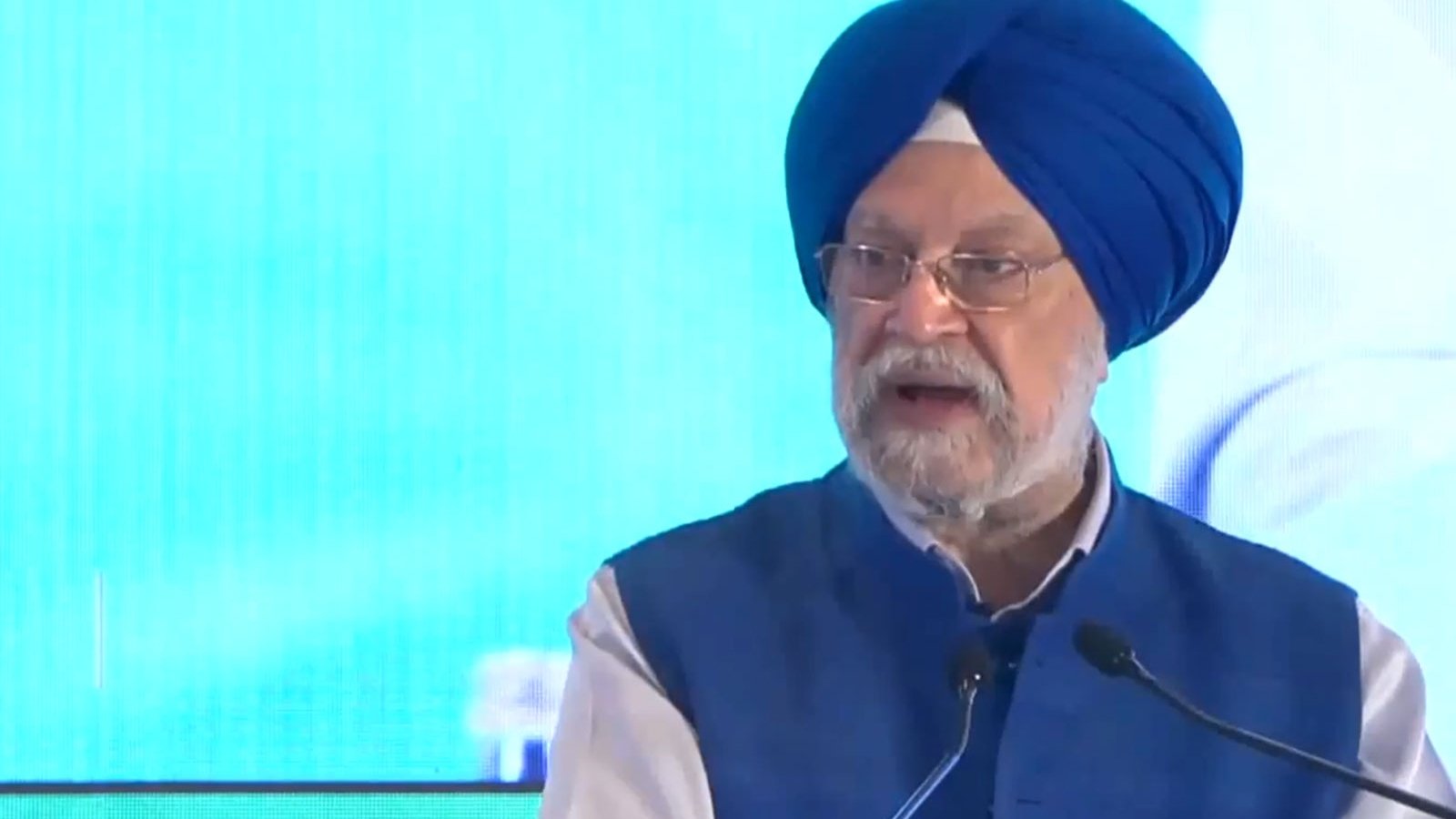
E20 Fuel Controversy: Union Minister for Petroleum and Natural Gas Hardeep Singh Puri on Friday defended India’s E20 ethanol-blended petrol programme, stating that extensive nationwide testing found only four contamination cases across nearly 1.07 lakh fuel retail outlets. Addressing the CII International Energy Conference & Exhibition in New Delhi, the minister said the findings demonstrated the strength of India’s fuel distribution network despite recent concerns surrounding E20 fuel.
The minister’s remarks came amid public discussion over ethanol-blended petrol after an industry body raised concerns in a communication dated July 28. According to Puri, oil marketing companies had already begun intensive fuel quality testing nearly two weeks before those concerns were highlighted.
He said dedicated testing teams collected around 2,000 fuel samples every day from petrol stations across the country to monitor fuel quality and identify any contamination issues. The nationwide exercise covered India’s vast retail fuel network serving millions of consumers daily.
Only Four Contamination Cases Detected During Nationwide Testing
Sharing the outcome of the testing exercise, Puri said only four contamination cases were detected among approximately 1.07 lakh retail fuel outlets. He added that these outlets collectively cater to nearly six to seven crore customers every day, indicating that contamination incidents represented an extremely small proportion of the country’s fuel distribution system.
The minister suggested that some parties had presented the testing results without proper context, creating unnecessary concerns over the E20 rollout. According to him, the large-scale testing exercise reflected the government’s proactive approach to monitoring fuel quality rather than evidence of widespread problems.
Fuel Quality Testing at a Glance
| Parameter | Details |
|---|---|
| Daily fuel samples collected | Around 2,000 |
| Total retail fuel outlets | Approximately 1.07 lakh |
| Daily customers served | About 6–7 crore |
| Contamination cases detected | 4 |
Puri Highlights Strength of India’s Fuel Retail Network
During his address, the petroleum minister said India’s fuel retail network has expanded significantly over the past decade. According to him, the number of fuel stations has increased from about 52,000 outlets in 2014 to nearly 1.07 lakh outlets at present.
Puri said the country’s expanding fuel infrastructure has continued to operate without disruption even during periods of global supply uncertainty. He noted that despite recent international challenges affecting energy markets, no fuel retail outlet in India ran out of stock, underscoring the resilience of the country’s fuel supply chain.
He attributed this performance to diversified crude oil sourcing, strong logistics infrastructure, trusted international partnerships, technological improvements and the country’s strategic petroleum reserves.
India’s Expanding Energy Network Helped Maintain Fuel Supplies
Highlighting the country’s preparedness in managing energy security, Hardeep Singh Puri said India’s fuel retail network has become significantly stronger over the years, enabling uninterrupted fuel availability even during periods of global uncertainty.
According to the minister, India’s network of petrol pumps has expanded from around 52,000 retail outlets in 2014 to nearly 1.07 lakh outlets today. Despite volatility in international energy markets and supply chain disruptions, he said every fuel station across the country continued to receive supplies without running out of stock.
Puri attributed this resilience to multiple factors, including diversified crude oil procurement, robust infrastructure, trusted partnerships with international suppliers, technological improvements across the fuel distribution system and the country’s strategic petroleum reserves.
India Holds Around 74 Days of Strategic Reserve Capacity
The minister said India currently has approximately 74 days of reserve capacity, providing an additional buffer against potential global supply disruptions. He noted that maintaining adequate reserves has become increasingly important as geopolitical developments continue to influence international energy markets.
According to Puri, this combination of strategic reserves and diversified sourcing has strengthened India’s ability to manage fluctuations in global crude supplies while ensuring uninterrupted availability of petrol and diesel across the country.
India’s Energy Demand Growing Faster Than the Global Average
Speaking about the country’s long-term energy outlook, Puri said India has emerged as the world’s third-largest energy consumer and importer while also becoming the fourth-largest oil refiner.
He stated that India’s energy demand is currently growing at roughly three times the global average, reflecting the country’s expanding economy and rising consumption.
Citing estimates from the International Energy Agency (IEA), the minister said India could account for nearly 30% of the increase in global oil demand between now and 2050.
| India’s Energy Snapshot | Details |
|---|---|
| Global Energy Consumer Ranking | 3rd largest |
| Global Energy Importer Ranking | 3rd largest |
| Global Refining Ranking | 4th largest |
| Energy Demand Growth | About three times the global average |
| Share in Global Oil Demand Growth by 2050 | Nearly 30% (IEA projection) |
| Strategic Reserve Capacity | Around 74 days |
Puri Compares India’s Growth With Global Refining Trends
The minister contrasted India’s expanding refining sector with developments in several advanced economies. He said Europe is witnessing a reduction of around 200,000 barrels per day in refining capacity, while the United States has not commissioned a new refinery in the last 50 years.
Against this backdrop, Puri said India’s continued investment in refining capacity and fuel infrastructure has positioned the country to meet rising domestic energy demand while strengthening long-term energy security.
India Increased Domestic LPG Production During Supply Concerns
Hardeep Singh Puri also highlighted the government’s efforts to strengthen domestic LPG availability during a brief period of concern over supplies from Gulf countries near the Strait of Hormuz.
According to the minister, India increased its domestic LPG production from around 34,000 metric tonnes per day to approximately 55,000 metric tonnes per day. He said the increase was achieved partly by reconfiguring refinery output, helping the country manage potential supply disruptions.
Puri added that India’s LPG import profile has also become more diversified. He said the United States now accounts for nearly 67% of India’s LPG imports, reducing dependence on suppliers from the Gulf region.
Government Announces Support for Mumbai High Production Revival
Speaking on domestic energy production, the minister said ONGC, Brazil’s Petrobras and BP are collaborating to revive production at the Mumbai High offshore fields, which were discovered in 1974.
He said the government will support drilling costs by up to 50%, with assistance capped at around ₹650 crore per well. The initiative is aimed at strengthening domestic oil production and supporting India’s long-term energy security.
| Key Energy Announcements | Details |
|---|---|
| Domestic LPG Production | Increased from 34,000 MT/day to 55,000 MT/day |
| US Share in India’s LPG Imports | About 67% |
| Mumbai High Partners | ONGC, Petrobras and BP |
| Government Drilling Support | Up to 50%, capped at around ₹650 crore per well |
Puri Says Excise Duty Cuts Helped Keep Fuel Prices Competitive
Addressing fuel prices, the petroleum minister said global crude oil volatility has led to a marginal increase in petrol and diesel prices over recent years. However, he noted that the central government’s excise duty reductions announced in November 2021, May 2022 and March 2026, amounting to nearly ₹10 per litre cumulatively, have helped cushion the impact on consumers.
According to Puri, these measures have enabled India to maintain petrol and diesel prices among the most affordable globally, including compared with neighbouring countries and several European nations.
Minister Expresses Confidence Over India’s Energy Preparedness
Concluding his address, Puri acknowledged that uncertainty continues to persist in global energy markets but said India remains well positioned to deal with future challenges. He credited the country’s diversified energy sourcing strategy, expanding infrastructure, strategic reserves and policy initiatives for strengthening energy security and ensuring uninterrupted fuel supplies.
The minister’s remarks came as discussions around the rollout of E20 petrol continue, with the government maintaining that extensive nationwide testing has found only a handful of contamination cases despite millions of consumers using the country’s expanding fuel retail network every day.

Praveen Yadav is the Founder and Editor at The Nation Bulletin. With over 3 years of experience in digital journalism and news reporting, he covers national affairs, governance, and breaking current events with a commitment to factual accuracy and verified reporting.