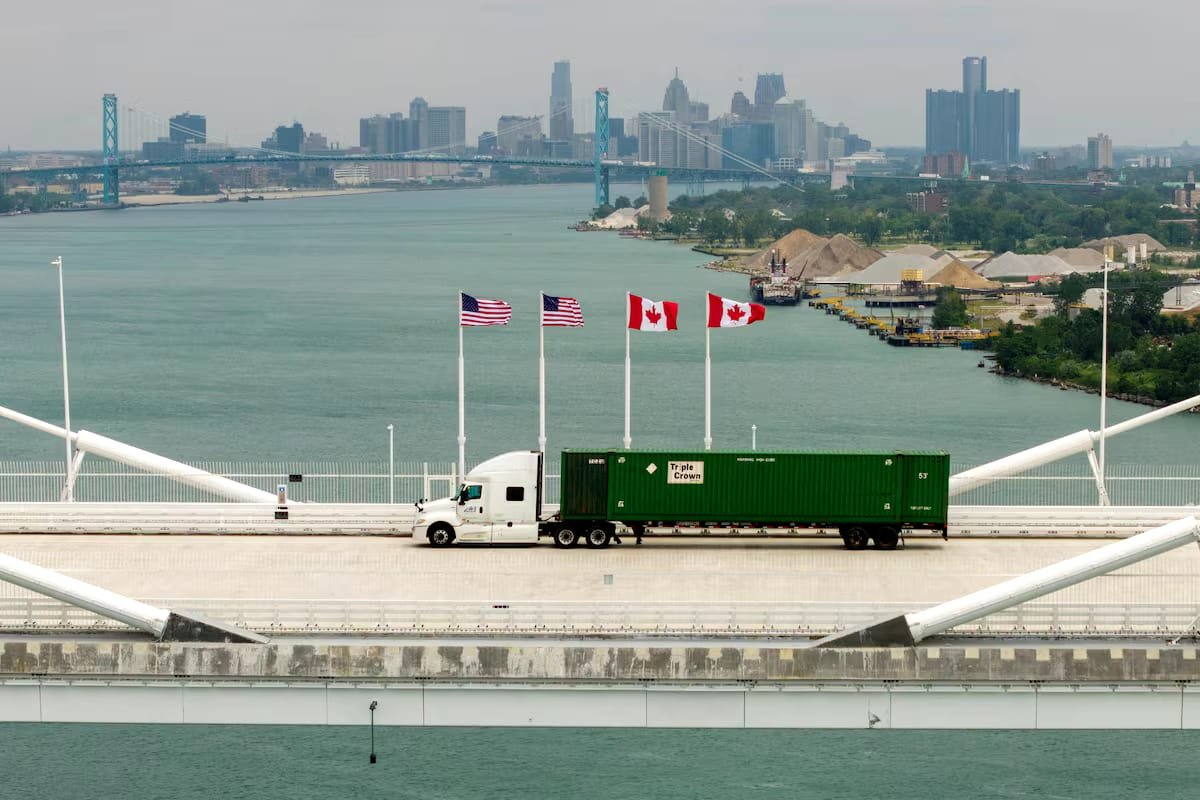
Washington/Ottawa — The United States has imposed new 50% tariffs on some Canadian goods after Washington and Ottawa failed to finalize a trade agreement, escalating tensions between the two longstanding allies. The duties took effect shortly after midnight on Saturday and cover about $20 billion worth of Canadian goods.
- Key Highlights:
- The new U.S. tariffs affect about $20 billion of Canadian goods.
- The affected products represent just over 5% of Canada’s exports to the United States.
- Canadian Prime Minister Mark Carney suspended trade negotiations and ordered dollar-for-dollar retaliation.
- Washington and Ottawa had appeared close to an agreement before last-minute differences halted the deal.
- No additional trade talks are currently scheduled, according to a senior Trump administration official.
US Imposes New 50% Tariffs on Canadian Goods
The new duties target Canadian products that do not qualify for preferential treatment under the U.S.-Mexico-Canada free-trade agreement. The affected goods include products such as wine, furniture, dairy products, cement, clothing, fishing rods and hockey equipment.
The value of the newly targeted goods is relatively small compared with Canada’s overall exports to the United States. About $20 billion of Canadian goods are covered, representing slightly more than 5% of Canada’s exports to its largest trading partner.
However, the move has significant political importance because it follows several days of negotiations aimed at easing broader trade tensions between Washington and Ottawa.
Canada Suspends Trade Negotiations
Canadian Prime Minister Mark Carney responded by suspending trade negotiations with Washington. He also said Canada would respond to the new U.S. duties on a dollar-for-dollar basis.
Carney said Canada’s negotiating team had worked to defend Canadian interests throughout the discussions but argued that changes made by the United States at the last minute undermined the possibility of reaching an agreement.
According to Carney, the changes proposed by Washington were unfair and uneconomic and raised questions about the reliability of any potential deal.
The Canadian prime minister had entered office promising to take a firm position toward President Donald Trump’s trade policies. Polling cited in the supplied material shows that most Canadians oppose making concessions to Trump.
Talks Appeared Close to Agreement Before Breakdown
The latest escalation came after three days of negotiations in Washington between Canada’s minister for trade with the United States, Dominic LeBlanc, and U.S. Trade Representative Jamieson Greer.
Hours before the tariffs were announced, the two sides appeared to be close to an agreement. Sources indicated that a possible deal could have reduced tariffs affecting steel, aluminum and automobiles. It could also have potentially allowed American alcohol products to return to Canadian liquor stores.
The agreement ultimately failed to materialize. Greer said Canada had declined to finalize the deal under terms that Washington believed had been agreed earlier in the week.
Greer described the collapse as a missed opportunity for Canada to strengthen its economic relationship with the United States. A senior Trump administration official similarly said the U.S. offer would have given Canada the strongest tariff position among major exporters to the American market.
Disagreements Over Steel, Autos and Lumber
According to the senior administration official, Canada sought further concessions in several important sectors, particularly steel, aluminum, automobiles and softwood lumber.
Those industries have already faced significant pressure from existing U.S. tariffs. The new duties therefore add another layer of uncertainty for Canadian businesses whose products do not receive preferential treatment under the North American trade agreement.
Trade experts have warned that some of the affected sectors are vulnerable to serious economic damage. Potential consequences include job losses and business closures, particularly if companies struggle to absorb the additional tariff costs or maintain access to the U.S. market.
Broader US-Canada Trade Relationship Under Pressure
The latest tariffs are unlikely by themselves to transform the overall U.S.-Canadian trade relationship because the affected goods represent only a small share of Canada’s exports to the United States.
However, the political fallout could be considerably wider. The escalation is expected to make negotiations surrounding the renewal of the U.S.-Mexico-Canada free-trade agreement more difficult.
The United States has already imposed tariffs on Canadian steel, lumber and automobiles. Those sectors have taken major hits over the past 18 months, although the economic weakness has largely remained concentrated within those industries.
No Further Talks Scheduled
A senior Trump administration official said there were no additional negotiations scheduled as the new tariffs came into effect. That leaves the immediate future of the broader trade discussions uncertain.
Trump had previously threatened additional duties on a wider range of Canadian imports, including wine, furniture, dairy products, cement, clothing, fishing rods and hockey equipment.
The latest breakdown therefore represents a significant setback after both sides appeared to be moving toward an agreement only hours earlier. For Canada, Carney’s decision to suspend negotiations and promise dollar-for-dollar retaliation marks a direct response to Washington’s latest tariff escalation.

Praveen Yadav is the Founder and Editor at The Nation Bulletin. With over 3 years of experience in digital journalism and news reporting, he covers national affairs, governance, and breaking current events with a commitment to factual accuracy and verified reporting.